


Large-scale white-collar displacement at middle and senior levels is a relatively new phenomenon in the Indian business environment, which both employees and employers are ill equipped to handle. This will certainly increase the chances of unions playing a more dominant role.
A senior HR head of a large global technology and e-commerce company once told HRKatha that unions can start playing an active role even in white-collar jobs, if organisations are unfair to employees.
In fact, a few years back, a UK-based trade union for white-collar employees had tried to make an entry into India, but had failed, as the response from employees wasn’t even lukewarm. Probably, it was little ahead of its time then.

However, now, with layoffs rampant in Indian IT companies, the voice of unions seems quite inevitable. Frankly, large-scale white-collar displacement at middle and senior levels is a relatively new phenomenon in the Indian business environment, which both employees and employers are ill equipped to handle. This will certainly increase the chances of unions playing a more dominant role.
“IT company employees also are free to form trade unions and redress their grievances by evoking the provisions of the Industrial Disputes Act, 1947. Any trade union with IT employees as its members can raise industrial disputes under Section 2 (k) of the Act and seek remedy.”
It’s true that there was a time when unions and strikes were known only to blue-collar workers in factories, mines and railway docks. White-collar employees and professionals, especially in corporate India, thought it below their dignity to band together under unions, march the streets, or yell slogans.
Having said that it is also a fact that airline pilots and bank officers do have their own guilds or unions. To that extent’, their right to form an association under the Constitution of India is a Fundamental Right and that they can also be registered as a trade union under the Trade Unions’ Act (TU Act),1926.
Provisions of Sections 2(g) and 2 (h) of The TU Act, 1926, define ‘trade dispute’ and ‘trade union’ respectively. Therefore, when interpreted in the light of ratios of cases, there is no doubt that such an association/union of white-collared professional job holders would find suitable protection under the provisions of The Trade Unions’ Act, 1926. The definition of ‘workmen’ under the Act is much broader and wider than under Sec. 2(s) of the Industrial Disputes Act, 1948. Such an association of white-collared professional workmen, would therefore, get necessary protection under The TU Act.
In fact, in June 2016, in reply to a petition by a labour union, the Tamil Nadu government had said software company employees too have the right to form unions.
For Unites Professionals, the membership numbers have grown from 4,000 to 14,000 in six months.
The then state labour secretary had said, “IT company employees also are free to form trade unions and redress their grievances by evoking the provisions of the Industrial Disputes Act, 1947. Any trade union with IT employees as its members can raise industrial disputes under Section 2 (k) of the Act and seek remedy.”
In May 2016, the Labour Court in Chennai had passed a judgment, which set a precedent for many such cases in future. It had termed a ‘techie’ working with the software company, HCL, as a ‘workman’. This brought the employees of software companies under the Industrial Disputes (ID) Act.
The Court said that as per the ID Act, any person employed in any industry, doing any kind of manual, skilled, unskilled, technical, operational, clerical or supervisory work, for hire or reward, is a ‘workman’.
The employee, K Ramesha, had joined HCL Technologies as senior service programmer on August 20, 2009. He also got an appraisal a year later, based on his good performance.
Surprisingly, in 2013, he was asked to leave merely because he had failed to improve his performance, despite counselling. However, the company did not provide any memo or document(s) nor did it pursue any further investigation. In the absence of an unsatisfactory answer from his employer, Ramesha had approached the Labour Court in Chennai.
NASSCOM is struggling to convince members of Unites Professionals India, a fast-growing information technology labour union, that the IT industry is not resorting to large-scale job cuts, nor is it facing an unstable future. However, the labour union claims that IT companies in the country are adopting a number of unfair means to cope with the economic downturn.
Ramesha’s case is no longer a unique one. Thousands of employees across IT companies are being asked to leave and the role of unions is increasing.
It is learnt that a section of Cognizant employees from Chennai, who are victims of voluntary or involuntary termination or retrenchment, have decided to revolt against the company, and seek the legal route to solve their issues. These employees have approached the Tamil Nadu State Labour Department to lodge protests and complaints.
Though the company calls it an act of weeding out the unfit, the employees concerned are blaming the company for cost-cutting measures, unfair treatment and forced resignations.
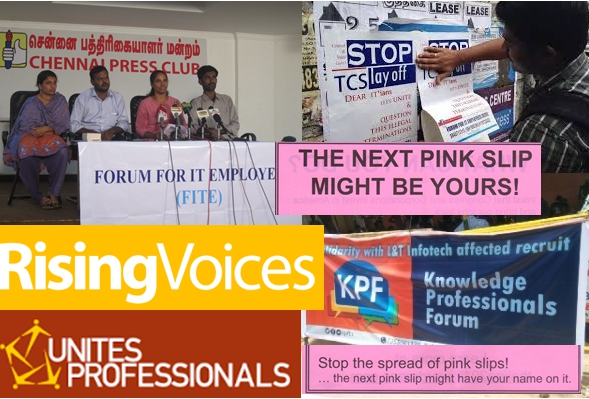
These employees have roped in ‘The Forum for IT Employees’ (FITE) into this issue to mediate, and compel Cognizant to reverse their decision.
In a similar kind of situation, the Knowledge Professionals Forum (KPF) — a welfare and support organisation for IT and ITeS employees—had protested when L&T Infotech had cancelled the offer letters of around 1,500 students in June, 2016.
On the other hand, NASSCOM is struggling to convince members of Unites Professionals India, a fast-growing information technology labour union, that the IT industry is not resorting to large-scale job cuts, nor is it facing an unstable future. However, the labour union claims that IT companies in the country are adopting a number of unfair means to cope with the economic downturn.
On May 1, Labour Day, Unites Professionals launched a month-long ‘Stop the Pink Slip’ campaign, aiming to collect 100,000 petitions from disgruntled IT workers to force the NASSCOM chairman to pressure the Indian IT industry to stop cutting jobs.
Their numbers are certainly increasing. In September, 2016, the union had only 4,000 members. Before the start of the campaign, the number increased three fold, to 14,000!
When the masses get affected, combined voices are bound to rise and collective bargaining will be resorted to.
1 Comment
For all that is bragged about the IQ of IT industry workers – I have to call them stupid to still clamour for a jobs in this industry. Reports and articles, since 2012-13, have been predicting a slowdown/downturn. If these employees were as smart as they claim, they would have prepared to move.
They aren’t really as smart with their lives. Are they?