



The résumé was impressive: 18 years in operations management, an MBA from a top-tier institution, a record of successful deliveries across complex mandates. Yet the 43-year-old professional had been searching for seven months, watching younger candidates with half the experience move briskly through interview processes while his applications stalled.
His liability, it seemed, was not incompetence but chronology.

Across India’s corporate landscape, professionals in their forties—once assumed to be entering their peak earning and influence years—are discovering an uncomfortable truth. Experience no longer compounds automatically. It is scrutinised, priced and compared against speed, adaptability and cost.
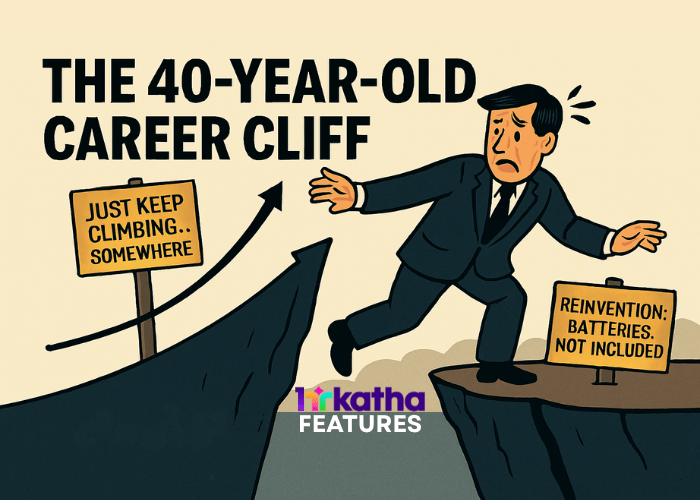
The 40-year career cliff is not about decline. It is about the market redefining value.
Capability versus perceived relevance
Rajani Tewari, chief people officer, GreenCell Mobility, frames it bluntly: “In today’s VUCA India, job retention after 40 isn’t about capability—it’s about perceived relevance.”
The question organisations are asking is rarely whether 40+ professionals can perform. It is whether they represent optimal value at this stage of business evolution—and at what cost.
“Those who stay curious, tech-savvy and outcome-driven don’t age out—they evolve into strategic assets the market cannot ignore.”
Rajani Tewari, CPO, GreenCell Mobility
Companies have grown leaner. Hierarchies flatter. Cost-to-value scrutiny sharper. Younger, digitally-fluent talent is perceived as faster to deploy and cheaper to employ, while experience must now demonstrate measurable business impact rather than rely on credentials alone. The half-life of skills is shrinking.
The market is no longer rewarding tenure. It is pricing relevance.
Subtle age bias compounds these structural shifts. Startup-influenced corporate cultures prize speed, visible energy and “cultural fit”—phrases that can quietly skew toward youth. The forty-something professional, regardless of actual adaptability, may be presumed slower to pivot or less aligned with contemporary work styles.
Yet some professionals thrive while others falter. The difference reveals uncomfortable truths—about individuals and about systems.
The challenge is both pervasive and measurable. According to Randstad India’s 2024 study, 31 per cent of employees report experiencing age-related discrimination, with 61 per cent observing explicit age biases in job advertisements—such as age limits or maximum experience cut-offs. The problem affects mid-career professionals acutely: 42 per cent of employees under 55 reported experiencing or witnessing ageism, compared with 29 per cent of those over 55. In multinational companies headquartered in India, 41 per cent of employees reported facing age-related bias, whilst 45 per cent felt age was a factor in layoffs.
Hiring preferences reveal the underlying dynamic. According to the Wheebox India Hiring Intent Survey 2024, which surveyed 152 organisations across 15 sectors, 28 per cent of employers prefer candidates with 1-5 years of experience and 24 per cent prefer those with 6-10 years—whilst appetite for professionals with 15-20 years of experience drops sharply, precisely when many workers reach their early forties.
Gajendra Chandel, a senior HR leader who has navigated multiple business cycles, frames the challenge differently: “After 40 or 45, employability is rarely about capability. It’s about adaptability of identity. In an AI-driven, geopolitically volatile world, boardrooms are quietly whispering: can you evolve as fast as the context?”
His observation points to a fundamental shift. The question facing 40+ professionals is not whether they possess skills, but whether they demonstrate willingness to continuously rebuild their professional identity. “Those who keep learning without ego don’t become irrelevant,” Chandel notes, “they become invaluable.”
“After 40 or 45, employability is rarely about capability. It’s about adaptability of identity. In an AI-driven, geopolitically volatile world, boardrooms are quietly whispering: can you evolve as fast as the context?”
Gajendra Chandel, senior HR leader
The success model: ace as differentiator
Arunima Mohanty, chief human resources officer, Metalman Auto, describes what distinguishes those who sustain momentum. She calls it the ACE Model—the integration of Analytical Mindset, Conceptual Knowledge and Emotional Intelligence.
“Analytical Mindset and Conceptual Knowledge enable leaders to grasp business levers quickly, decode competitive landscapes, shape strategic direction and design effective operating models,” she explains. This is the classical advantage of experience: pattern recognition built across cycles and crises.
But analytical sharpness alone is insufficient.
“Strategy alone does not drive transformation—people do. This is where Emotional Intelligence becomes the force multiplier.”
Execution, alignment and trust determine whether strategy translates into results.
The implication is clear: experience retains value only when it manifests as business acumen combined with human leverage. Tenure without translation does not survive scrutiny.
Yet even professionals who embody ACE confront structural forces beyond their control.
“Strategy alone does not drive transformation—people do. This is where Emotional Intelligence becomes the force multiplier.”
Arunima Mohanty, CHRO, Metalman Auto
The gender divide: different rules, different barriers
The 40-year cliff is not gender-neutral.
Tewari observes a stark divergence: “Men at this stage are typically evaluated for leadership scale and operational stewardship, whilst women are more likely to be navigating re-entry after caregiving breaks or balancing eldercare responsibilities.”
At 40, men are assessed for expansion. Women are assessed for continuity.
Women returning after career interruptions are evaluated through what Tewari calls a “re-entry versus readiness lens.” They must demonstrate sustained competence after perceived disruption. Men of identical age are assessed for capacity to take on larger mandates.
The presumption runs in opposite directions.
Operational design often reinforces this imbalance. Field mobility requirements, shift-based roles and relocation expectations can disadvantage women managing dual responsibilities—even when capability remains intact.
Yet Tewari points to an under-recognised truth: “Mid-career women often bring high resilience, stakeholder maturity and governance strength.”
Organisations that redesign career pathways around life stages rather than linear tenure—through returnships, phased leadership roles and caregiving support—retain this capability. Those that do not quietly lose it.
The gender dimension is not peripheral. It is structural.
The technical imperative and structural reality
Beneath conversations about emotional intelligence lies a harder economic question: do 40+ professionals possess the technical fluency contemporary roles demand?
The assumption that younger professionals are inherently more comfortable with AI, analytics and emerging tools has become widespread. Those who sustain relevance are, in Tewari’s words, “curious, tech-savvy and outcome-driven.”
They continuously update capabilities. They adopt AI tools. They frame experience not as knowledge of legacy systems but as judgment about which new technologies solve real business problems.
Digital fluency combined with domain depth creates an advantage neither alone can deliver.
Yet individual adaptability cannot always override structural economics.
Flattened hierarchies and automated coordination are hollowing out the middle—precisely the layer disproportionately occupied by 40+ professionals. Even those who excel at ACE may find fewer roles aligned with their seniority.
The cost dimension intensifies the pressure. A 40+ professional commands significantly higher compensation than a 28-year-old. AI has compressed the gap between experience and output—and shareholders notice.
Younger professionals augmented by technology may deliver sufficient output at materially lower cost. For organisations, the trade-off is compelling. For individuals, destabilising.
Divergent career trajectories
The professionals who sustain momentum share consistent traits.
They treat technical currency as non-negotiable. They leverage experience as judgment, not entitlement. They demonstrate measurable impact rather than cite tenure.
They position themselves across multigenerational teams, communicating with both junior digital natives and senior decision-makers. Experience becomes valuable when framed as pattern recognition and strategic calibration—not resistance to change.
Chandel has observed this pattern repeatedly: “I have seen 40+ professionals struggle—and I have seen them soar. The difference is not age, it is attitude toward reinvention. Experience becomes powerful when it is worn lightly… when pattern recognition is combined with humility to learn new technologies, at AI speed and new ways of working.”
His insight captures the essential paradox: experience must be simultaneously leveraged and transcended. In today’s world, as Chandel puts it, “curiosity is the real job security.”
Gender complicates this equation. Women navigating re-entry succeed when organisational systems recognise resilience and governance capabilities as assets. Men plateau when they remain anchored in operational stewardship whilst leadership expectations shift toward transformation.
Sector matters. Technology, consulting and financial services—characterised by velocity and youth-centric cultures—pose sharper cliffs. Manufacturing, healthcare and infrastructure often retain stronger appreciation for regulatory insight, stakeholder networks and institutional memory.
But even in these sectors, relevance cannot be assumed.
Relevance as active practice
The uncomfortable truth is that professional relevance after 40 must now be actively maintained.
Experience is no longer insurance. It is evidence—subject to ongoing evaluation.
Career strategies that once delivered stability—climbing hierarchies, accumulating expertise, expecting reciprocal loyalty—no longer guarantee leverage.
As Tewari puts it, “Those who stay curious, tech-savvy and outcome-driven don’t age out—they evolve into strategic assets the market cannot ignore.”
For organisations, systematically undervaluing 40+ professionals risks discarding institutional judgment and stakeholder capital that cannot be replicated by algorithms alone. Companies that invest in reskilling, role redesign and life-stage flexibility retain capability competitors abandon.
The gender imbalance demands equal attention. Organisations cannot profess commitment to diversity while maintaining career architectures that penalise caregiving breaks. A forty-something woman with a non-linear trajectory represents accumulated resilience—not diminished readiness—if evaluation criteria are designed accordingly.
The 40-year career cliff is neither inevitable nor universal. But navigating it requires clear-eyed recognition that the rules have shifted.
Experience no longer compounds automatically. It must be continuously translated into contemporary value.
The professionals who thrive beyond 40 will not be those who rely on tenure—but those who treat relevance as an active practice, earned repeatedly in markets that have stopped granting it by default.