


Close Menu
    Facebook X (Twitter) Instagram
    • Our Story
    • Partner with us
    • Reach Us
    • Career
    Subscribe Newsletter
    HR KathaHR Katha
    • Exclusive
      • Exclusive Features
      • Perspectives
      • Friday Features
      • herSTORY
      • Rising Stars
      • Case-In-Point
      • Point Of View
      • Research
      • HR Pops
      • Dialogue
      • Movement
      • Profile
      • Beyond Work
      • By Invitation
    • Brief News
      • Global HR News
      • Compensation & Benefits
      • Diversity
      • Events
      • Gen Y
      • Hiring & Firing
      • HR & Labour Laws
      • Learning & Development
      • Merger & Acquisition
      • Performance Management & Productivity
      • Talent Management
      • Tools & Technology
      • Work-Life Balance
    • Special
      • Editorial
      • HR Forecast 2026
      • Cover Story
      • HR Forecast 2024
      • HR Forecast 2023
      • HR Forecast 2022
      • HR Forecast 2021
      • HR Forecast 2020
      • HR Forecast 2019
      • New Age Learning
      • Coaching and Training
      • Learn-Engage-Transform
    • Studio
      • The CHRO Playbook
      • Quick HR Insights
      • The Corner Office
    • Reports
      • Whitepaper
        • HR Forecast 2024 e-mag
        • Future-proofing Manufacturing Through Digital Transformation
        • Employee Healthcare & Wellness Benefits: A Guide for Indian MSMEs
        • Build a Future Ready Organisation For The Road Ahead
        • Employee Experience Strategy
        • HRKatha 2019 Forecast
        • Decoding and Driving Employee Engagement
        • One Platform, Infinite Possibilities
      • Survey Reports
        • Happiness at Work
        • Upskilling for Jobs of the Future
        • The Labour Code 2020
    • Forums
      • HRKatha Inner Circle
      • HRKatha Futurecast
      • Leadership Summit 2025
      • Rising Star Leadership Awards
      • HRKatha Futurecast 2025
      • Automation.NXT
      • The Great HR Debate
    WhatsApp LinkedIn X (Twitter) Facebook Instagram
    HR KathaHR Katha
    Home»Exclusive Features»Research»Future Workforce: Redesigning of jobs is inevitable
    Research

    Future Workforce: Redesigning of jobs is inevitable

    mmBy Lipi Agrawal | HRKathaOctober 5, 2018Updated:October 11, 20184 Mins Read30348 Views
    Share LinkedIn Twitter Facebook WhatsApp
    Share
    LinkedIn Twitter Facebook WhatsApp

    A complex-looking future is already knocking at the door. Organisations cannot afford to go easy on preparing their workforces for times when almost everything around us will be disrupted, or at least influenced by AI-enabled processes. With a prevalent fear of certain jobs getting swept away, awareness about this shift just doesn’t seem to be an issue. Yet, however, a new research by Accenture reveals that only 20 per cent of Indian business leaders believe their workforce has the skills needed to work with advanced technologies, such as AI.

    Although the vast majority of Indian organisations believe that advanced technologies will be crucial for future growth, only a few plan to increase their training investment significantly in the next few years, thereby limiting their ability to harness the potential of advanced technologies, such as artificial intelligence (AI).
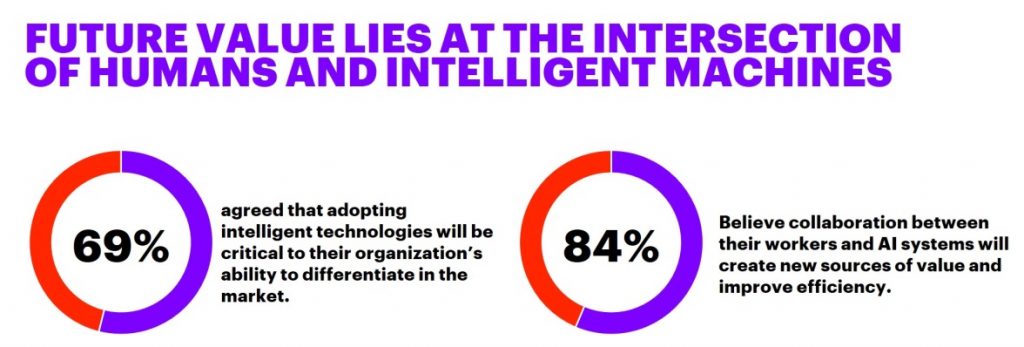
    Accenture’s Future Workforce Study, based on a survey of 1,100 workers across skill levels in India and a study of 100 senior executives in the country, found that while 69 per cent of the senior executives agreed that adopting intelligent technologies will be critical to their organisation’s ability to differentiate in the market, none said their organisations plan to increase their training investments over the next three years significantly. This, despite 59 per cent of the executives identifying skills shortage as a critical hindrance to future growth.

    We are entering the age of man–machine collaboration, where machines will augment human capabilities, allowing people to focus on what they do best while doing the things that humans would rather not.

    Surprisingly, on the other hand, the vast majority of workers surveyed, expressed the need for training, with 93 per cent saying it will be important to learn new skills if they are to work with intelligent technologies in the next three to five years, and even more (95 per cent) saying they believe that AI will help them perform their jobs more efficiently.

    The future being talked about here, isn’t far. “We are entering the age of man–machine collaboration, where machines will augment human capabilities, allowing people to focus on what they do best while doing the things that humans would rather not,” says Sunit Sinha, who leads Accenture’s Talent and Organisation practice in India. This makes it clear that the future workforce needs to be skilled to work alongside machines, with a focus on improving the intrinsically human abilities that will determine their success. The commitment to using advanced technologies for growth, needs to be supported by an equal commitment to transforming the organisation for the future.

    With that in mind, Accenture has already begun putting back 60 per cent of the money it saves through investments in AI into its training programmes. As a result, it has retrained tens of thousands of people whose roles were automated, over the past two years.

    Sinha believes it is not the jobs but the tasks that get hit by automation. Hence, jobs will remain but the nature of jobs will change drastically over time, taking away the transactional bit and letting humans focus on the more creative aspects of a job.

    Research suggests three strategies to help leaders shape the future workforce in the age of AI:

    Reimagine work to better understand how machines and people collaborate

    More than half (56 per cent) of the Indian executives surveyed believe that traditional job descriptions will become obsolete, and 22 per cent report that they’ve already redesigned jobs to a large extent in their organisations.

    Teach people to work with intelligent machines

    To fill the new and reconfigured jobs of the intelligent enterprise, companies will need new approaches to training. ‘New skilling’ programmes must be rapid, flexible, customised and scalable to maximise the value that can be achieved when humans and machines work together. Also, companies will need to invest more in training.

    Prepare the organisation for human–machine collaboration

    To foster the human–machine collaboration that will give the best results, companies must not only address the skills challenge, but also make organisational changes — including redeploying talent, organising for agility, and adapting leadership to the needs of the intelligent enterprise.

    Research shows that AI, like all new technologies, will drive efficiencies by eliminating some roles, but it will also help create new jobs by enabling companies to achieve sustainable competitiveness, which is about driving efficiencies and growing at the same time. Ultimately, it is not so much of a jobs issue than a skills issue!

    Share. LinkedIn Twitter Facebook WhatsApp
    mm
    Lipi Agrawal | HRKatha

    On days less busy, Lipi enjoys being a foodie, poet and an explorer. Add to that her experience as a journalist who covered the HR beat for seven years and you know her grasp on content is firm as well.

    Leave A Reply Cancel Reply

    Related Posts

    76% of tech professionals are satisfied with their jobs, yet 65% would consider switching

    November 4, 2026

    26% frontline employees report negative transformation experiences, nearly 3x the senior management rate

    October 28, 2026

    India’s tech professionals have already decided before you call them

    October 21, 2026

    India’s staffing industry claims 40 to 45% of formal payroll additions. What does that mean?

    October 14, 2026
    zoha
    Editorial

    Hard work built India’s global reputation. Availability cannot define its future

    I must have been in school when I first heard the slogan. I was passing…

    The rift between the corner office and the floor below

    A general manager at a large Indian steel conglomerate recently described an exchange with his…

    EDITOR'S PICKS

    The HR question that has no perfect answer

    November 6, 2026

    herSTORY: Nandini Matiyani, GCHRO, Strides

    November 5, 2026

    Case-in-Point: The internal whistleblower bypass

    November 5, 2026

    HR Perspectives by Dev Jha: “Engagement scores are not the same as commitment”

    November 4, 2026
    Latest Post

    Nitesh Madan takes charge as CHRO at Siddharth Grease & Lubes

    Movement November 6, 2026

    Nitesh Madan has joined Siddharth Grease & Lubes as chief human resources officer (CHRO), taking…

    Apple cuts employee AI spending limits

    Brief News November 6, 2026

    Apple has reduced the amount employees can spend on artificial intelligence (AI) tools, tightening internal…

    Block offers laid-off US employees up to 90 days of pay

    Brief News November 6, 2026

    Fintech company Block is offering laid-off employees in the US at least 60 days of…

    Chandreyi Das Sharma joins Generac as regional HR – APAC

    Movement November 6, 2026

    Generac has appointed Chandreyi Das Sharma as regional HR – APAC, bringing in a human…

    Asia's No.1 HR Platform

    Facebook X (Twitter) Instagram LinkedIn WhatsApp Bluesky
    • Our Story
    • Partner with us
    • Career
    • Reach Us
    • Exclusive Features
    • Cover Story
    • Editorial
    • Dive into the Future of Work: Download HRForecast 2024 Now!
    © 2026 HRKatha.com
    • Disclaimer
    • Refunds & Cancellation Policy
    • Terms of Service

    Type above and press Enter to search. Press Esc to cancel.