



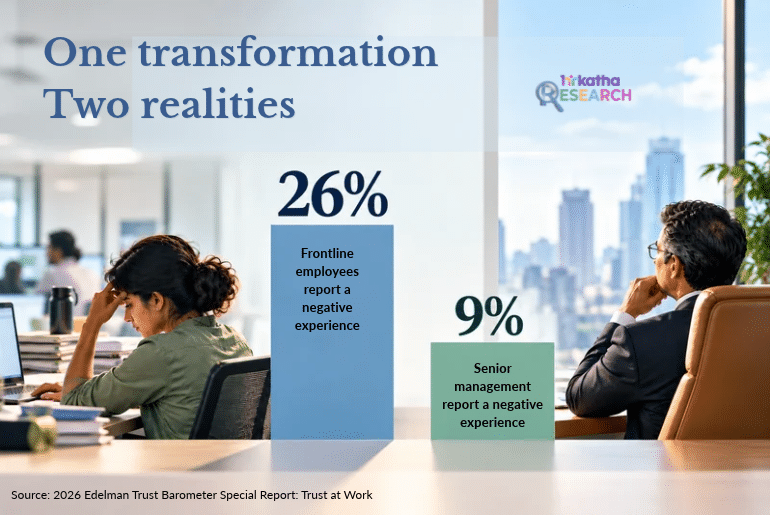
Transformation looks different depending on where one sits in the organisational hierarchy. From the boardroom, restructuring may represent strategic realignment. An AI rollout promises productivity. Further down the organisation, the same initiatives can mean additional responsibilities, unfamiliar systems and workloads that expand without corresponding rewards.
That divide emerges from the ‘2026 Edelman Trust Barometer Special Report: Trust at Work’, based on a survey of 10,018 employees across ten countries, including India, China, Japan, Germany, Brazil, South Africa, the UAE, the UK, the US and Canada. Among senior management respondents, classified as executives in the study, 9 per cent reported a negative transformation experience. Among employees in non-management roles, the figure was 26 per cent, nearly three times as high.
The difference becomes more pronounced when mixed experiences are included. Forty-nine per cent of employees in non-management roles described their transformation experience as less than positive, compared with 17 per cent of senior management respondents.
The findings raise a question rarely featured in transformation scorecards: can an organisation consider change successful when the people implementing it experience something fundamentally different from those who approved it?
Change has become the normal condition
Globally, 76 per cent of employees experienced at least one major workplace transformation during the previous 12 months. In India, the figure reached 96 per cent, the highest among the ten countries surveyed.
Integration of AI was the most common change, experienced by 53 per cent of respondents. Strategy shifts followed at 47 per cent, culture changes at 45 per cent and layoffs or workforce reductions at 38 per cent. More than four in ten employees experienced three or more transformations within a year.
Organisations are no longer asking employees to adapt to occasional disruption. Many are asking them to operate in a near-permanent state of adjustment while maintaining existing performance expectations.
Each initiative brings its own demands, but employees experience the combined consequences. A restructuring may alter reporting relationships just as an AI implementation changes workflows and a revised strategy introduces new targets. Each transformation may make sense individually to its sponsors. Together, they can make everyday work progressively harder to navigate.
Hierarchy of transformation
Senior management is more likely to participate in designing transformation, understand its strategic rationale and influence its implementation. Frontline employees are more likely to encounter its operational consequences.
A leadership team may celebrate a restructuring because reporting lines have been simplified and costs reduced. The employees affected may find themselves managing responsibilities previously distributed across several positions.
Neither perspective is necessarily inaccurate. They are measuring different outcomes.
The survey does not establish precisely why employees in non-management roles report worse experiences. However, the disparity suggests that organisations risk evaluating transformation through the experiences of those who have the greatest influence over it.
The problem becomes particularly acute when senior leaders assume that their understanding of a change is shared throughout the workforce. Knowing why a decision was made is not the same as knowing what it demands of the people expected to carry it out.
A transformation can be strategically coherent and operationally punishing at the same time.
Workload matters more than the message
The report identifies added work without additional pay as the leading reason employees give for a negative transformation experience. Other frequently-cited factors include poor strategic alignment, divisions among employees, surprise announcements and greater difficulty meeting customer needs.
Positive experiences offer an instructive contrast. Employees most frequently cited more manageable workloads, followed by strategic alignment, adequate guidance, easier customer service and opportunities for growth.
Workload appears at the top of both rankings.
This challenges the tendency to treat resistance to change primarily as a communication problem. Explaining the benefits of transformation matters, but communication cannot compensate for a process that makes people’s jobs substantially harder.
An AI system that introduces additional checks or a restructuring that redistributes work without adequate support can undermine confidence regardless of how persuasive the original business case appears.
Employees’ ability to influence how change affects them also matters. Among those who reported at least one good transformation experience, 67 per cent attributed it to being empowered to adapt on their own terms. This included receiving guidance, having time to plan, developing skills and being heard.
The findings suggest that employees are not necessarily resisting change itself. They may be resisting the loss of control over how that change affects their work.
Surveillance anxiety reaches the senior management floor
The report also challenges another assumption about organisational hierarchy: that monitoring is primarily a concern for junior employees, while senior management is responsible for doing the monitoring.
Globally, 59 per cent of employees worry about being monitored by their employer without consent. This finding is based on nine of the ten countries surveyed, with China excluded because of the sensitivity of the questions. In India, the figure reaches 80 per cent, the highest among those nine countries.
More surprisingly, 71 per cent of senior management respondents express this concern, compared with 50 per cent of employees in non-management roles.
The finding suggests that seniority does not necessarily provide protection from surveillance anxiety. Senior leaders may exercise authority over teams while remaining subject to scrutiny from boards, corporate headquarters or other decision-makers above them.
The survey does not establish why senior management reports greater concern. However, it complicates the familiar picture of workplace monitoring as something imposed by managers on employees further down the hierarchy.
Artificial intelligence makes the issue more consequential. Employees are being encouraged to use technologies that can improve productivity while worrying that their digital conversations or interactions with AI platforms might be used against them.
The tension is visible in attitudes towards AI itself. Among employees with positive transformation experiences, 40 per cent expressed enthusiasm or passion for its growing workplace use. Among those with negative experiences, only 18 per cent did so.
These findings do not establish that poorly managed transformation causes resistance to AI. But they suggest that technology adoption cannot be separated from employees’ wider experience of organisational change.
The cost of getting change wrong
Differences in transformation experience are accompanied by substantial differences in workplace trust and commitment.
Among employees with negative transformation experiences, 60 per cent trusted their manager, compared with 85 per cent among those with positive experiences. Trust in the CEO stood at 49 per cent in the negative-experience group, against 82 per cent in the positive-experience group.
The association extends to retention. Eighty-three per cent of employees with positive experiences wanted to remain with their organisation for many years, compared with 51 per cent of those with negative experiences.
Similarly, 83 per cent of employees with positive experiences were willing to do more than expected to help their employer succeed. Among those with negative experiences, the figure was 57 per cent.
These gaps do not prove that transformation alone determines trust or commitment. But they show how closely employees’ experience of change is associated with their attitudes towards leadership and their willingness to invest in the organisation.
The broader picture is troubling. Across the seven markets used for historical comparison, employer trust declined from 79 per cent in 2024 to 74 per cent in 2026. India was among the countries recording its lowest employer-trust level in the study’s historical series.
Transformation is not the only possible explanation. Economic insecurity, compensation and career prospects also shape employee confidence. But the findings suggest that how change is experienced deserves greater attention than it typically receives.
What transformation scorecards overlook
Organisations have become adept at measuring whether transformation delivers its intended business outcomes. Cost savings, productivity improvements and implementation timelines are routinely tracked.
They are considerably less adept at measuring who bears the cost along the way.
A transformation that reduces headcount may improve financial efficiency while increasing workloads for those who remain. An AI implementation may accelerate selected processes while introducing new responsibilities elsewhere. A revised operating model may simplify decisions for senior leaders while complicating everyday work for employees.
None of these outcomes necessarily invalidates the business case for change. But they expose the limits of judging transformation exclusively by the objectives of those who commissioned it.
The senior leader who approves a restructuring and the employee who inherits the additional workload may both be counted as participants in the same transformation. They have not, however, experienced the same event.
Perhaps that is the more uncomfortable finding in the data. The people responsible for designing organisational change may have the least direct experience of what that change actually feels like.
