



A manufacturing plant can expand its capacity faster than an organisation can develop the people needed to run it. New production lines can be commissioned, technology can be installed and operations can be scaled up. Building the technical expertise and leadership capability to support that growth is a different challenge, particularly when specialised talent is already in short supply.
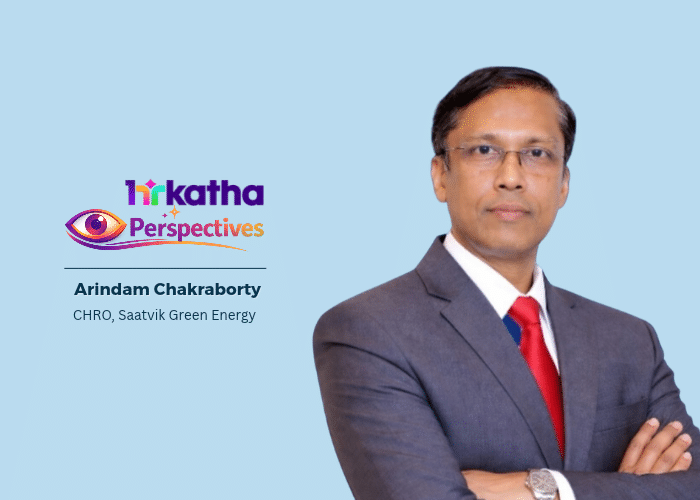
Saatvik Green Energy is confronting these questions as it expands beyond its established Ambala operations into a new greenfield facility in Odisha and develops capabilities in cell manufacturing alongside module production. For Arindam Chakraborty, CHRO at Saatvik Green Energy, the answer lies partly in looking much further down the leadership pipeline than organisations traditionally do.
In conversation with HRKatha, Chakraborty explains why succession planning must begin two to three levels below a critical position, how employees moving between manufacturing facilities can develop capabilities that formal training cannot easily replicate, and why HR must share responsibility for business outcomes rather than remain a separate support function.
Succession that starts early enough
As manufacturing operations expand, leadership requirements can grow faster than the internal talent pipeline. Why do you believe succession planning must begin two to three levels below a critical role?
As Saatvik expands into cell manufacturing, the number and complexity of roles have increased. Leadership demand can grow faster than the internal talent pipeline, which makes it important to balance internal development with targeted external hiring.
We distinguish potential from readiness through consistent observation over time rather than isolated assessments. An employee may demonstrate strong performance but may not yet be ready to manage a production ramp-up, a quality escalation or a technology transition. Readiness requires the ability to handle greater complexity, think critically and manage ambiguity under pressure.
For critical roles, particularly those requiring deep manufacturing expertise, succession planning must begin two to three levels below the target role. Our aim is to identify people who are ready to step up now and those who can be developed to be ready within 18 months. Starting succession planning at one level below is too late in a fast-scaling manufacturing environment.
When a senior role opens, we assess both internal and external candidates to ensure the most suitable person is selected. This also gives internal employees a fair and visible opportunity to compete.
Growth cannot be sustained through capacity expansion alone. It must be supported by a strong internal pipeline that is built well ahead of when it is needed.
“HR must share ownership of business outcomes rather than operate separately from the functions it supports.”
Keeping the people who built the plant
Specialised manufacturing talent is difficult to replace, particularly during expansion. Beyond competitive compensation, what makes skilled employees want to build their careers at Saatvik?
The competition for specialised talent is a challenge across industries. In cell manufacturing, cell technology, logistics and supply chain, skilled employees play a critical role in the organisation’s competitiveness. Losing people in these roles without having suitable successors leaves an organisation vulnerable in ways that are immediately felt on the floor.
Retention cannot be addressed through compensation alone. Career progression matters as much. Employees want to understand what their future within the organisation looks like, the responsibilities they can take on and the opportunities available to them.
Some want to build specialised technical careers. Others prefer generalist roles. Understanding those individual aspirations helps place people in roles where they can contribute and remain motivated over the long term. Even competitive compensation may not be enough if an employee feels they are in the wrong role.
We also place importance on continuous communication and accessible leadership. I connect personally with new joiners every 45 days to understand their experience, identify what is working and what needs to change, and use that feedback to improve our practices. Our CEO connects with general managers and above every 90 days for the same purpose.
These are not town hall announcements. They are conversations that translate into action.
We have employees at our Ambala plant who have been with us for more than four years through different phases of the factory’s growth. Some have moved to Odisha, creating opportunities for cross-learning and knowledge transfer.
Career development, communication, skilling and meaningful connection are all part of what keeps them.
“Hiring should not simply be about filling a vacancy based on what the role requires today.”
Learning on the shop floor
Saatvik has moved employees from Ambala to help establish its new Odisha facility. What does that experience reveal about the kind of learning that genuinely prepares people for larger responsibilities?
Formal training and certifications are only one part of capability building in a manufacturing organisation. The real test is whether employees can take on assignments that challenge their existing capabilities, with the right guidance and support to help them succeed.
A significant part of learning happens on the shop floor through hands-on experience, mentoring, shadowing and repeated practice. At Saatvik, we integrate learning into work through opportunities such as commissioning new production lines, managing technology transitions and leading cross-functional teams.
During the development of our new plant in Odisha, we moved capable and high-potential employees from Ambala to help establish the facility. Engineers, senior engineers and mid-management employees have worked on a greenfield project, contributed to timely commissioning and managed critical aspects of cost, quality and project execution.
These assignments allow employees to take on larger responsibilities while contributing directly to business outcomes.
We are also developing structured training centres on the shop floor where employees can understand machine workflows, anticipate possible breakdowns and learn how to respond to operational challenges.
Alongside this, we are building a directory that documents problems encountered during installation and commissioning, the actions taken and the outcomes achieved. When similar challenges arise in the future, that knowledge is available to the team rather than sitting with one individual.
Learning is effective when employees can apply their knowledge independently in unfamiliar situations and respond confidently to more complex technical and managerial challenges.
“The real test of learning is whether an employee can apply knowledge independently in an unfamiliar situation.”
Hiring for what the role will become
Solar manufacturing technologies are changing rapidly. How do you assess whether someone can grow with a role rather than simply meet its current requirements?
Hiring should not simply be about filling a vacancy based on what the role requires today. Workforce planning needs to be a proactive and holistic exercise that anticipates the organisation’s future needs. As Saatvik grows, roles evolve faster than most hiring frameworks can keep pace with.
We look beyond credentials to assess a candidate’s capabilities and suitability for the role both now and as the business evolves. We look for evidence of adaptability through a candidate’s previous experience, growth trajectory and ability to demonstrate skills consistently over time. A CV alone is not sufficient to assess this.
At senior levels, particularly in manufacturing, we also assess the candidate’s ability to manage ambiguity and adapt to changing circumstances.
We consider the existing team and identify the additional value a new hire can bring, whether through cross-functional coordination, stakeholder management or addressing a specific capability gap.
The objective is to build a balanced team with the right people in the right roles, not simply to fill the position in front of us.
“Career progression matters as much as compensation. Even competitive pay may not be enough if an employee feels they are in the wrong role.”
Business partner, not administrator
As Saatvik scales, how can HR demonstrate that it is contributing to manufacturing and commercial performance rather than simply supporting business functions?
At Saatvik, business partnering extends across manufacturing, sales and supply chain. HR should share ownership of business outcomes rather than operate separately from the functions it supports.
Our HR business partners work with business leaders on metrics such as revenue per sales employee, which reflects whether people have been integrated effectively, trained appropriately and equipped to manage their responsibilities.
We look at how long new joiners stay, with HR and business leaders jointly responsible for improving that experience.
When hiring for specialised roles in cell manufacturing, we ensure that consultants interact directly with process and manufacturing heads rather than working only through HR. This gives them a clearer understanding of what the role actually requires.
HR business partners follow a structured calendar of people conversations, connecting with new joiners, high performers, employees who may need support, people moving into new roles and those leaving the organisation.
Senior-level probation confirmations include a meaningful two-way discussion about experience, learning, areas that need attention and expectations for the future. These are not administrative checkpoints.
For future HR leaders in this sector, the most important capabilities will be managing ambiguity, understanding workforce productivity and connecting people decisions to measurable business outcomes.
Technology and AI can support analysis and decision-making, but important people decisions must continue to be informed by conversations and a genuine understanding of employees.
The CHROs who will matter over the next decade are those who combine commercial understanding, technological awareness and a deep understanding of people. Their contribution should be measured not only by how well they attract and retain talent, but by how they help the organisation grow, adapt and compete.
“Succession planning must begin two to three levels below the target role, not one.”