



A hiring manager scans hundreds of applications.
Most candidates have strong academic credentials. Prestigious institutions. Impressive degrees.
Yet the hiring team struggles to determine who can actually solve real problems.
Meanwhile, inside the organisation, technical skills are abundant. But collaboration breaks down. Conflicts escalate. Young employees question decisions without context.
The issue is not talent supply. It is how organisations evaluate, develop and engage people.
By 2026, this tension will intensify—and force a fundamental rethink.
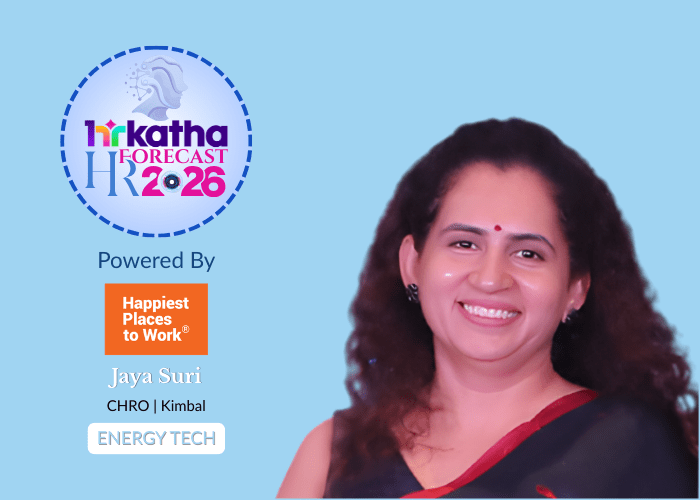
Jaya Suri, CHRO at Kimbal, an engineering and technology-driven organisation, believes the future of work will not be shaped by credentials or policies alone. It will be shaped by capability, emotional intelligence and purpose-driven cultures.
“Skills-based hiring has definitely gained momentum, and I strongly believe this shift is real and irreversible,” she says. “But the biggest challenge organisations still face is not intent — it is execution.”
Three signals point to how talent systems must evolve.
Signal 1: Skills-based hiring will succeed only when assessment evolves
The debate around skills versus degrees persists. Yet most organisations still default to pedigree-based hiring.
Why? Because degrees provide a convenient filter when thousands of applications arrive. They simplify shortlisting. But they rarely predict performance.
“Degree-based hiring offers a quick filter,” Suri explains. “But it often comes at a cost — longer hiring cycles, higher compensation expectations, faster attrition, and sometimes an entitlement mindset shaped by industry norms rather than organisational values.”
Degrees may indicate potential. But they do not reveal adaptability, learning ability or long-term commitment.
The real barrier is evaluation infrastructure.
Assessing skills requires different systems: practical interviews, real-world problem solving, simulations and structured competency frameworks. These take more time to design and execute than credential screening.
“By 2026, organisations will need to seriously invest in sharper and more predictive assessment frameworks,” Suri says. “The focus will move from ‘Where did you study?’ to ‘How do you think, learn and deliver?'”
The shift will be driven by business needs—speed, agility and sustainable growth. Organisations that redesign hiring processes around demonstrated capability will build stronger talent density. Those continuing to rely on pedigree shortcuts may hire quickly—but not necessarily well.
Skills-based hiring will succeed when interview processes become sharper, fairer and more predictive of long-term performance.
Signal 2: The AI age will elevate emotional intelligence as core capability
As artificial intelligence automates technical and repetitive tasks, human capabilities rise in value.
Technical expertise alone no longer differentiates high performers.
“Soft skills are no longer optional,” Suri says. “They are becoming core capabilities.”
This is particularly visible in technology-driven organisations. Technical proficiency is widespread. But collaboration, judgment and empathy determine actual impact.
At Kimbal, leadership development increasingly focuses on emotional intelligence, conflict resolution, non-violent communication and critical thinking.
“We begin with the ‘knowing self’ journey,” Suri explains. “When individuals understand themselves better and heal from past experiences, they become more balanced, self-aware and effective at work. Performance improves naturally when people are emotionally grounded.”
This reflects a deeper shift in how organisations think about human capability.
The traditional concept of work-life balance—where work and personal life occupy separate compartments—is becoming obsolete.
“A human being cannot be split into parts,” Suri says. “People bring their emotions, experiences and realities to work every day, whether organisations acknowledge it or not.”
The question is whether organisations create space for that wholeness.
By 2026, emotional intelligence, empathy, creativity and human judgment will become the true differentiators. Organisations that allow people to bring their whole selves to work will unlock greater creativity, resilience and collaboration.
Those treating employees as purely functional contributors will struggle to harness human potential in an AI-driven environment.
Signal 3: Inclusion will be measured through voice, not metrics
Diversity dashboards have become common. But numbers alone rarely capture real impact.
For Suri, inclusion is less about representation and more about participation—specifically, whose voices shape decisions.
“Diversity by itself is not the end goal,” she says. “The real outcome of diversity is better growth, productivity and decision-making.”
At Kimbal, inclusion is designed around open dialogue and cross-generational collaboration. In meetings, hierarchy is deliberately flattened.
“Every voice matters equally — whether it is the CEO or a management trainee,” Suri explains. “Some of our most innovative and fresh ideas have come from young team members.”
This extends beyond gender diversity. Age diversity and generational perspectives are actively encouraged. When experience meets new thinking, breakthroughs emerge.
True inclusion exists when employees feel psychologically safe to challenge assumptions and express disagreement.
“In fact, silence in a meeting can be dangerous,” Suri notes. “If high-performing employees stop speaking up, or if there are no disagreements in reviews or board meetings, it often signals stagnation.”
Healthy debate, diverse viewpoints and open conversations are early indicators of organisational vitality.
By 2026, leading organisations will measure inclusion less through demographic metrics and more through employee voice, psychological safety and the diversity of ideas shaping strategy.
The Gen Z shift: From compliance to trust
Another force is reshaping organisational culture: Gen Z employees approach work fundamentally differently.
They question hierarchy. They seek purpose and context. They want transparency around decisions.
“For Gen Z, it is not just about how work is done, but why it is being done,” Suri says. “They seek logic, meaning and context behind every decision.”
At Kimbal, this prompted a radical rethink of traditional HR policies.
Instead of layering rules, the organisation created what it calls the “Book of Trust.” While statutory requirements like codes of conduct and compliance remain non-negotiable, most people practices—leave policies, work arrangements, flexibility—were written by employees themselves.
“Many of our Gen Z employees contributed directly to defining how they want to work, what flexibility means to them, and what responsibilities come with that freedom,” Suri explains.
When people help shape the rules they live by, compliance becomes natural and engagement rises.
For Gen Z, trust is not a benefit. It is the foundation of meaningful work. Organisations attempting to manage this generation through traditional control mechanisms will face mounting friction.
What HR must abandon
Looking ahead, Suri believes HR must rethink its own philosophy.
The traditional idea of “human resource management” may itself be outdated.
“Human beings cannot be managed like machines or processes,” she says. “What truly drives people is purpose, not control.”
Every individual has a different purpose. When organisations recognise and align with that purpose, passion follows naturally.
“When people are passionate about what they do, rules, boundaries and rigid frameworks become secondary,” Suri explains. “Passion creates ownership, accountability and energy that no policy can enforce.”
The role of HR must evolve: not to manage people, but to enable them.
By helping employees discover purpose, build capability and contribute meaningfully, organisations unlock performance that policies alone cannot create.
“In 2026, the focus must shift towards helping individuals discover and connect with their purpose—and aligning it with the organisation’s larger mission,” Suri says.
When organisational purpose and individual purpose converge, work stops feeling like work. People exceed expectations not because they are asked to, but because they want to.
Three Strategic Imperatives
Skills Assessment: Replace credential filters with structured capability frameworks—practical interviews, simulations and competency-based evaluation that predict long-term performance.
Emotional Capability: Invest in emotional intelligence, self-awareness and critical thinking as core leadership competencies—not peripheral soft skills.
Trust Architecture: Move beyond policy-heavy governance towards employee-designed systems rooted in psychological safety, accountability and shared ownership.
The Purpose Advantage
The next generation of workplaces will not be defined by policies, processes or degrees.
They will be defined by purpose alignment.
Organisations focusing only on credentials will struggle to build adaptable teams. Those investing in skills, emotional intelligence and trust-driven cultures will unlock deeper engagement and sustained performance.
By 2026, the question will not be how organisations manage employees.
It will be whether they can help people discover meaning in the work they do.
Because when purpose and capability align, performance stops being enforced.
It becomes voluntary.
And that is where the future of work truly begins.
1 Comment
Dear Radhika,
You “thrive on exploring new ideas and embracing challenges,” and so do I. Survival of the adaptable is what Darwin taught us. A newspaper man wrote survival of the fittest, and it went viral before its time. Conflict is a wasted natural resource so often mismanaged, and, when we run from it and not toward it, valuable information and insight can be lost. Your words resonate in me, and we vibrate at the same frequency. Change is inevitable, and, yet, we dread it. I’m not especially fond of surprises or drastic changes either, so I decided long ago to become the change agent myself and lead the way. There’s a price to pay for jumping out front, but it’s worth it to me (and you?).