

Close Menu
    Facebook X (Twitter) Instagram
    • Our Story
    • Partner with us
    • Reach Us
    • Career
    Subscribe Newsletter
    HR KathaHR Katha
    • Exclusive
      • Exclusive Features
      • Perspectives
      • Friday Features
      • herSTORY
      • Rising Stars
      • Case-In-Point
      • Point Of View
      • Research
      • HR Pops
      • Dialogue
      • Movement
      • Profile
      • Beyond Work
      • By Invitation
    • News
      • Global HR News
      • Compensation & Benefits
      • Diversity
      • Events
      • Gen Y
      • Hiring & Firing
      • HR & Labour Laws
      • Learning & Development
      • Merger & Acquisition
      • Performance Management & Productivity
      • Talent Management
      • Tools & Technology
      • Work-Life Balance
    • Special
      • HR Forecast 2026
      • Cover Story
      • Editorial
      • HR Forecast 2024
      • HR Forecast 2023
      • HR Forecast 2022
      • HR Forecast 2021
      • HR Forecast 2020
      • HR Forecast 2019
      • New Age Learning
      • Coaching and Training
      • Learn-Engage-Transform
    • Magazine
    • Reports
      • Whitepaper
        • HR Forecast 2024 e-mag
        • Future-proofing Manufacturing Through Digital Transformation
        • Employee Healthcare & Wellness Benefits: A Guide for Indian MSMEs
        • Build a Future Ready Organisation For The Road Ahead
        • Employee Experience Strategy
        • HRKatha 2019 Forecast
        • Decoding and Driving Employee Engagement
        • One Platform, Infinite Possibilities
      • Survey Reports
        • Happiness at Work
        • Upskilling for Jobs of the Future
        • The Labour Code 2020
    • Conferences
      • Leadership Summit 2025
      • Rising Star Leadership Awards
      • HRKatha Futurecast
      • Automation.NXT
      • The Great HR Debate
    WhatsApp LinkedIn X (Twitter) Facebook Instagram
    HR KathaHR Katha
    Home»Exclusive Features»HR Pops»Lily padding: When career loyalty means hopping, not staying
    HR Pops

    Lily padding: When career loyalty means hopping, not staying

    How Gen Z turned job mobility into a strategy, and why HR must rethink what loyalty really means
    mmBy Liji Narayan | HRKathaMarch 31, 2026Updated:March 31, 20263 Mins Read15873 Views
    Share LinkedIn Twitter Facebook WhatsApp
    Lily padding, hopping from one job to another to build skills
    Share
    LinkedIn Twitter Facebook WhatsApp

    What does it mean?

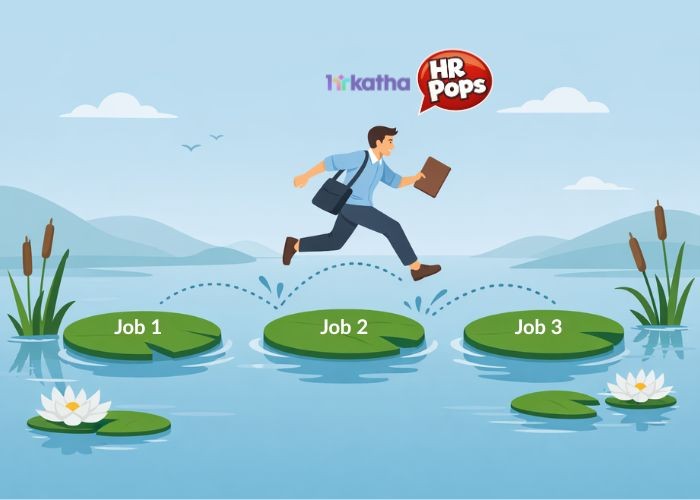
    Lily padding is a career strategy in which professionals – particularly younger workers – move deliberately from one role to another to build skills, exposure, and opportunity.

    The metaphor comes from a frog moving across a pond, hopping from one lily pad to the next. Each move is intentional and forward-looking.

    This is not a rejection of commitment. It is a response to a changing world of work.

    Unlike traditional careers, which followed a linear progression – entry-level to mid-level to senior roles – lily padding is non-linear. Each move is designed to expand capabilities, broaden perspective, and remain relevant in shifting markets.

    Where did the idea come from?

    The term gained traction in the 2020s as Generation Z entered the workforce.

    Earlier generations tended to value stability and long-term association with a single employer.

    In contrast, younger workers – shaped by economic uncertainty, rapid technological change, and shifting social expectations – view careers as a series of strategic moves rather than a single upward climb.

    The rise of remote work, gig platforms, and global opportunities accelerated this shift. Waiting several years for a promotion is no longer seen as necessary when similar or better opportunities may exist elsewhere.

    Lily padding also reflects changing priorities. Many workers now place greater emphasis on learning, meaning, and flexibility than on tenure or hierarchy.

    Why is it relevant for HR?

    For HR leaders, lily padding challenges traditional assumptions about loyalty, retention, and career progression.

    Its implications are significant:

    • Retention strategies need rethinking: Employees may leave not because they are dissatisfied, but because they seek new experiences
    • Internal mobility becomes critical: Organisations must offer visible, flexible pathways across roles, functions, and geographies
    • Learning must be continuous: Employees expect ongoing development, not periodic training
    • Culture must evolve: Flexibility, autonomy, and purpose increasingly matter more than hierarchy
    • Employer branding gains importance: Growth opportunities, wellbeing, and transparency are key attractors

    In effect, organisations must compete not just on pay, but on the quality and variety of experience they offer.

    The uncomfortable question

    Lily padding is often framed as empowering, but it comes with trade-offs.

    For individuals, frequent movement can limit the development of deep expertise. Breadth increases, but depth may suffer. There is also the fatigue of constant transition be it job searches, onboarding, and the need to prove oneself repeatedly.

    For organisations, the costs are equally real. High turnover disrupts continuity, erodes institutional knowledge, and increases hiring costs. Long-term projects can suffer when key contributors move on.

    There is also a more complex concern: frequent movement can make it difficult to distinguish between high performers and those who move before their limitations become visible.

    A rational response?

    Is lily padding a rejection of commitment, or a rational response to organisations that no longer guarantee stability or clear progression?

    In many cases, it is both.

    Some professionals move strategically, building diverse and valuable skill sets. Others may be reacting to frustration, lack of feedback, or limited growth opportunities.

    For HR, the challenge lies in understanding the difference, and in creating conditions where those with high potential choose to stay.

    and remain relevant in shifting markets and transparency broaden perspective career loyalty means hopping career progression deliberate job hopping to build skills forward-looking move growth opportunities hop from one lily pad to another Job Hopping job hopping to gain exposure LEAD Lily padding Lily padding also reflects changing priorities lily padding is non-linea lily pads linear progression Loyalty move jobs to expand capabilities move to progress non-linear movement not staying rational response to organisations Retention wellbeing
    Share. LinkedIn Twitter Facebook WhatsApp
    mm
    Liji Narayan | HRKatha

    HRKatha prides itself in being a good journalistic product and Liji deserves all the credit for it. Thanks to her, our readers get clean copies to read every morning while our writers are kept on their toes.

    Leave A Reply Cancel Reply

    Related Posts

    herSTORY: Beena Jacob, CHRO, Blue Dart

    September 10, 2026

    AI now shapes hiring at 85% of Indian firms. Only 35% report new early-career roles or skill needs

    September 9, 2026

    Delayering: The word that flattened workplaces

    September 8, 2026

    POV: Should organisations hire for culture fit or culture add?

    September 7, 2026
    zoha
    Editorial

    AI-native workers are forcing managers to earn their relevance

    They did not arrive announcing themselves. They joined as analysts, engineers, content writers, recruiters and…

    Employees are redesigning work before their companies do

    Nobody announced that work would change this way. There was no strategy document, pilot programme…

    EDITOR'S PICKS

    Case-in-Point: The cost of flexibility

    September 10, 2026

    herSTORY: Beena Jacob, CHRO, Blue Dart

    September 10, 2026

    AI now shapes hiring at 85% of Indian firms. Only 35% report new early-career roles or skill needs

    September 9, 2026

    HR Perspectives by Sriharsha Achar: “If every senior vacancy requires an external search, the organisation has a pipeline problem”

    September 9, 2026
    Latest Post

    Onus of vigilance clearance and APRs lies with employer, not employee: J&K and Ladakh High Court

    News September 10, 2026

    The High Court of Jammu & Kashmir and Ladakh has ruled that an employee cannot…

    Flipkart tests food delivery service Eat In among Bengaluru employees

    News September 10, 2026

    Flipkart has started testing its food-delivery service, Eat In, among employees in Bengaluru as it…

    Karnataka approves aerospace policy targeting Rs 60,000 crore investment, 60,000 jobs

    News September 10, 2026

    The Karnataka Cabinet has approved the Aerospace Policy 2026–31, which aims to attract Rs 60,000…

    India expands healthcare workforce to improve access to specialised care

    News September 10, 2026

    India is expanding its medical, nursing and allied healthcare workforce as it seeks to improve…

    Asia's No.1 HR Platform

    Facebook X (Twitter) Instagram LinkedIn WhatsApp Bluesky
    • Our Story
    • Partner with us
    • Career
    • Reach Us
    • Exclusive Features
    • Cover Story
    • Editorial
    • Dive into the Future of Work: Download HRForecast 2024 Now!
    © 2026 HRKatha.com
    • Disclaimer
    • Refunds & Cancellation Policy
    • Terms of Service

    Type above and press Enter to search. Press Esc to cancel.