


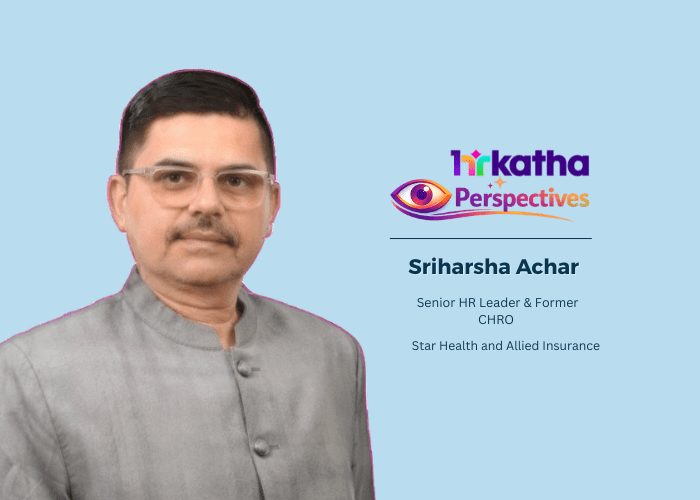
Sriharsha Achar has spent more than four decades as a people leader across manufacturing, IT, healthcare and health insurance. That breadth gives him a particular vantage point. He has watched similar people dilemmas recur across very different industries, often with organisations making the same mistakes in different forms.
In conversation with HRKatha, Achar reflects on what those four decades have taught him about hiring for relevance rather than today’s perfect fit, building leadership pipelines before vacancies appear, designing careers around expertise rather than titles, and judging leadership by what remains after the leader has moved on.
The ATS problem
If skills are becoming obsolete faster, why are organisations still hiring for such precise matches with today’s job description?
ATS systems are programmed to find the perfect fit. That is precisely the problem.
When a system is optimised to match candidates to today’s job description, it can screen out people who might be more valuable tomorrow. Organisations should hire less for a precise match with what the role requires now and more for the ability to learn, unlearn and relearn. Problem-solving and resilience matter alongside technical competence.
The best hire is not necessarily the person who knows the most today. It is the person who can remain relevant as the role changes around them.
Capability-building therefore has to become continuous rather than an annual training event. The half-life of technical skills is shrinking. That is not new information. The problem is that many hiring systems and development calendars are still built for a world in which skills lasted longer.
Relevance is the real currency. Organisations that hire for it and continue to build it will be better positioned than those still optimising for today’s perfect fit.
“Careers are not built by maximising every opportunity. They are built by making the right choices when the obvious choice is not necessarily the right one.”
Capability, capacity, context
When should an organisation build a leader internally, and when is going outside actually the better decision?
I have always looked at this through three lenses: capability, capacity and context.
If the organisation has people with the potential and time to grow into roles, build internally. If a critical capability is missing, the organisation needs a significant change in direction or an outside perspective is genuinely required, then buy from the market.
The mistake is treating this as an either-or decision. Strong organisations build their leadership bench while selectively acquiring capabilities they do not yet possess.
The signal that tells you whether you are getting this right is succession strength. If every senior vacancy requires an external search, the organisation has a pipeline problem. That is not a recruiting failure. It is a development failure that has been deferred long enough to become a crisis.
There is another mistake worth naming. Organisations frequently judge people by title rather than capability.
Someone recently approached me about finding a suitable CHRO candidate. I referred a person with 23 to 24 years of experience, a strong profile and a record of doing exactly what the organisation needed. Their current title was Senior Manager. The conversation stopped there.
That organisation was not looking for capability. It was looking for a signal it could recognise. Those are not the same thing.
“Move across functions. But do not merely collect experiences. Collect experiences into expertise.”
Confidence through experience, not communication
Organisations spend considerable effort reassuring employees about AI. Why does so much anxiety persist?
You cannot build AI confidence through communication alone. Employees need experience.
The shift leaders need to make is from telling people that AI will not replace them to giving people direct experience of AI making their work better. That means being transparent about what will change, investing in reskilling, involving employees in redesigning workflows and demonstrating tangible productivity gains in their specific context, not in the abstract.
Most importantly, leaders must acknowledge the anxiety around AI rather than dismiss it. Dismissal does not reduce fear. It simply pushes it underground, where it becomes harder to address.
The objective is not to promise that every job will remain unchanged. That promise cannot be kept. The objective is to give people confidence that they can remain valuable as the nature of work changes around them.
That is the only confidence that holds when the next change arrives.
“My biggest measure of leadership today is not what I accomplished. It is what continued to grow after I moved on.”
What continued to grow after you left
After four decades in HR, what changed your understanding of what good leadership actually looks like?
The most important shift in my four decades as a people leader was moving from being the person with the answers to being the person who asks the right questions.
Early in my career, success was largely about delivering results myself. Over time, I realised that the real multiplier is creating an environment where others can deliver, grow and eventually outperform you.
That changed how I approached leadership. It meant giving people space rather than directions and building leaders who do not need you rather than followers who do.
My biggest measure of leadership today is not what I accomplished. It is what continued to grow after I moved on.
That is the question I would ask of any leader: not simply what did you build, but what is still standing, still growing and still producing value without you in the room?
“Not simply what did you build, but what is still standing, still growing and still producing value without you in the room.”
Collect experiences into expertise
A broad career creates perspective, but breadth can also become superficial. How should HR professionals decide where they need to go deep?
Follow a T-shaped model: broad exposure across HR combined with genuine depth in one, two or three areas.
Early in a career, the focus should be on breadth: business partnering, talent management, rewards, learning, employee relations and transformation. Moving across these areas builds perspective and adaptability.
But breadth without depth leaves you as a generalist without differentiation. At some point, you need to develop a distinctive point of view and become known for something specific.
That transition does not happen automatically. It requires a deliberate choice about where to go deep and the discipline to stay long enough in a domain to develop real expertise rather than surface familiarity.
Move across functions. But do not merely collect experiences. Collect experiences into expertise.
“That organisation was not looking for capability. It was looking for a signal it could recognise. Those are not the same thing.”
The trade-off that stays
Looking back, which career trade-off do you think professionals understand too late?
The trade-off I return to most often is career acceleration versus long-term credibility.
Acceleration is always available. There are always opportunities to take the bigger title faster, chase the next role or optimise for visibility. Earlier in my career, I understood why those choices were tempting.
Some of my most valuable experiences did not immediately look attractive. There were difficult assignments in unglamorous businesses, roles that required rebuilding rather than building, and periods where the learning was significant but the recognition was not.
I learned to choose learning over title, substance over speed and long-term reputation over short-term gratification. Not because those choices were obvious at the time, but because experience eventually showed me the difference.
Careers are not built by maximising every opportunity. They are built by making the right choices when the obvious choice is not necessarily the right one.
“Relevance is the real currency. Organisations that hire for it will be better positioned than those still optimising for today’s perfect fit.”