


Close Menu
    Facebook X (Twitter) Instagram
    • Our Story
    • Partner with us
    • Reach Us
    • Career
    Subscribe Newsletter
    HR KathaHR Katha
    • Exclusive
      • Exclusive Features
      • Perspectives
      • Friday Features
      • herSTORY
      • Rising Stars
      • Case-In-Point
      • Point Of View
      • Research
      • HR Pops
      • Dialogue
      • Movement
      • Profile
      • Beyond Work
      • By Invitation
    • Brief News
      • Global HR News
      • Compensation & Benefits
      • Diversity
      • Events
      • Gen Y
      • Hiring & Firing
      • HR & Labour Laws
      • Learning & Development
      • Merger & Acquisition
      • Performance Management & Productivity
      • Talent Management
      • Tools & Technology
      • Work-Life Balance
    • Special
      • Editorial
      • HR Forecast 2026
      • Cover Story
      • HR Forecast 2024
      • HR Forecast 2023
      • HR Forecast 2022
      • HR Forecast 2021
      • HR Forecast 2020
      • HR Forecast 2019
      • New Age Learning
      • Coaching and Training
      • Learn-Engage-Transform
    • Studio
      • The CHRO Playbook
      • Quick HR Insights
      • The Corner Office
    • Reports
      • Whitepaper
        • HR Forecast 2024 e-mag
        • Future-proofing Manufacturing Through Digital Transformation
        • Employee Healthcare & Wellness Benefits: A Guide for Indian MSMEs
        • Build a Future Ready Organisation For The Road Ahead
        • Employee Experience Strategy
        • HRKatha 2019 Forecast
        • Decoding and Driving Employee Engagement
        • One Platform, Infinite Possibilities
      • Survey Reports
        • Happiness at Work
        • Upskilling for Jobs of the Future
        • The Labour Code 2020
    • Forums
      • HRKatha Inner Circle
      • HRKatha Futurecast
      • Leadership Summit 2025
      • Rising Star Leadership Awards
      • HRKatha Futurecast 2025
      • Automation.NXT
      • The Great HR Debate
    WhatsApp LinkedIn X (Twitter) Facebook Instagram
    HR KathaHR Katha
    Home»Exclusive Features»Research»Indian workforce: More confident about ‘Artificial Intelligence’ and ‘Automation’ than US, UK and South Africa
    Research

    Indian workforce: More confident about ‘Artificial Intelligence’ and ‘Automation’ than US, UK and South Africa

    mmBy Dr. Prajjal Saha | HRKathaJune 21, 2016Updated:May 10, 20195 Mins Read3513 Views
    Share LinkedIn Twitter Facebook WhatsApp
    Share
    LinkedIn Twitter Facebook WhatsApp

    Around 80 per cent of Indian respondents were confident that they have the skills to work abroad, however 40 per cent of them also worry about ‘brain drain’.

    The Indian workforce seems to be less worried about the future of jobs in comparison to their counterparts in the US, the UK, and South Africa.

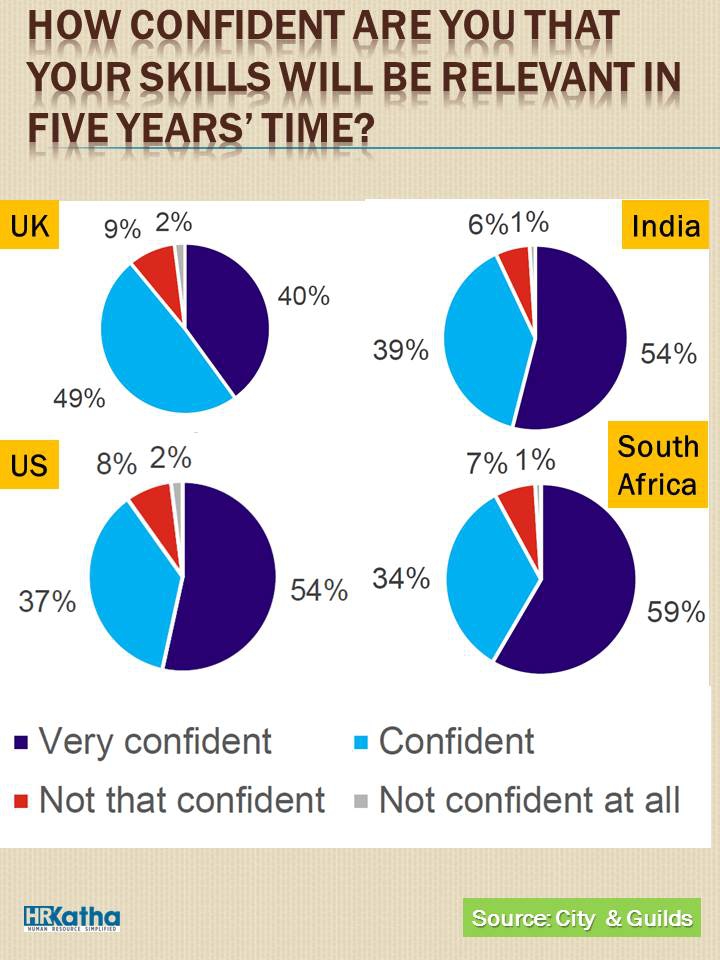
    According to a survey by City & Guilds, which interviewed around 8,157 employees from the United Kingdom, United States, India and South Africa, 69 per cent of respondents did not believe that their skills will lose relevance in 5 years’ time. To add to this, close to 90 per cent of the respondents were confident that they had the relevant skills and ability to help their respective companies’ progress.

    The Indian workforce seem to the least bothered about the changing landscape at the workplace as only 7 per cent of Indian respondents were found to be concerned – 6 per cent were not that confident and 1 per cent not confident at all.

    A little higher than India was South Africa where only 8 per cent of respondents were afraid of losing relevance. Similarly, in the US, only 10 per cent of the respondents weren’t confident about staying relevant where as in the UK, the number was 11 per cent.

    However, this false sense of confidence seem to be a worrying fact for the industry as the World Economic Forum (WEF) has predicted that the world is going through a fourth industrial revolution which will further displace the role of humans in the economy in favour of machines and automation.

    How ‘Artificial Intelligence’ will impact the future of work?

    The sense of urgency to adapt skills to the changing nature of the economy is missing amongst employees at large, with many thinking their jobs will not be affected by future trends.

    Close to 50 per cent of the respondents across markets – 51 per cent in South Africa, 50 per cent in India, 48 per cent in the US and 55 per cent in the UK, feel that they are overqualified for their current job.

    When asked about how issues such as technological changes, intelligent automation, artificial intelligence, globalisation and immigration will impact their job prospects in a decade, the maximum negativity was around increased immigration and artificial intelligence.

    However, views differ across the world about the benefits and challenges around immigration and globalisation.

    In more developing nations for instance, immigration is seen as an opportunity –but also something that can result in ‘brain drain’.

    How ‘Automation’ will affect jobs in next 5-10 yrs?

    In more developed economies –notably the US –there are concerns around the threat to job prospects, even though it is acknowledged that many industries would struggle without migrant labour.

    Around 36 per cent of respondents from South Africa, 29 per cent from India, 27 per cent from the UK and 24 per cent from the US were concerned about increased immigration.

    In fact 51 per cent of Indians felt that increased immigration would have a positive impact (those who voted in negative were concerned that outsourcing to other countries can be a threat.)

    Interestingly, 80% of Indian respondents were confident that they have the skills to work abroad, however 40 per cent of them also worry about ‘brain drain’.

    On the other hand more than 40 per cent of respondents from the US and the UK felt that would have absolutely no impact and only 24 per cent and 27 per cent of respondents from the US and the UK, respectively, presume this to be totally negative – which is surprising because there is such hue and cry over increased immigration in these two countries.

    Indians believe technological advancements will boost their career

    Interestingly, 78 per cent of the respondents from across these markets and 94 per cent of respondents from India were confident that technological advancements will have a positive impact on the workplace.

    However, awareness of future trends appears to be higher among business leaders compared to general employees. In fact, the latter is less likely to be concerned about intelligent automation and artificial intelligence.

    Around 70 per cent of senior leaders and CEOs believe that automation and artificial intelligence could replace a number of jobs in their organisations in ten years’ time.

    Close to 58 per cent and 57 per cent of senior leaders from the UK and India, respectively feel threatened by the rise of automation/ artificial intelligence. Similarly 53 per cent and 50 per cent of senior leaders from the UK and India respectively, opined that that a machine could do their job in future.

    For the US and South Africa, the figure hovers around 35-40 per cent.

    The other area of concern for the senior leaders is decentralised workforce and 57 per cent of them feel it will have an impact on their future job prospects.

    Around 64 per cent and 46 per cent of senior leaders believe the rise of freelancing/ consulting vs full-time employment and the decline of traditional industries will have a positive impact on their job prospects, respectively.

    The survey also reveals that only a small percentage recognise understanding how to work in multigenerational markets as a skills gap in many organisations – but this could grow as the multigenerational workforce becomes a reality.

    Share. LinkedIn Twitter Facebook WhatsApp
    mm
    Dr. Prajjal Saha | HRKatha

    Dr. Prajjal Saha is a business journalist and the editor-publisher of HRKatha. He writes on the realities of work and organisations, offering a clear-eyed view of how companies translate intent into action—often revealing the gap between the two. With over 25 years of experience, he focuses on interpreting workplace trends and leadership decisions in a way that is both insightful and accessible. He founded HRKatha in 2015 to create a platform for credible, insight-driven analysis of the evolving workplace.

    Leave A Reply Cancel Reply

    Related Posts

    India’s tech professionals have already decided before you call them

    October 21, 2026

    India’s staffing industry claims 40 to 45% of formal payroll additions. What does that mean?

    October 14, 2026

    52.3% of urban Indian workers commute by two-wheeler

    October 7, 2026

    20% of managers say AI is cutting their need for empathy. Just 12% see the opposite

    September 30, 2026
    zoha
    Editorial

    The rift between the corner office and the floor below

    A general manager at a large Indian steel conglomerate recently described an exchange with his…

    Can India become a skills-first economy while remaining a collar-conscious society?

    Consider two employees beginning their careers. One joins a technology company as a junior analyst.…

    EDITOR'S PICKS

    Microaffirmations: The small gestures that build big trust

    October 27, 2026

    For TELUS Digital, the diversity question is no longer how many but where

    October 27, 2026

    POV: Are organisations mistaking visible passion for genuine commitment?

    October 26, 2026

    The rift between the corner office and the floor below

    October 26, 2026
    Latest Post

    Microsoft’s voluntary-exit offer to 60,000 employees, including India team

    Compensation & Benefits October 27, 2026

    Microsoft has rolled out a voluntary-exit programme that could affect around 60,000 employees worldwide —…

    Microaffirmations: The small gestures that build big trust

    HR Pops October 27, 2026

    What do ‘microaffirmations’ mean? A manager credits an employee whose idea was overlooked in a…

    For TELUS Digital, the diversity question is no longer how many but where

    Exclusive Features October 27, 2026

    A company can have respectable gender diversity numbers and still have a leadership problem. Women…

    Embassy Group staff to go on 9-Day Diwali break

    Brief News October 27, 2026

    Embassy Group, the Indian real-estate development firm, has announced the much-anticipated annual festive break for…

    Asia's No.1 HR Platform

    Facebook X (Twitter) Instagram LinkedIn WhatsApp Bluesky
    • Our Story
    • Partner with us
    • Career
    • Reach Us
    • Exclusive Features
    • Cover Story
    • Editorial
    • Dive into the Future of Work: Download HRForecast 2024 Now!
    © 2026 HRKatha.com
    • Disclaimer
    • Refunds & Cancellation Policy
    • Terms of Service

    Type above and press Enter to search. Press Esc to cancel.