


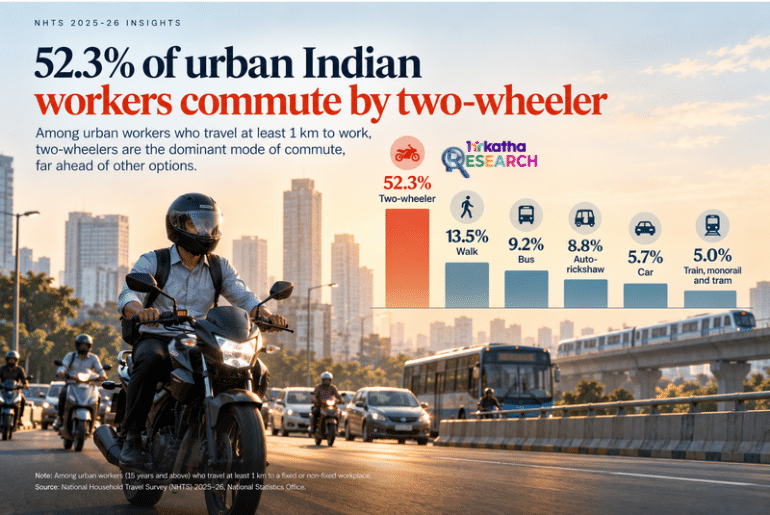
More than half of urban Indian workers who travel at least a kilometre to work get there primarily on a two-wheeler.
The figure is 52.3 per cent, according to the National Household Travel Survey (NHTS) 2025–26, the first all-India survey of its kind. Conducted by the National Statistics Office, it covers 492,023 households and more than 2 million people across 14,274 villages and 10,377 urban blocks. The survey counts trips of 1 km or more and identifies the mode used for the longest distance as the primary mode of travel.
The dominance of the two-wheeler becomes more striking when set against the alternatives. Among urban workers making such trips, buses account for 9.2 per cent, train, monorail and tram for 5 per cent, cars for 5.7 per cent and auto-rickshaws for 8.8 per cent. Another 13.5 per cent walk.
For HR, that is more than a transport statistic. It says something about where responsibility for getting to work currently sits. For a large share of urban India’s commuting workforce, the journey to work depends on an asset the employee must own or access, fuel the employee must buy and a daily journey the employee must organise.
The employment contract may begin at the office door. The economic cost of getting there begins much earlier.
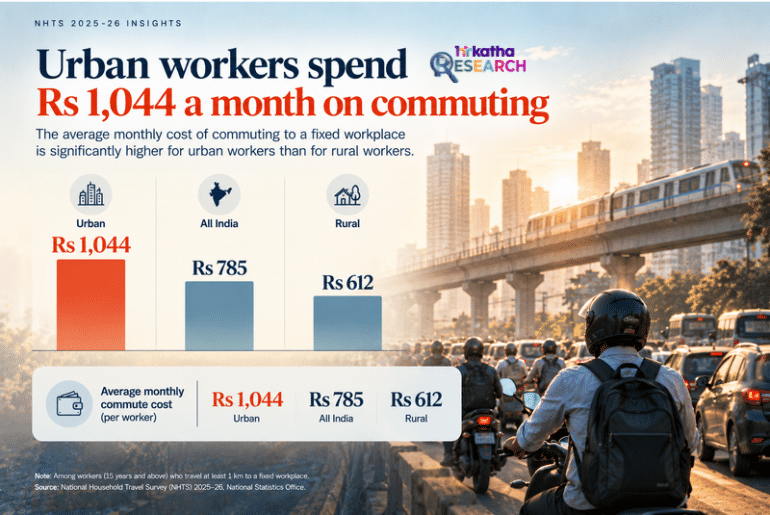
The Rs 1,044 cost that sits outside salary
The NHTS 2025–26 survey puts a number on part of that burden.
An urban worker travelling to a fixed workplace spends an average of Rs 1,044 a month on the commute. The corresponding figure in rural India is Rs 612. Across India, the average is Rs 785.
That Rs 1,044 is easy to dismiss in isolation. But compensation is experienced as disposable income, not merely as CTC. Two employees earning the same salary can derive different economic value from it if one can reach the office cheaply while the other must spend more simply to report for work.
That makes office location, in effect, part of the employee’s compensation equation even when it never appears on the payslip.
Employers already recognise this indirectly when they provide buses, cabs, fuel reimbursement or transport allowances. The survey suggests the underlying question is much broader. When an organisation chooses an office, it is also choosing some portion of the cost its employees will have to bear to reach it.
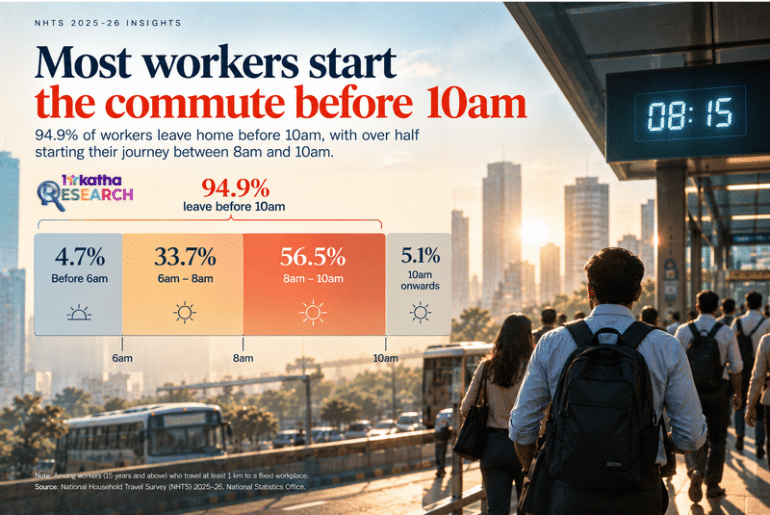
56.5 per cent leave for work in the same two-hour window
Cost is only one part of the commute. Time matters too.
Among workers travelling to fixed workplaces, 94.9 per cent leave home before 10am. More than half, 56.5 per cent, begin their commute between 8am and 10am, while another 33.7 per cent leave between 6am and 8am.
Urban workers also have longer journeys. While 86.1 per cent of rural workers travelling to a fixed workplace reach it within 30 minutes, the proportion falls to 79.3 per cent in urban India. Another 16.6 per cent of urban workers take between 30 and 60 minutes, compared with 11.8 per cent in rural areas.
The average journey remains relatively modest, at 27 minutes for urban workers travelling to fixed workplaces. But averages obscure where the organisational problem lies. A company deciding between two office locations is not merely comparing rent, floor space and proximity to clients. It is also determining how many employees must enter the same congested travel window, how long that journey is likely to be and which modes of transport are realistically available to them.
That turns commute accessibility from an employee inconvenience into a workforce-planning variable.
Rail-based commuting is concentrated in a few places
The national figure also conceals large geographical differences.
Train, monorail, tram and similar rail-based modes account for just 5 per cent of urban worker commutes nationally. But the share rises to 20.7 per cent in Maharashtra, 16.5 per cent in West Bengal and 14.4 per cent in Delhi.
That matters for organisations making location decisions because “urban India” is not one commuting market. The practical accessibility of an office can change considerably from one city or employment cluster to another.
A company moving an office to save on real estate may therefore be shifting part of that saving onto employees through a more expensive or difficult commute. Conversely, an office with stronger transport connectivity can potentially widen the geographical pool from which an employer can recruit without changing a rupee of compensation.
The lease cost is visible to finance. The commute cost is dispersed across hundreds or thousands of employees, which makes it easier to overlook.
The mobility gap between men and women is 14 points in cities
There is another number in the survey that should interest employers.
Among urban workers, 66.6 per cent of men and 52.9 per cent of women make work trips of at least 1 km, a gap of almost 14 percentage points. In rural India, 59.6 per cent of male workers make such trips compared with only 37.7 per cent of female workers, a gap of nearly 22 points.
The survey does not establish why the urban gender gap is smaller, so the difference cannot be attributed directly to better transport infrastructure. Nor does the figure measure labour-force participation itself. It measures travel among workers.
But it does expose something relevant to hiring: the propensity to travel more than a kilometre for work is not distributed equally across the workforce.
For an organisation trying to expand its female talent pool, office accessibility therefore deserves to sit alongside recruitment strategy, flexibility and workplace safety. A job can technically be available to everyone while the journey required to reach it makes the opportunity considerably easier for some workers to take up than others.
The commute is part of the job, even if HR does not count it
None of this means employers can solve India’s transport infrastructure problem. Nor does the NHTS 2025–26 survey tell companies where they should locate offices or whether they should provide transport.
What it does is put numbers around something workforce planning often treats as background noise.
52.3 per cent of urban workers making work trips of at least 1 km depend primarily on two-wheelers. Urban workers travelling to fixed workplaces spend Rs 1,044 a month on average getting there. One in six takes between 30 and 60 minutes to reach work. And the likelihood of travelling more than a kilometre for work differs materially between men and women.
These are employee realities created partly outside the organisation. But decisions made inside the organisation can amplify or reduce them.
HR already examines where talent lives, what it costs, how difficult it is to hire and whether employees are willing to come to the office. The travel data suggest another question belongs in that conversation: how difficult is the office to reach?
Because an office is not merely a place where employees work. It is also a place they have to get to.