


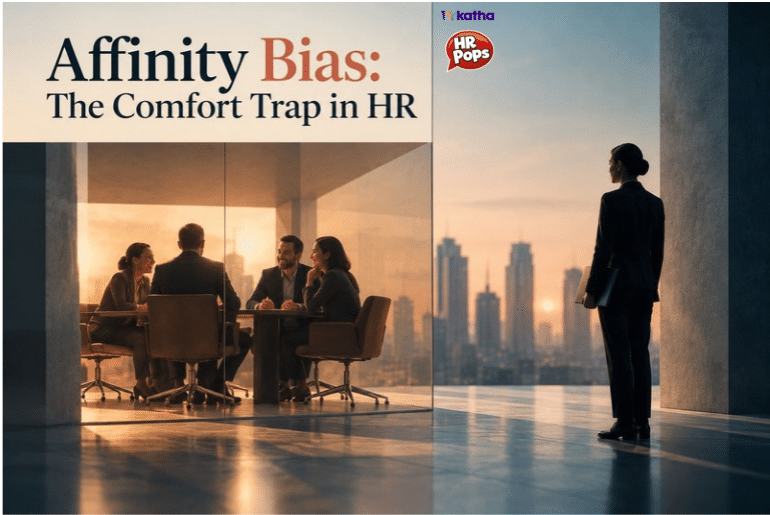
What does ‘affinity bias’ mean?
Affinity bias is the tendency to feel more positively towards people who seem familiar to us.
The similarity might be obvious: the same university, hometown, language or professional background. Or it may be subtler: a shared communication style, sense of humour, way of thinking or approach to work.
In ordinary conversation, this feels like chemistry but in an interview, it can become evidence.
A hiring manager meets a candidate and immediately feels that they will “fit”. A senior leader sees something of their younger self in a promising employee. A manager finds one team member particularly easy to work with because they approach problems in much the same way.
None of this necessarily feels like bias, and that is precisely the problem.
Affinity bias rarely announces itself as a preference for one kind of person over another. It arrives as comfort, rapport and instinctive confidence in someone who feels familiar.
When that feeling begins influencing who gets hired, trusted, developed or promoted, familiarity starts acquiring organisational value.
Where did the idea come from?
Affinity bias sits within a much older body of research into similarity and human relationships.
Sociologists use the term homophily to describe the tendency for connections to form more readily between people who share characteristics, backgrounds or beliefs. The idea is often summarised by the observation that “similarity breeds connection”.
Organisational research has found related patterns in workplaces. Similarity can influence attraction, relationships, networks and assessments between managers and employees. Over time, the language of unconscious or implicit bias brought greater attention to how these preferences could affect employment decisions without decision-makers deliberately intending to discriminate.
“Affinity bias” became a useful way of describing one particular version of the problem: we may favour someone not because we consciously believe other people are inferior, but because something about that person feels reassuringly familiar.
That distinction matters.
Some biases operate through discomfort with difference.
Affinity bias can operate through pleasure in similarity.
Why is it relevant for HR?
Because organisations distribute opportunity through thousands of decisions that contain an element of judgement.
Who gets shortlisted? Who is considered “high potential”? Who receives the difficult assignment that provides visibility? Who gets invited into an important meeting? Who receives more patient coaching after making a mistake? Who does a senior leader decide to sponsor?
Affinity can influence all of them.
One decision may make little difference. But organisational careers are cumulative. An employee who receives slightly more trust may receive a better assignment. That assignment creates greater visibility. Visibility strengthens the next performance discussion. A stronger rating improves promotion prospects. Promotion creates access to more influential networks.
A small preference can therefore compound into a substantial career advantage without any individual decision appearing obviously unfair.
That is what makes affinity bias particularly consequential for HR. The organisation may have perfectly neutral policies while opportunity continues to travel through relationships that are anything but neutral.
The effect becomes especially important in leadership pipelines. If leaders repeatedly identify potential in people who think, communicate and behave like them, succession systems can reproduce the characteristics of existing leadership while appearing entirely meritocratic.
Nobody needs to say, “We want more people like us.”
They simply keep choosing people who feel right.
The uncomfortable truth
Affinity bias borrows some of the most respectable language in management.
“Cultural fit” is the obvious example.
Organisations genuinely need people who can work within their values and operating environment. But the boundary between cultural fit and personal comfort is remarkably easy to blur. A candidate who communicates differently, challenges assumptions or lacks familiar credentials can feel like a risk even when those differences might be exactly what the organisation needs.
The same problem appears in sponsorship.
Formal mentoring programmes can be designed centrally. Informal advocacy cannot. Senior leaders often invest most heavily in employees they understand, trust and enjoy working with. If similarity makes those relationships easier to form, access to sponsorship can become uneven long before a formal promotion decision takes place.
Hybrid work introduces another variation. Proximity itself can create familiarity. Employees who are seen more frequently may become easier for managers to recall, involve and trust. What looks like a judgement about contribution can partly reflect repeated exposure.
The uncomfortable part is that none of this requires bad intentions.
Indeed, good intentions can make the bias harder to detect. A manager who sincerely believes they are an excellent judge of people may interpret immediate rapport as evidence of potential. An interviewer may describe an unfamiliar candidate as “not quite the right fit” without being able to identify anything deficient in their capability.
The danger begins when comfort masquerades as judgement.
What HR should do
Affinity bias cannot be eliminated by telling people to stop preferring familiarity.
The more useful response is to make consequential decisions less dependent on unstructured instinct.
Structured interviews help because candidates are assessed against predetermined criteria rather than whatever happens to impress an interviewer. Calibration can force managers to explain performance and potential judgements with evidence. Promotion and succession discussions become stronger when decision-makers are required to distinguish demonstrated capability from vague assessments such as “leadership presence” or “fit”.
Diverse decision-making groups can help too, although diversity on a panel does not automatically eliminate bias. The objective is to prevent one person’s comfort from becoming the organisation’s definition of merit.
It is important for HR to also look beyond formal decisions. Stretch assignments, introductions, informal sponsorship and access to senior leaders often determine who becomes promotion-ready long before the promotion process begins. An organisation can make its final selection process scrupulously fair while allowing opportunity to be distributed unevenly for years beforehand.
That means examining not only who gets promoted, but who gets the experiences that make promotion possible.
The goal is not to remove human judgement.
It is to stop familiarity from receiving more evidential weight than it deserves.
The takeaway
Affinity bias survives because it rarely feels unfair to the person exercising it.
It feels like chemistry. Trust. Cultural fit. A good instinct about someone.
And sometimes those instincts are right.
The problem begins when organisations cannot distinguish between recognising talent and recognising themselves in someone else.
Human resources cannot prevent people from feeling more comfortable with some colleagues than others.
Nor should it try.
Its responsibility is to ensure that comfort does not quietly become a currency through which careers are built.
Because the most persistent bias may not be the person we consciously exclude.
It may be the person we instinctively choose.