


Artificial Intelligence (AI) is supposed to make human skills more valuable. One number suggests the story may be more complicated.
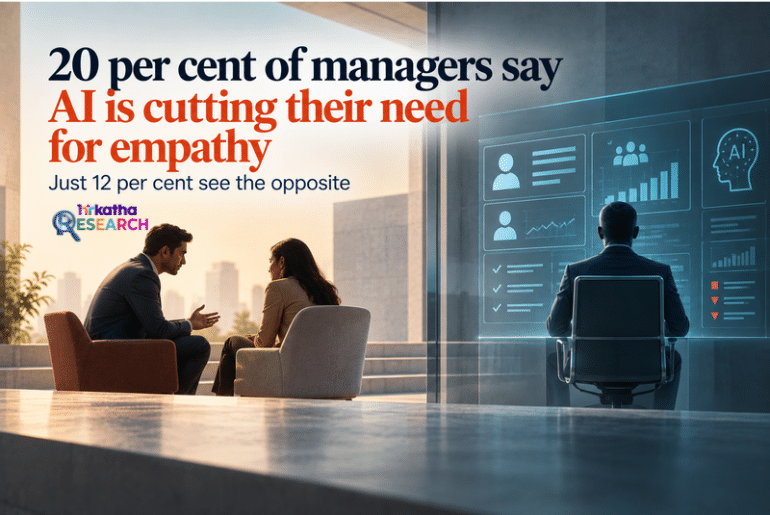
Among managers using algorithmic-management software in Germany, France, Italy and Spain, 20 per cent say the technology has reduced their need for empathy. Just 12 per cent say it has increased it, according to the OECD policy brief AI and Skills: What We Know So Far, published in June 2026.
The OECD is careful about what follows from this. It calls the finding a signal rather than evidence of a broad decline in social skills and says it is too early to draw firm conclusions.
That caution matters. But so does the number, because it runs against much of what the same brief finds elsewhere.
For most workers, AI is not reducing the importance of skills. It is changing which ones matter.
Less than 1% will need advanced AI skills
For all the anxiety around becoming “AI-ready”, fewer than one per cent of workers are expected to need advanced AI-specific skills, such as programming or developing AI models. For everyone else, the requirement is more prosaic and much broader: digital capability, the ability to use and interpret data, managerial skills and human capabilities such as problem-solving, creativity and innovation.
That distinction matters. The workforce AI is creating is unlikely to consist of a small technical elite surrounded by people displaced by machines. A much larger group will use AI without building it, which means their value increasingly lies in knowing what to ask of the technology, how to interpret what comes back and when not to trust it.
The evidence from employers points in the same direction. More than half of employers in manufacturing and finance that have adopted AI say it has increased their need for highly educated workers. Employment has also grown fastest in occupations highly exposed to AI where the technology tends to complement workers rather than replace them.
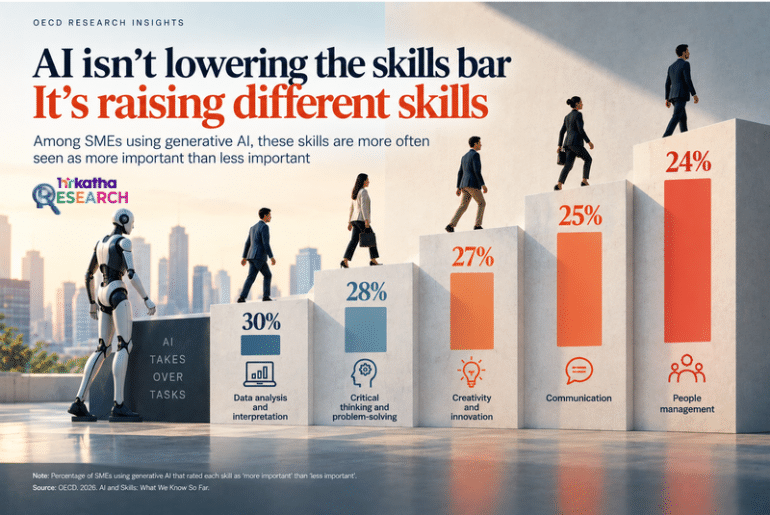
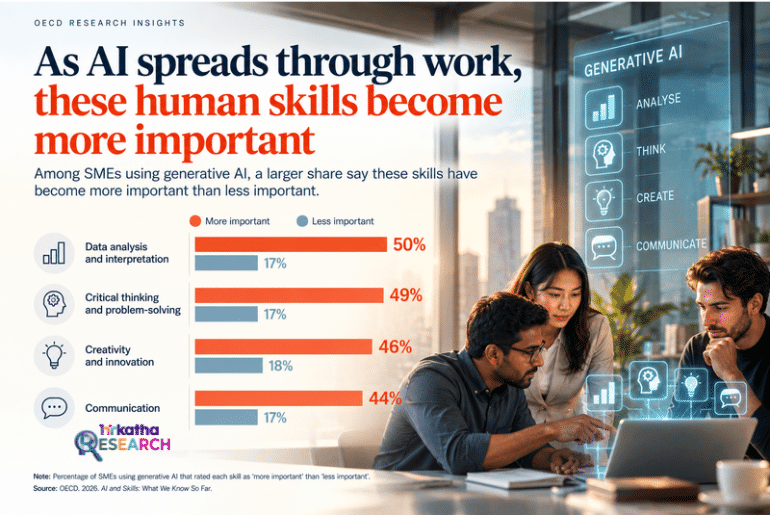
The pattern extends beyond formal qualifications. Among SMEs surveyed about generative AI, data analysis and interpretation, critical thinking and problem-solving, creativity and communication were all more likely to be judged more important than less important as AI spread through work. The technology may be taking over tasks, but on this evidence it is not making the remaining work intellectually cheaper.
Artificial intelligence may be taking over tasks. On this evidence, it is not making the remaining work intellectually cheaper.
Then comes the empathy anomaly
That is what makes the 20 versus 12 finding interesting.
Algorithmic-management systems can allocate work, monitor performance and provide managers with information about what employees are doing. Some of the sensing that once depended on a manager observing people directly can therefore arrive through software.
The OECD data suggest this could affect the human side of management unevenly. Its survey of managers using algorithmic-management software measures perceived changes in the need for active listening, conflict resolution, empathy and communication. For empathy, more managers in the four European countries covered report a decrease than an increase.
There are two possible readings. Technology could remove administrative monitoring and leave managers with more time for judgement, coaching and development. Or it could begin substituting for some of the interpersonal work through which managers previously understood their teams.
The evidence does not yet establish which direction will dominate. Indeed, the OECD explicitly calls for monitoring what AI does not merely to productivity and skills, but to job quality, social interaction and worker well-being.
That is a narrower conclusion than “AI is destroying empathy”. It is also a more consequential one. If managers increasingly understand employees through dashboards, the question is not whether the software itself possesses empathy. It is whether the organisation still requires managers to exercise it.
Nearly 40% say AI is already filling a skills gap
Artificial intelligence is doing something else at the same time: compensating for capabilities organisations cannot find.
Nearly two in five SMEs report having faced a worker shortage during the previous two years, while about one in three report lacking skills or experience among existing staff. Among SMEs that experienced a skills gap, nearly 40 per cent say generative AI helped compensate for it. A quarter say it helped compensate for a worker shortage.
The country differences are striking. Among SMEs using generative AI that had experienced a skills gap, 63.3 per cent in Japan say the technology helped compensate for it. In Ireland, the corresponding figure is 28.5 per cent. For worker shortages, the figures are 32.6 per cent and 16.5 per cent respectively.
The OECD data does not establish why those differences are so large. What it does show is that access to the same class of technology does not produce the same organisational result.
AI can apparently compensate for missing skills. Whether a company has the capability to make AI do so is another matter.
More than half of AI users are being trained
This is where training enters the picture.
More than half of workers using AI report receiving employer-funded training. More importantly, the workers who receive it consistently report better outcomes from AI than those who do not.
The difference extends well beyond productivity. Figure 6 of the brief compares trained and untrained AI users in finance and manufacturing across five measures: performance, enjoyment of work, mental health, physical health and safety, and fairness in management. On every measure in both sectors, trained workers are more likely to say AI improved the outcome.
That makes training more than an implementation issue. It changes how employees experience the technology.
The irony is that the organisations that could benefit most from that capability are often those struggling most to acquire it.
40% say skills are stopping AI adoption
Among manufacturing and finance employers that have not adopted AI, around 40 per cent identify a lack of skills as a barrier. Among SMEs not using generative AI, more than half cite skills as an obstacle.
That creates an awkward loop. Firms need skills to adopt AI. AI can then help compensate for skills they do not have. But organisations without sufficient skills may struggle to reach the point at which the technology begins closing those gaps.
The divide around AI could therefore become less about who has access to the technology than about who possesses the organisational capability to use it.
And that returns the argument to empathy.
The OECD evidence does not show that AI is making human skills obsolete. For the most part, it suggests the opposite. Higher-level skills remain valuable, employers are asking for more educated workers, and capabilities such as critical thinking, creativity, communication and data interpretation are becoming more important.
Empathy is the anomaly. For now, it is 20 per cent against 12 per cent among a particular group of managers in four European countries, not a verdict on the future of management.
But it raises a useful question for organisations racing to automate the managerial layer.
When technology becomes better at telling a manager what is happening, does the manager become better at understanding why, or does the organisation gradually stop asking them to?
Whether that stays a signal or becomes a pattern is what the OECD says it cannot yet tell.