


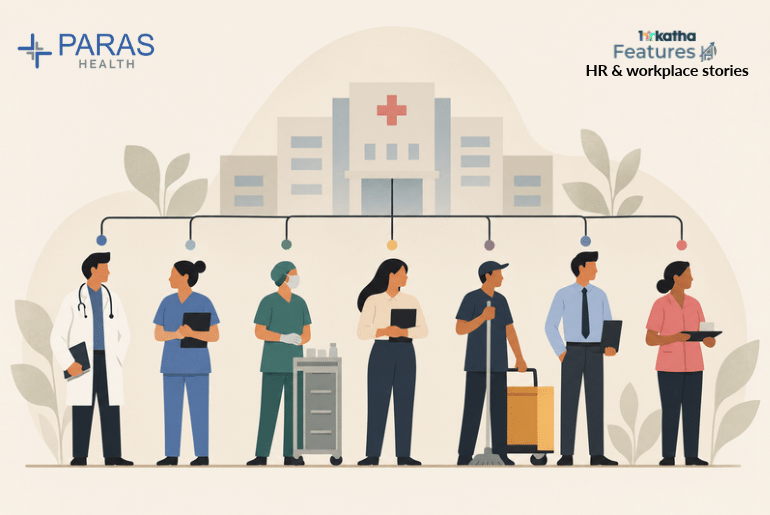
A hospital has one organisation chart. It does not have one workforce.
At Paras Health, which operates eight hospitals and employs more than 2,800 people, the gap between those two things is where the HR challenge begins. Doctors, nurses, technicians, patient-facing teams, corporate employees and contracted workers operate in different environments, carry different responsibilities and arrive with different expectations.
A common HR architecture may be necessary across them. A common employee experience is considerably harder to define.
Balkishan Sharma, chief human resources officer, began not with a new programme but with what he describes as a reset of the basics.
“I always believe in back to basics. When you don’t go to your basics and start from zero, you will not be able to understand the real challenges of the organisation,” he says.
That has led to a restructuring of the HR architecture, including a revised band structure and, from April this year, a move to an AI-based HRMS platform.
The technology provides a common backbone. The more complicated work lies in deciding what should be standardised across the organisation and what needs to change depending on whether the employee is a doctor, nurse, technician, manager or contracted worker.
The first 90 days as a retention lever
One of the first areas Paras Health has concentrated on is early attrition.
Nursing and other operational roles can see employees leave within the first few months, making the period immediately after joining particularly important.
NEEV, Paras Health’s 90-day onboarding programme, begins with pre-boarding and continues through structured interactions during the first three months. Functional champions are assigned to new employees so that onboarding does not remain solely an HR activity.
Doctors receive a different form of induction.
Know Your Doctor/Pulse Start is designed as a two-way interaction in which new and senior clinicians have an opportunity to demonstrate and discuss their expertise rather than simply receive information about the organisation.
The distinction reflects the wider workforce problem. A clinician who has spent years developing specialist expertise does not necessarily need the same onboarding experience as a nurse, technician or corporate employee.
Sharma says early attrition, measured within the first three months, has fallen from around 30 per cent to 15 per cent.
It is still an early measure, but the decline gives Paras Health an indication that the first 90 days may be an important intervention point in its broader attrition problem.
Recognition that travels across the hospital
Workforce diversity also affects something as apparently straightforward as recognition.
Paras Ratna, the organisation’s recognition programme, is organised around four pillars: collaboration, patient delight, excellence and innovation.
Employees can appreciate colleagues through their mobile phones in real time. The “I Appreciate You” mechanism and “Thank You” card allow recognition to travel across hierarchical levels rather than coming only from managers.
Each appreciation carries points with monetary value attached. Employees progress through levels from Emerging at 1,000 points to Legend at 5,000, with the highest tier involving recognition by the managing director alongside the employee’s family.
Patient feedback can feed into the system too. If a patient specifically names a nurse or technician for good care, that acknowledgement translates into points.
“That era is gone: Best Employee of the Month and Star Employee of the Month,” Sharma says.
The programme generated more than 1,000 appreciation exchanges in its first month.
Sharma says nurses, technicians and doctors are among those participating.
“When we take an initiative and if it is not going to last mile, I think the effectiveness will not be there,” he says.
That last-mile participation is particularly relevant in a hospital. Many of the employees who shape a patient’s experience sit outside corporate functions and senior management. A recognition system concentrated primarily among office employees would therefore capture only a narrow part of the organisation.
Measuring learning beyond attendance
Paras Health is taking a similar approach to learning.
Its learning management system, previously manual, has been digitised and has reached around 80 per cent adoption. Training attendance is captured through QR codes, giving HR visibility into participation across locations.
Sharma sees that as the starting point rather than the outcome.
“First is participation. Start from basics. First, you have to look at the coverage, then you have
to look at the effectiveness.”
The Paras Manager Excellence Programme, a one-day intervention for managers and supervisors across bands, has been delivered in Kanpur and Patna, with more units planned.
Paras Health intends to go beyond attendance and participant feedback by asking line managers whether they can see changes in behaviour after employees complete the programme.
That distinction matters because digitising learning makes participation easier to measure. Effectiveness remains harder.
The first tells the organisation whether somebody attended. The second asks whether anything changed afterwards.
The supervisors closest to the floor
The next capability intervention focuses on nursing team leaders and technical supervisors.
These employees occupy an important position in a hospital. They make rosters, handle daily conflicts, manage teams and help ensure that patient-care areas remain staffed.
“When you are into healthcare, you have to think: whenever you take any initiative, you have to connect with patient experience. Then only it works,” Sharma says.
That connection provides a common thread through several otherwise different HR interventions.
Onboarding affects how quickly employees settle into their roles. Manager capability affects the teams delivering care. Staffing affects whether hospital operations can run as intended.
Recognition can incorporate feedback directly from patients.
Contracted employees create another layer.
They may not sit on Paras Health’s payroll, but they interact with patients inside its hospitals. The organisation therefore includes them in induction and shift-level briefings, with expectations around behaviour and service standards.
From the patient’s perspective, the distinction between a directly employed worker and someone employed by a contractor may not be particularly visible. That makes some degree of common behavioural standard necessary even when the employment relationships are different.
Building the pipeline
Paras Health is also developing an internal leadership programme using psychometric testing, line-manager feedback, 360-degree assessments and a nine-box framework combining performance and potential.
Employees identified through the process will move into learning journeys and capstone projects.
Sharma points to examples of internal mobility already taking place. The organisation’s CIO has moved into a group COO role. A regional operations director who joined as head of a 30-bed hospital now has responsibility for two Gurgaon units and Srinagar.
The leadership pipeline becomes particularly relevant as the hospital network expands.
New hospitals need people who can run operations and understand the organisation. Developing some of that capability internally reduces the extent to which every expansion depends on finding experienced leaders externally.
It also gives Paras Health another way of assessing whether its talent architecture is working: not simply by identifying potential, but by seeing whether people identified internally are eventually able to take on larger roles.
The attrition number
The broader context for much of this work is attrition.
Sharma says attrition was around 68 per cent during the period associated with Paras
Health’s DRHP filing and has since fallen to around 45 per cent. The target is to bring it below 40 per cent by the end of the year. He places the broader healthcare benchmark at around 38 to 40 per cent.
The numbers put the scale of the challenge into perspective.
A decline from 68 to 45 per cent is substantial, but 45 per cent still means considerable workforce movement. It also explains why onboarding, recognition, manager capability and internal career development are being addressed together rather than as separate HR priorities.
Not all attrition, of course, can be addressed through HR programmes. Working conditions, staffing levels, local labour markets, managers and career opportunities all form part of the experience that determines whether people stay.
That is particularly relevant for Paras Health because those conditions can differ not only from one hospital to another, but also between workforce groups inside the same hospital.
Sharma’s response has involved physical presence alongside the new data infrastructure. He says he visits at least one hospital every week and, over seven months, has visited each hospital more than six times.
There is an interesting contrast in the two approaches.
The HRMS is intended to give Paras Health a common view of its workforce across eight hospitals. The hospital visits give Sharma a closer view of the differences that a common system may not fully capture.
That may ultimately be the tension Paras Health has to manage.
Doctors, nurses, technicians, contracted workers and corporate employees can sit within the same HR architecture. They can be measured through common systems and connected to common organisational standards.
But building one HR system does not make them one workforce. The challenge is knowing where consistency helps, and where the differences still matter.