

Close Menu
    Facebook X (Twitter) Instagram
    • Our Story
    • Partner with us
    • Reach Us
    • Career
    Subscribe Newsletter
    HR KathaHR Katha
    • Exclusive
      • Exclusive Features
      • Perspectives
      • Friday Features
      • herSTORY
      • Rising Stars
      • Case-In-Point
      • Point Of View
      • Research
      • HR Pops
      • Dialogue
      • Movement
      • Profile
      • Beyond Work
      • By Invitation
    • Brief News
      • Global HR News
      • Compensation & Benefits
      • Diversity
      • Events
      • Gen Y
      • Hiring & Firing
      • HR & Labour Laws
      • Learning & Development
      • Merger & Acquisition
      • Performance Management & Productivity
      • Talent Management
      • Tools & Technology
      • Work-Life Balance
    • Special
      • Editorial
      • HR Forecast 2026
      • Cover Story
      • HR Forecast 2024
      • HR Forecast 2023
      • HR Forecast 2022
      • HR Forecast 2021
      • HR Forecast 2020
      • HR Forecast 2019
      • New Age Learning
      • Coaching and Training
      • Learn-Engage-Transform
    • Studio
      • The CHRO Playbook
      • Quick HR Insights
      • The Corner Office
    • Reports
      • Whitepaper
        • HR Forecast 2024 e-mag
        • Future-proofing Manufacturing Through Digital Transformation
        • Employee Healthcare & Wellness Benefits: A Guide for Indian MSMEs
        • Build a Future Ready Organisation For The Road Ahead
        • Employee Experience Strategy
        • HRKatha 2019 Forecast
        • Decoding and Driving Employee Engagement
        • One Platform, Infinite Possibilities
      • Survey Reports
        • Happiness at Work
        • Upskilling for Jobs of the Future
        • The Labour Code 2020
    • Forums
      • HRKatha Inner Circle
      • HRKatha Futurecast
      • Leadership Summit 2025
      • Rising Star Leadership Awards
      • HRKatha Futurecast 2025
      • Automation.NXT
      • The Great HR Debate
    WhatsApp LinkedIn X (Twitter) Facebook Instagram
    HR KathaHR Katha
    Home»Exclusive Features»HR Pops»Hybrid creep: When flexibility becomes permanent availability
    HR Pops

    Hybrid creep: When flexibility becomes permanent availability

    Hybrid work promised employees greater control over their time. In some workplaces, it has quietly given employers greater access to it.
    mmBy Liji Narayan | HRKathaNovember 24, 2026Updated:November 24, 20264 Mins Read132 Views
    Share LinkedIn Twitter Facebook WhatsApp
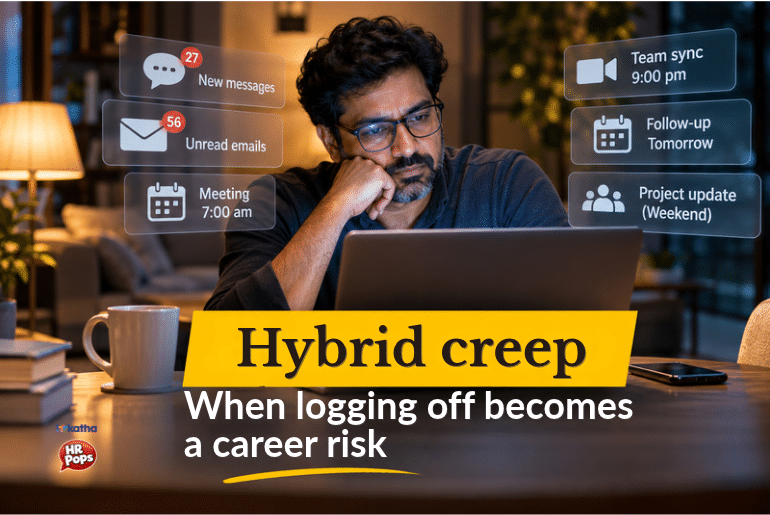
    Hybrid Creep (HR Pops)
    Share
    LinkedIn Twitter Facebook WhatsApp

    What does ‘hybrid creep’ mean?

    The word ‘creep’ is deliberate. It describes neither a dramatic shift nor a formal policy change, but a gradual expansion that is barely noticeable while it is happening.

    A meeting scheduled beyond working hours becomes a recurring appointment. An occasional late-night response becomes an expectation. A quick weekend check-in becomes part of the working routine.

    Nobody formally extends the working day, yet it grows longer.

    Hybrid creep describes the gradual expansion of work demands into personal time within hybrid working arrangements. It manifests through additional meetings, extended availability, faster response expectations and the erosion of boundaries between professional and personal life.

    It is not necessarily a consequence of hybrid work failing. It can emerge when hybrid work becomes sufficiently embedded that organisations stop questioning where its boundaries lie.

    Where did the idea come from?

    The concept did not emerge from academic research. It was named by workplace observers watching what happened after the pandemic emergency ended and hybrid arrangements became permanent.

    Between 2021 and 2023, a pattern became consistent enough to describe. Employees were responding to messages after hours because they had done it once and nobody said to stop.
    Managers were scheduling additional check-ins because they could no longer see their teams and needed reassurance. Meeting loads increased not because more decisions required meetings, but because meetings had become a substitute for the physical visibility that offices had previously provided for free.

    The analogy that stuck was scope creep: the tendency of project requirements to expand without anyone formally authorising the expansion. Hybrid creep works the same way. Each individual extension of work into personal time seems manageable. No single meeting is unreasonable. No single late reply becomes a policy. But the accumulation is real, and by the time it is visible, it has already become normal.

    Why is it relevant for HR?

    What makes hybrid creep particularly difficult to identify is that it often operates under the language of flexibility.

    An employee responding to messages at 9 pm appears to be exercising autonomy. Joining an early-morning call with a global team looks like collaboration. A calendar filled with check-ins can be interpreted as engagement.

    Yet the distinction between choosing to work at a particular hour and feeling obliged to remain available at that hour is considerable.

    The underlying question is one of power. Who determines when flexibility begins and ends? If employees can choose where they work but cannot comfortably decide when to disconnect, their autonomy is limited.

    For HR, this matters because exhaustion is not simply a function of the number of hours worked. The persistent anticipation of another message, meeting or request can interfere with psychological recovery even when employees are not actively working.

    There is an equity dimension too. Employees with caregiving responsibilities, health conditions or other commitments may have less capacity to accommodate unpredictable demands outside working hours.

    What appears to be flexibility for one employee can become a professional disadvantage for another.

    The uncomfortable truth

    Hybrid creep is not primarily a problem of technology. Technology makes extended availability possible; organisational culture can make it desirable.

    Consider what happens when employees who respond to emails at midnight, remain permanently visible on collaboration platforms and accommodate meetings at inconvenient hours are also the ones recognised as particularly committed.

    Their colleagues learn something about the organisation that no formal policy needs to explain.

    The company may say it rewards outcomes. Its promotion decisions may suggest that it rewards availability.

    HR can introduce policies encouraging employees to disconnect, launch wellbeing programmes and train managers in trust-based leadership. But unless the criteria for recognition and advancement reflect those principles, the interventions are unlikely to address the underlying problem.

    Employees interpret organisational culture through consequences. They notice who gets promoted, whose contribution is celebrated and which behaviours earn managerial approval.

    If maintaining personal boundaries carries a perceived career penalty, extended availability becomes a rational response rather than an individual failure to manage time.

    The organisation has effectively made overwork an informal condition of advancement without ever writing it into policy.

    The takeaway

    Hybrid creep exposes a contradiction at the heart of flexible working. An arrangement intended to give employees greater control over their working lives can also give organisations greater access to their personal time.

    For HR, the test is not whether the company has a flexible-working policy or encourages employees to disconnect. It is whether an employee who delivers consistently, maintains reasonable boundaries and remains unavailable outside agreed working hours has the same opportunity to advance as someone who is constantly accessible.

    Until that question is answered, flexibility remains an ambiguous benefit.

    When availability becomes the price of advancement, flexibility is no longer entirely a choice.

    employee autonomy Employee Burnout employee wellbeing flexible working HR Pops Hybrid creep hybrid working Organisational Culture Performance Management Right to Disconnect Workplace Culture workplace equity Work–life balance
    Share. LinkedIn Twitter Facebook WhatsApp
    mm
    Liji Narayan | HRKatha

    HRKatha prides itself in being a good journalistic product and Liji deserves all the credit for it. Thanks to her, our readers get clean copies to read every morning while our writers are kept on their toes.

    Leave A Reply Cancel Reply

    Related Posts

    Nvidia employees celebrate CEO’s return

    November 24, 2026

    Can Nvidia remain Nvidia without Jensen Huang?

    November 22, 2026

    Rising Star: Mugdha Mahambrey on why HR leaders should be capable of running businesses

    November 20, 2026

    Howden puts employee ownership and flexible healthcare benefits at the heart of its people strategy

    November 19, 2026
    zoha
    Editorial

    Can Nvidia remain Nvidia without Jensen Huang?

    Jensen Huang co-founded Nvidia in 1993. For thirty-three years, he was its chief executive and,…

    Companies owe their people more than what is legal

    When Canva announced a restructuring affecting 1,271 employees, or 22 per cent of its workforce,…

    EDITOR'S PICKS

    Hybrid creep: When flexibility becomes permanent availability

    November 24, 2026

    Reliance Retail wants to solve attrition before employees join

    November 24, 2026

    POV: Is AI making work better, or simply raising productivity expectations?

    November 23, 2026

    Can Nvidia remain Nvidia without Jensen Huang?

    November 22, 2026
    Latest Post

    Hybrid creep: When flexibility becomes permanent availability

    HR Pops November 24, 2026

    What does ‘hybrid creep’ mean? The word ‘creep’ is deliberate. It describes neither a dramatic…

    Nvidia employees celebrate CEO’s return

    Global HR News November 24, 2026

    Nvidia employees welcomed CEO Jensen Huang back with loud cheers and chants after the company…

    Reliance Retail wants to solve attrition before employees join

    Exclusive Features November 24, 2026

    Retail is often a person’s first experience of employment. For many, it can also be…

    Mahyco picks Ashutosh Sharma to play group CHRO

    Movement November 24, 2026

    After serving as chief human resources officer at  Reliance Industries for over five years, Ashutosh…

    Asia's No.1 HR Platform

    Facebook X (Twitter) Instagram LinkedIn WhatsApp Bluesky
    • Our Story
    • Partner with us
    • Career
    • Reach Us
    • Exclusive Features
    • Cover Story
    • Editorial
    • Dive into the Future of Work: Download HRForecast 2024 Now!
    © 2026 HRKatha.com
    • Disclaimer
    • Refunds & Cancellation Policy
    • Terms of Service

    Type above and press Enter to search. Press Esc to cancel.