


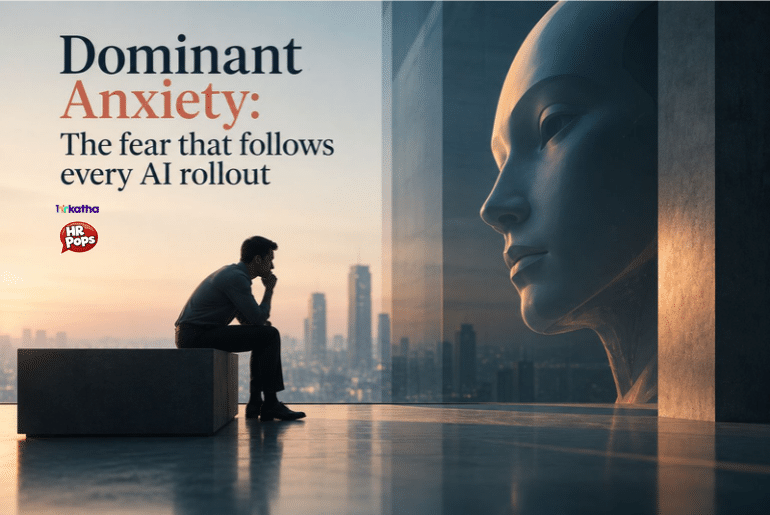
What does ‘dominant anxiety’ mean?
Every major workplace transformation produces several reactions at once: curiosity, excitement, scepticism, resistance and fear. Sometimes one becomes powerful enough to colour all the others.
That is useful shorthand for dominant anxiety: the concern that becomes so prominent that it begins shaping how people interpret everything happening around a change.
With AI, that anxiety rarely concerns the technology alone.
Employees may worry about whether their jobs will survive, whether the skills they spent years acquiring will remain valuable, whether algorithms will judge their performance, whether decisions will become less transparent, or whether productivity gains will eventually translate into fewer people.
Underneath these concerns sits a more personal question:
Will I still matter?
That question helps explain why another demonstration of what AI can do does not necessarily make employees more enthusiastic about using it. The better the technology becomes, the more impressive demonstration can sometimes intensify the very anxiety it was supposed to reduce.
Where did the idea come from?
“Dominant anxiety” is better understood as a descriptive idea than as a management concept with a single recognised origin.
Psychology and sociology have long examined how periods of technological, economic and social disruption generate collective anxieties. Different eras have attached those anxieties to different threats: mechanisation, unemployment, globalisation, outsourcing and automation among them.
Workplace technology has repeatedly produced its own version.
Industrial automation raised questions about the future of manual labour. Offshoring and outsourcing created insecurity around where work would be performed and who would perform it. Digitalisation transformed occupations that had previously appeared relatively secure.
AI continues that history, but with an important difference.
Many earlier technologies were understood primarily as replacing physical or routine work. Generative and analytical AI operate increasingly in territory employees associate with expertise itself: writing, coding, analysis, design, judgement and problem-solving.
The anxiety is therefore not merely, “Will technology take my job?”
For many employees it is closer to, “If technology can do what made me valuable, what makes me valuable now?”
Why is it relevant for HR?
That distinction matters because job insecurity is only one form of AI anxiety.
A copywriter watching AI produce usable copy in seconds may begin questioning the value of a craft built over years. An analyst confronted with increasingly sophisticated AI-generated analysis may wonder which part of their expertise remains distinctive. A recruiter using algorithmic screening may worry about being accountable for decisions partly shaped by a system they cannot fully interrogate.
These anxieties concern different things: employment, identity, expertise, control, fairness and accountability.
Treating all of them as generic “resistance to change” prevents HR from understanding what employees are actually resisting.
Anxiety also changes behaviour.
Employees uncertain about how AI will affect their jobs may avoid experimenting with tools that could help them. Others may rush to demonstrate AI proficiency because they believe being seen as an early adopter offers protection. Employees who believe digital systems are monitoring performance may begin optimising what the system can measure rather than what the organisation actually needs.
The important point is that anxiety is not merely an employee sentiment to be measured.
It can become an organisational force.
The uncomfortable reality
Organisations frequently respond to AI anxiety as though it were an information deficit.
Employees are worried because they do not understand the technology. Explain it better, provide training, hold a town hall, demonstrate the benefits and resistance should decline.
Sometimes it does.
But information cannot resolve uncertainty that is real.
AI will change some jobs substantially. Certain tasks will disappear. Skills that once commanded a premium may become easier to replicate. Organisations may use productivity gains to redesign teams or reduce hiring. Algorithmic systems can make mistakes and reproduce biases. Monitoring technologies can create legitimate questions about privacy and surveillance.
Employees do not need to misunderstand AI to worry about these things.
That creates a credibility problem for HR. Reassurance becomes ineffective when employees suspect the organisation knows no more about the eventual consequences than they do.
It becomes still less credible when people remember previous transformations in which efficiency, empowerment or digitalisation were followed by restructuring and job losses.
The problem, then, is not simply whether employees trust AI.
It is whether they trust the organisation deploying it.
What HR should do
The first mistake is assuming that success means reducing anxiety.
Anxiety can contain useful information. Fear about job security may reveal that employees do not understand how roles will change. Concern about algorithmic decisions may expose weak governance. Resistance to monitoring may reveal legitimate questions about privacy. Anxiety about declining expertise may identify professions in which career paths need to be redesigned.
The useful question is therefore not, “How do we reassure employees?”
It is, “What is this anxiety telling us?”
That requires specificity. HR needs to distinguish fears that arise from misinformation from those rooted in genuine uncertainty or organisational choices. The first may require explanation. The second requires answers, safeguards or sometimes an admission that the organisation does not yet know.
Transparency matters particularly when AI influences decisions about people. Employees should understand where AI is being used, what information it relies upon, where human judgement enters the process and who remains accountable when something goes wrong.
Most importantly, organisations need to demonstrate rather than merely declare responsible use. Governance, audits, appeal mechanisms and visible corrections when systems fail provide evidence that reassurance cannot.
Trust grows when employees can see what happens after the technology gets something wrong.
The takeaway
AI anxiety is inconvenient because organisations want employees to experiment just as employees are trying to understand what that experimentation could eventually mean for them.
HR cannot eliminate that contradiction with better communication.
Nor should it try.
Anxiety can reveal where employees believe their value is threatened, where organisational intentions are unclear and where trust has not kept pace with technological ambition. Suppressing those concerns removes information HR should be listening to.
The organisations that navigate AI well will not necessarily be those whose employees worry least.
They may be the ones that pay closest attention to what employees are worried about.
Because the most useful question after an AI rollout may not be, “How do we make people less anxious?”
It may be, “What are they seeing that we need to understand?”