


Close Menu
    Facebook X (Twitter) Instagram
    • Our Story
    • Partner with us
    • Reach Us
    • Career
    Subscribe Newsletter
    HR KathaHR Katha
    • Exclusive
      • Exclusive Features
      • herSTORY
      • Perspectives
      • Point Of View
      • Case-In-Point
      • Research
      • Dialogue
      • Movement
      • Profile
      • Beyond Work
      • Rising Star
      • By Invitation
    • News
      • Global HR News
      • Compensation & Benefits
      • Diversity
      • Events
      • Gen Y
      • Hiring & Firing
      • HR & Labour Laws
      • Learning & Development
      • Merger & Acquisition
      • Performance Management & Productivity
      • Talent Management
      • Tools & Technology
      • Work-Life Balance
    • Special
      • Cover Story
      • Editorial
      • HR Forecast 2024
      • HR Forecast 2023
      • HR Forecast 2022
      • HR Forecast 2021
      • HR Forecast 2020
      • HR Forecast 2019
      • New Age Learning
      • Coaching and Training
      • Learn-Engage-Transform
    • Magazine
    • Reports
      • Whitepaper
        • HR Forecast 2024 e-mag
        • Future-proofing Manufacturing Through Digital Transformation
        • Employee Healthcare & Wellness Benefits: A Guide for Indian MSMEs
        • Build a Future Ready Organisation For The Road Ahead
        • Employee Experience Strategy
        • HRKatha 2019 Forecast
        • Decoding and Driving Employee Engagement
        • One Platform, Infinite Possibilities
      • Survey Reports
        • Happiness at Work
        • Upskilling for Jobs of the Future
        • The Labour Code 2020
    • Conferences
      • Leadership Summit 2025
      • Rising Star Leadership Awards
      • HRKatha Futurecast
      • Automation.NXT
      • The Great HR Debate
    • HR Jobs
    WhatsApp LinkedIn X (Twitter) Facebook Instagram
    HR KathaHR Katha
    Home»News»Recovery for India’s ‘labour force participation’ to remain slow in the next two years: ILO
    News

    Recovery for India’s ‘labour force participation’ to remain slow in the next two years: ILO

    mmBy Akshit Pushkarna | HRKathaJanuary 19, 20225 Mins Read17100 Views
    Share LinkedIn Twitter Facebook
    Share
    LinkedIn Twitter Facebook

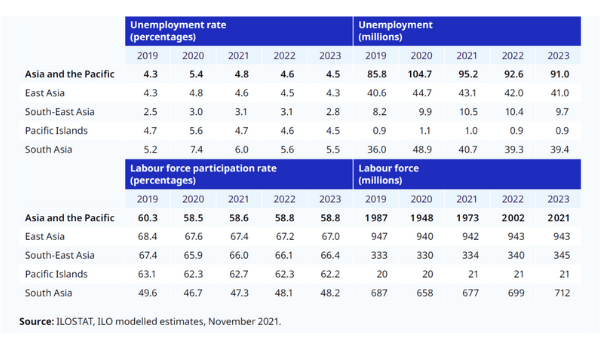
    In the ‘World Employment and Social Outlook: Trends 2022’ report, the International Labour Organisation’s (ILO) comprehensive research team predicts that the labour market, which saw a significant dip in the initial phase of the pandemic, that is 2020, will continue on a recovery path, albeit gradually. Speaking about India and the Asia-Pacific region in particular, the recovery of Labour Force Participation is expected to pick up slowly and remain below pre-pandemic levels in 2022 and 2023.

    Pre-COVID-19, India’s labour force participation rate (LFPR) stood at 49.3 per cent. It declined to 46.3 per cent in 2020. In fact, LFPRs are expected to remain below their pre-crisis levels through 2023 in all subregions of South Asia.

    The labour force participation rate is a measure by which an economy determines the proportion of its working population which is actively working or looking for work. The proportion is derived from the total working population -16 to 64 age group – of an economy. Students, housewives and people above the age of 64 are not part of the labour force.

    However, the report observes that the total number of unemployed would decline in the coming two years. The number will still be much higher than in 2019. The number of unemployed in the workforce, globally, according to ILO, will hover around 203 million, much higher than 2019’s 186 million. The recovery in employment is expected to be sharp for higher-income countries. It estimates that half of the increase in employment is likely to be concentrated in countries with higher incomes between the years 2021-23. As for lower-middle-income countries, India being one, the estimates do not show high growth employment wise.
    “The lower-middle-income countries such as India, Philippines and Bangladesh, have seen the largest drop in the employment rate and in the LFPR. They are also seeing the slowest recovery,” the report says.

    Employment-to-population ratio in South Asia in the 2019-2023 period dropped from 47 to 45.5 per cent, as per the ILO report. The unemployment rate in the region remained stable at six per cent, but the Indian average unemployment rate has been higher in 2021.

    Independent economic think tank, the Centre for Monitoring Indian Economy (CMIE), recorded that the unemployment rate increased significantly as of the last quarter of the 2021. The urban unemployment rate rose from 8.21 per cent in November 2021 to 9.3 per cent in December 2021, while the rural unemployment rate rose from 6.44 per cent to 7.28 per cent.

    Sectors most heavily hit

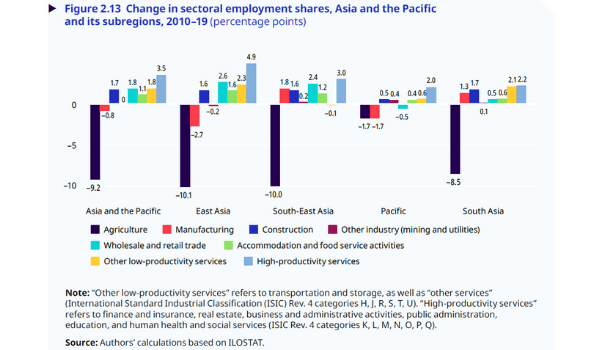
    The most heavily-hit sectors in India in terms of employment are hospitality, manufacturing, and wholesale and retail trade. The report pointed out that the major reasons behind the labour drop in manufacturing are supply-chain disruptions, shifts in market demand, and pandemic-induced changes in labour supply. It also said that the region had the largest decline in manufacturing employment as a proportion of total employment due to the pandemic.

    For retail and tourism, a large share of the workforce in the area comprises women, youth and informal workers. Due to the adverse impact on the employment in these sectors, the overall representation of women, youth and informal workers in the workforce has fallen.
    The report observes that although most of the employment in these sectors involves interpersonal interaction, they face lower risks from automation than do occupations in other sectors – at least in the immediate future. However, occupational tasks that cannot be undertaken remotely and require human contact continue to remain vulnerable to public health emergencies such as the pandemic. At the global level, the demand, and hence employment in these sectors will still take time to reach pre-pandemic levels. “Given the need arising from the pandemic to harmonise travel measures and logistics, including health and safety protocols, the recovery of international tourist flows to pre-pandemic levels is not expected before 2024,” the report says.

    ‘Informal’ workers

    The UN body’s report said that the most affected sector of the workforce during the past two years has been the informal workforce. A large chunk of the sector had to retract to financially depend on government measures. In the South Asia region, the dent made by new variants of the virus along with generally slow vaccine rollout rates is leading to a ‘downward revision of the region’s growth prospects, especially for South Asia and South-East Asia.’

    Gig working is one of the biggest emerging employment trends in the region. The report says that for developing countries such as India, gig working already accounts for half of the total employment. This contribution would further increase in the near future.

    It also highlighted a key aspect associated with gig-working, that is, employment uncertainty. “In developing economies, gig workers often subscribe to multiple platforms to try to access enough gigs and so piece together an income. The uncertainty of whether one will get enough gigs, among other factors, makes this form of work insecure,” the report said.

    ILO labour force participation slow
    Share. LinkedIn Twitter Facebook
    mm
    Akshit Pushkarna | HRKatha

    A post graduate in journalism from Xavier's Institute of Communications, Mumbai, Akshit is keen to learn and pen down his observations. An adventurer at heart, he also competes as a boxer and a powerlifter.

    Leave A Reply Cancel Reply

    Related Posts

    How this startup refused to reimburse staff for purchase of AI tool

    November 9, 2025

    Cluely’s $500 “refer-a-date” bonus sparks mixed reactions

    November 7, 2025

    How SBI adds the ‘Spark’ to employees’ communication

    November 7, 2025

    Report: UK workforce set to lose 6,00,000 workers due to long-term health issues

    November 7, 2025

    EMPLOYEE FINANCIAL WELLNESS HUB

    Beyond the bonus: Why financial literacy matters more than pay rises

    A Rs 10,000 disappears with alarming speed in urban India: transport, meals, utilities, occasional entertainment.…

    The hidden cost of financial anxiety

    A young software engineer in Bengaluru earns Rs 12 lakhs annually—double what her parents made…

    EDITOR'S PICKS

    How to make your organisation sticky

    November 10, 2025

    HRKatha Rising Star Leadership Summit: When five name changes teach you everything about leadership

    November 7, 2025

    Why CHROs need Corporate Communications to win the war for talent

    November 7, 2025

    If HR had a Genie: Three wishes that might actually fix the workplace

    November 7, 2025
    Latest Post

    Why it may get difficult for Indian professionals to get high-paying jobs in the US

    Global HR News November 10, 2025

    Henceforth, it will become very difficult for people to enter the US if they are…

    How to make your organisation sticky

    Editorial November 10, 2025

    The sticky organisations of tomorrow won’t be those offering the highest salaries or fanciest perks.…

    NTT Data Business Solutions has elevated Tirumala Reddy Koduri to executive head of people & culture, APAC, India

    Movement November 10, 2025

    NTT Data Business Solutions has elevated Tirumala Reddy Koduri to executive head of people &…

    Bhawna Bakshi elevated to lead-executive & leadership hiring, Kenvue

    Movement November 10, 2025

    Kenvue, a global consumer health company has elevated Bhawna Bakshi to lead executive and leadership…

    Asia's No.1 HR Platform

    Facebook X (Twitter) Instagram LinkedIn WhatsApp Bluesky
    • Our Story
    • Partner with us
    • Career
    • Reach Us
    • Exclusive Features
    • Cover Story
    • Editorial
    • Dive into the Future of Work: Download HRForecast 2024 Now!
    © 2025 HRKatha.com
    • Disclaimer
    • Refunds & Cancellation Policy
    • Terms of Service

    Type above and press Enter to search. Press Esc to cancel.