


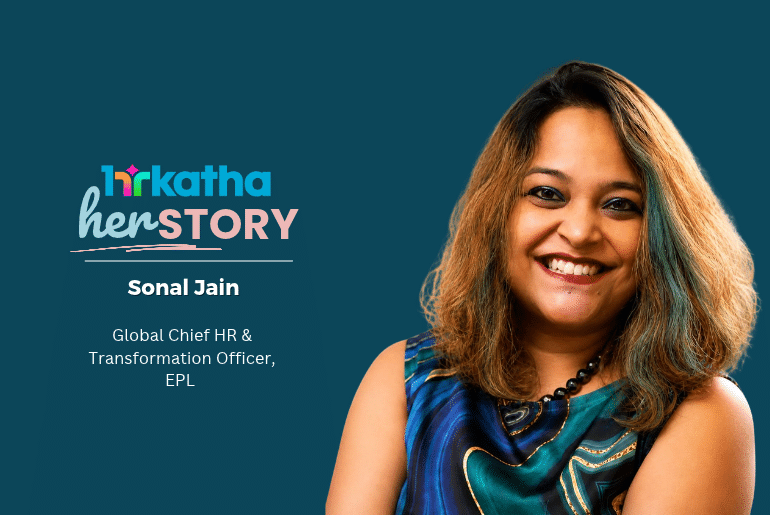
Of courage and self-awareness
For Sonal Jain, global chief HR & transformation officer, EPL, one of the biggest barriers she encountered as a woman leader was not always outside her. Sometimes, it was within her own mind.
“I was very conscious and would often wonder, ‘Am I saying the right thing?’” she recalls.
Across multiple roles, Jain was almost always the only woman on the leadership team. There was just one exception, where there were two.
That made her think twice before speaking. How would her statement be received? Should she say it at all?
Over time, she learnt to turn that self-consciousness into self-awareness. More importantly, she developed the courage to say what she believed was right in the moment without subsequently feeling guilty about having voiced it.
Looking back, she would tell her younger self something equally simple: “Time is precious.
Don’t let it slip away.”
For Jain, that means being intentional about where time and energy are invested, which opportunities deserve attention and which ones do not.
From being liked to being fair
Finding the courage to speak was one part of Jain’s evolution as a leader. Becoming comfortable with how others responded was another.
Early in her career, she admits, she had a strong need to be liked. She wanted people to think of her as nice.
Experience gradually taught her that being liked was different from being respected for being fair and adding value.
One of her mentors helped make that distinction clearer. As Jain became more senior, the mentor told her, some people would like her and others would not. People carry different perspectives, and leadership inevitably involves decisions on which reasonable people can disagree.
The challenge was not to eliminate disagreement. It was to develop the ability to appreciate different points of view, agree to disagree when necessary and still align on execution.
Almost a decade ago, Jain consciously began moving away from seeking approval towards creating value, being fair and doing what she believed was right.
Her test of leadership became simpler: even when people disagreed with her, could they still say that she had been fair and had added value?
Abundance, courage and kindness
Three values have come to define Jain’s leadership style: abundance, courage and kindness.
They influence how she approaches difficult situations, handles conflict and builds relationships. But she also believes leadership requires the ability to step away from the immediate problem and see the larger picture.
That becomes particularly important during change.
“Once there is clarity on why we want to do something, we can rally the organisation around change,” she says.
For Jain, bringing people through transformation requires more than communicating an end goal. It means creating clarity around why the change is necessary, establishing governance and accountability, and helping people understand their role in making it happen.
“It is about how you communicate, create governance and accountability, and bring people along. At the core of my leadership style are abundance, courage and kindness.”
Building for what comes next
Technology is changing rapidly, but Jain believes organisations also need to pay attention to what is happening around it: customers, markets and expectations are changing at the same time.
That means building for the future without becoming so rigid about what that future will look like that the organisation loses its ability to adapt.
In the industrial environment, Jain sees brand owners and brand champions being required to innovate with the speed and quality customers increasingly expect.
The organisational implications follow quickly.
Roles need to change. Capabilities and skills have to evolve. And people need enough learning agility to adapt as customer expectations and competitive conditions shift.
For Jain, future readiness is therefore not simply a technology question. It is also about whether the organisation and its people can keep evolving as the environment around them changes.
Different sources of inspiration
Jain does not identify a single person as the source of her leadership philosophy. Two leaders, however, have had a particular influence.
One is Leena Nair, CEO of Chanel, under whose leadership Jain had the opportunity to work.
What she admires is Nair’s ability to dream, shape a vision and rally an organisation behind it, while keeping people, wellbeing and diversity central to that ambition.
The other is Anand Kripalu, a veteran of India’s FMCG industry, with whom Jain worked directly at EPL.
Here, the qualities that stayed with her were different: clarity of thought, simplicity in driving an agenda and the ability to bring change, people and alignment together.
Between the two are several qualities Jain herself values in leadership: ambition without losing sight of people, and change without unnecessary complexity.
“Even when people disagree with you, they should still be able to say: she is fair, and she adds value.”
Rethinking what learning means
There is one HR practice Jain believes needs rethinking: the way organisations measure learning.
She readily admits that she has been guilty of the conventional approach herself, focusing on how many courses people completed.
Over time, she began asking a different question.
What capabilities does the organisation actually need for where the business is going?
That changes the conversation from learning activity to capability.
It means identifying the hard and soft skills the future will demand, and determining whether people are actually developing them rather than merely accumulating completed courses.
Jain believes skills such as agility, flexibility, collaboration, conflict management and decision-making often receive less attention than they deserve.
Someone can possess excellent technical skills and still struggle when circumstances change because resilience, adaptability or judgement has not developed alongside them.
The useful measure of learning, then, is not simply how much training took place. It is whether people are better equipped for what comes next.
“The limits we place on ourselves should never determine how high we can fly.”
Quick fire round
One skill you’re currently working on developing?
Sensing patterns and building judgement with wisdom.
Your definition of success today versus 10 years ago?
Ten years ago, success was about performance ratings and promotions. Today, it is about finding fulfilment in my work and contributing meaningfully to my organisation, my ecosystem and the world around me, especially my family and my team.
If not HR, what career path would you have pursued?
I always had a dream of serving in the armed forces, but I couldn’t pursue it for various reasons.
One book that changed your perspective on leadership?
Jonathan Livingston Seagull changed my perspective because it showed me that the limits we place on ourselves should never determine how high we can fly.
Early to bed, early to rise. Is it practical? Does it really make a person healthy, wealthy and wise?
Absolutely. I believe waking up early, spending time in nature and eating early are among the best habits one can have, although whether it makes you wealthy is still a question mark.
Supporting other women
For Jain, supporting women at work became a much more personal commitment in 2011.
That year, she led a programme for women in supply chain at Hindustan Unilever. She describes the experience as life-changing.
Since then, improving gender representation has become more than an area of professional interest. She sees it almost as a mission.
Across roles and organisations, Jain has continued to support the gender representation agenda. But she does not believe representation alone is enough.
The more important question is whether the organisation is creating an ecosystem and culture in which women can succeed and progress.
At EPL, she points to movement in women’s representation from 27 per cent to 33 per cent globally over three years. The organisation also works with 150 persons with disabilities, 26 per cent of whom are women. In India, she says, its CSR work includes helping women in local communities build the ability to support their communities in turn.
For Jain, the numbers matter because representation can be measured. But the larger ambition is to create the conditions that allow those numbers to translate into meaningful participation and opportunity.