



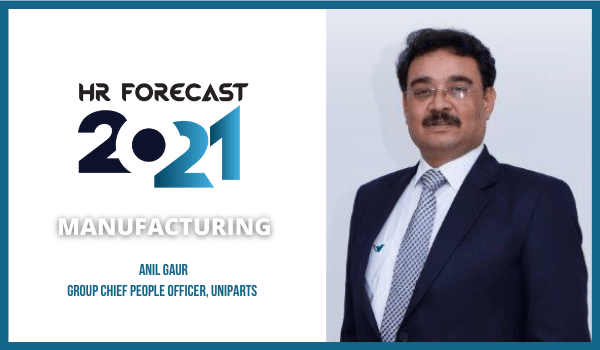
2020: What to learn – what to erase
For manufacturing companies in India, such as the Uniparts Group, work-from-home (WFH) came as a big change, but the good part is that we learnt to standardise, regulate and accelerate the WFH situation.

We realised its impact on businesses. It not only helped us safeguard our people, but also reduced commuting hassles and air pollution, resulted in cost savings and offered opportunity to spend quality time with family. At the Uniparts Group, we decided on WFH in mid-March 2020 and by June, we did away with the rented corporate office and shifted to one of the factory locations to save space and cost. This new normal has pushed companies to a different orbit of work culture, savings and managing surprises and complexities differently.
Another realisation was digitisation and the need for technological advancement. Even during the peak of lockdown, our company was able to function smoothly due to our strong digital. We are now aggressively investing on bringing the latest technology and accelerating digitisation along with innovative ways to promote it in all our manufacturing and delivering processes. On the personal front, the year forced us to understand the difference between needs and wants.
HR needs to be more resilient
Anti-fragile people are those who manage well during changes, volatility, complexities and chaotic situations or may be survive by chance. We are all living in an unpredictable social, political and economic era, wherein every day is full of surprises and unexpected happenings.
Going forward, people will need to focus on the emerging skills of managing uncertainties, versatility, flexibility, agility, pace of response, learning and navigating naturally amidst disruption. I think the actual VUCA world, which we have been discussing for more than a decade, is being experienced by us now. In such a situation, it is the HR function that will help organisations navigate new-age challenges. Therefore, HR professionals need to be anti-fragile and consider building resilience in the organisation. That means, managing not only with data and certainties, but with intuition and vulnerability by way of creating and facilitating an enabling environment and culture.
Shift of talent calculus to more buy-and-rent and less build
When organisations need to acquire talent, they have three options available — buy, build, and/or borrow. They can buy talent, that means hire someone from outside to fill the skill gap immediately. They can also choose to build talent, which involves training and retraining of employees to assume new or different responsibilities. Or they can also borrow talent, that is, engage with a freelance advisor or consultant to perform specific tasks, what we call gig-workers.
In the VUCA world and amidst the fast technological advancement, the life span of any skill and competence has become extremely less. Hence, it has become difficult to train people and wait for them to deliver, because building and developing talent takes its own course and time. Building a talent pool works better when one’s workforce is stable, and one is in a situation to effectively keep them engaged in the organisation.
As we move forward, the need for specialised skills will increase to deliver faster. In such a scenario, ‘buy and borrow’ is the best strategy, and instead of hiring a full-time employee, organisations will prefer to hire a freelancer, advisor, contractor, or consultant. Another option is hiring part-time, on-call, or seasonal workers. This is right around the corner — what is referred to as the ‘gig economy’. But using a ‘borrow’ strategy involves a mindset shift. For years, organisations have considered freelancers as ‘temporary’ or ‘dispensable’ workers, but those days are over. To successfully implement ‘borrow’ tactics, organisations should view contingent workers as an essential piece of their workforce strategy. The biggest advantage of borrowing talent is the proper utilisation of resources. Organisations can get specialised talent when they need, without hiring a full-time employee.
The actual VUCA World, which we have been discussing for over a decade, is being experienced by us now
Extension of fixed-term employment is another opportunity to use borrowing tactics. At the Uniparts Group, we have consciously started looking at retirements. We start telling retiring employees — six months to a year in advance — that freelance or consulting work is available. It is a win-win for the employees and the company both, because it allows known and capable employees an opportunity to stay with the organisation longer. The decision to build, borrow, or buy largely depends upon the time and resources available. Organisations with limited time may not be able to build talent. Similarly, companies with limited budgets may not be able to buy the talent they need. Therefore, they should think about their current and future skills requirements and then plan accordingly. Hence, I believe that with the increase in demand for skills, companies will shift their investments from developing talent to buying and borrowing from outside.
HR to stay human in virtual workplace
In a virtual workplace, HR professionals need to look at the consumerism of HR by creating the WOW employee experience, which can be achieved by being humane with people. Human resources must focus on total employee experience by providing them with the user experience they have outside the firewall. Provide choice, flexibility and personalisation by way of regular communication, conversation, connection and collaboration. As information continues to grow at a fast pace, we need to ensure that the right information reaches the right audience faster with the help of technology. This will help in alignment and in building transparency and trust. Hence, the remedy is to communicate, communicate and communicate.
Today, in order to be successful and achieve organisational results, it is important to understand how employees prefer to work and what their needs are. Therefore, authentic one-on-one conversations with people are important to discover the talents and individual strengths. Employees need tools that allow them to connect across the organisation, leverage intellectual property and gain insights from one another. These will result in better collaboration, which is the core of innovation. This is also required to solve business problems and operate productively, by leveraging knowledge across the organisation.

2 Comments
Very insightful article.
But the concept of retaining retiring employees as free lancers or consultants can be counter productive also. This would not allow new leadership talent to develop and newer ways of doing things won’t get promoted.
Good read. Retaining retiring people is an old and prevailing strategy. This kind of needs comes only when companies do not work on building alternative to retiring people in advance. This is a short term approach to fill talent gap. If need arises to do so, the retained employee should develop talent from internal team.