



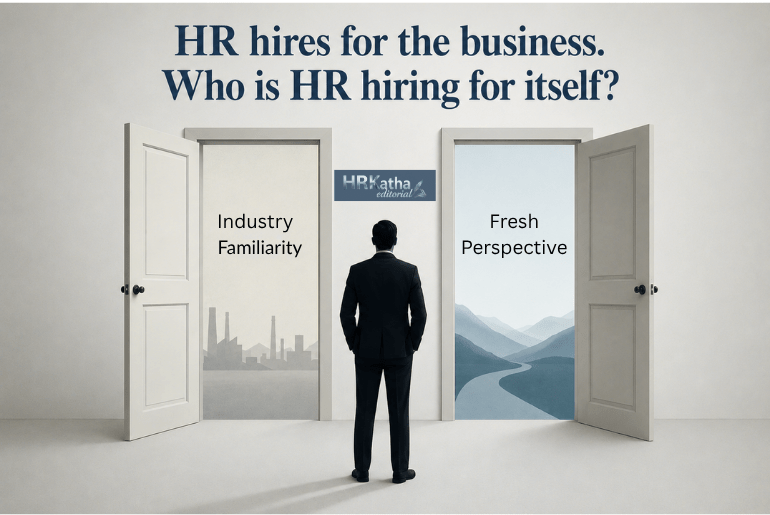
Hire for potential, not just pedigree. Look beyond industry boundaries. Avoid groupthink. Value transferable capability. Bring in fresh perspective. Do not confuse familiarity with competence.
Then HR hires for itself.

And suddenly the function that champions adaptability becomes remarkably cautious.
Every organisation hiring a senior HR professional eventually confronts the same question: should the hire come from the same industry or from outside it? The debate appears practical on the surface. In reality, it reveals something deeper about how HR understands its own value.
Because the answer changes depending not only on the role, but on whether HR genuinely believes the ideas it asks the rest of the business to accept.
For much of corporate India’s history, same-industry hiring in HR was not even debated. It was assumed.
The logic made sense in the era in which it emerged. HR in manufacturing required understanding unions, labour law complexity, shop-floor dynamics, and the informal realities of industrial relations. Banking HR meant understanding branch structures, regulatory oversight, and the culture of financial institutions. Pharmaceuticals demanded fluency in compliance-heavy environments and scientific talent management.
These were not superficial differences. They shaped the work itself.
An HR professional entering from outside the sector often spent years learning operational context before becoming credible with business leaders. Industry familiarity shortened that curve. Companies preferred insiders because the function itself was seen as contextual rather than portable.
“The function that champions adaptability becomes remarkably cautious.”
At that time, HR was also a different function.
It was more administrative, more process-driven, and more closely tied to operational execution than strategic influence. The emphasis was on compliance, continuity, and organisational stability. In that world, sector fluency mattered enormously.
What changed was not merely HR. It was the nature of Indian business itself.
As business partnering models spread through Indian corporations, HR repositioned itself as strategic rather than administrative. Organisational design, leadership development, workforce planning, talent philosophy, and culture transformation became central to the function’s identity. These were capabilities that travelled more easily across industries.
At the same time, entirely new sectors emerged without established HR ecosystems of their own.
E-commerce, fintech, startups, and digital businesses scaling through the 2010s had no deep internal HR talent pools. They hired aggressively from FMCG, consulting, technology services, telecom, and multinational corporations because they had little choice.
“Same-industry hiring feels safer. Familiarity creates comfort.”
Something interesting happened in the process.
Many cross-industry HR leaders succeeded precisely because they did not carry the assumptions of the sectors they entered. They questioned practices insiders treated as obvious. They imported frameworks that felt unfamiliar but useful. They distinguished between what was genuinely industry-specific and what was simply organisational habit disguised as necessity.
That distinction remains central to the debate today.
Some HR work is deeply contextual. Some is far more transferable than organisations admit.
Industrial relations remains highly industry-dependent. A professional navigating union negotiations in a manufacturing environment cannot immediately replicate that capability in hospitality or technology. The operational context genuinely matters.
Talent acquisition sits somewhere in the middle. Sector knowledge matters because talent markets behave differently across industries. Understanding where talent sits, how compensation moves, and which competitors aggressively poach employees creates real advantage.
But many other HR capabilities travel surprisingly well.
“Industry experience matters most when organisations want continuity. Cross-industry hiring matters most when organisations want change.”
People analytics, organisational design, leadership development, workforce planning, HR technology, and culture transformation rely less on sector fluency than on problem-solving capability and business understanding. The methodology often matters more than the industry.
And yet HR functions frequently default to same-industry hiring even for roles where the contextual requirement is relatively weak.
Part of the reason is credibility.
Business leaders are often impatient with HR professionals who require time to understand the business model, competitive dynamics, or operational realities of the organisation they support. An HR Business Partner who asks basic industry questions struggles to establish peer-level trust quickly.
But there is another reason HR rarely acknowledges openly: same-industry hiring feels safer.
A same-sector hire reduces perceived risk because familiarity creates comfort. The language sounds familiar. The references make sense. The behavioural cues are recognisable. Senior leadership feels reassured that the person will “fit”.
“Inherited assumptions begin to feel universal.”
The irony is that HR itself spends enormous energy advising businesses not to overvalue cultural familiarity when hiring other functions.
The contradiction becomes most visible at senior levels.
When organisations hire CHROs during periods of stability, they often prioritise industry fluency, regulatory understanding, and operational continuity. This is particularly true in banking, pharmaceuticals, insurance, and heavily regulated sectors where institutional complexity matters.
But when organisations seek transformation, the logic quietly reverses.
Suddenly, boards and CEOs begin looking outside the industry. They search for leaders who can challenge inherited assumptions, modernise talent systems, reshape culture, and bring perspectives unavailable internally.
The same organisation that once insisted industry experience was non-negotiable starts treating external perspective as strategic advantage.
“HR often becomes far more conservative than the advice it gives everyone else.”
The conservatism often becomes even more visible one level below the CHRO.
Many senior HR leaders who advocate fresh thinking for the business hire surprisingly familiar profiles into their own teams. People from the same industries, the same kinds of organisations, sometimes even the same HR vocabulary and operating style.
Part of this is understandable. HR leadership is heavily relationship-driven. CHROs work closely with their immediate teams and often prioritise trust, speed of alignment, and low-friction execution. Familiarity feels efficient.
But it also creates replication. Functions begin hiring people who think similarly, frame problems similarly, and reinforce the same assumptions about talent and organisation design.
The irony is difficult to miss. HR frequently advises businesses to avoid hiring in their own image while quietly reproducing itself in exactly that way.
This reveals something important.
Industry experience matters most when organisations want continuity. Cross-industry hiring matters most when organisations want change.
The interesting question is whether organisations always recognise which of those two they actually need.
Some same-industry HR leaders possess deep strategic capability and exceptional business fluency. Others simply understand the rituals and language of the sector well enough to appear strategically sophisticated without fundamentally challenging anything.
Conversely, some cross-industry HR hires bring genuinely fresh thinking. Others underestimate contextual complexity and spend too long learning what insiders already know.
The difference is rarely the industry background itself.
It is whether the HR leader understands the business at a structural level rather than merely an HR-programme level.
When interviewing senior HR leaders, the distinction becomes obvious quickly. Some discuss workforce questions through the lens of margins, growth constraints, market positioning, operating models, and strategic trade-offs. Others discuss the same issues almost entirely through frameworks, engagement scores, capability models, and process language.
Only one group is truly operating as business leaders.
Industry experience can help build that fluency. But it does not guarantee it.
In fact, one of the hidden risks of long single-industry careers is that leaders sometimes stop distinguishing between what is genuinely sector-specific and what is merely legacy behaviour.
The longer people remain inside one ecosystem, the more inherited assumptions begin to feel universal.
Cross-industry professionals are often better at identifying those blind spots because they have seen multiple operating cultures solve similar problems differently.
That is increasingly why the most sought-after CHROs today tend to carry experience across multiple sectors. They combine contextual adaptability with enough breadth to recognise patterns that insiders miss.
This shift reflects a broader change in what organisations expect from senior HR.
The modern CHRO is no longer evaluated primarily on process execution or administrative stability. Increasingly, the role involves transformation, organisational redesign, workforce strategy, leadership influence, and navigating ambiguity during business shifts.
Those capabilities depend less on industry memory and more on strategic judgment.
And that brings the debate back to HR itself.
HR advises organisations constantly that talent is adaptable, learning agility matters, and transferable capability should not be underestimated.
The interesting question is whether HR fully believes that when hiring its own people.
Because when HR hires for itself, the function often becomes far more conservative than the advice it gives everyone else.