



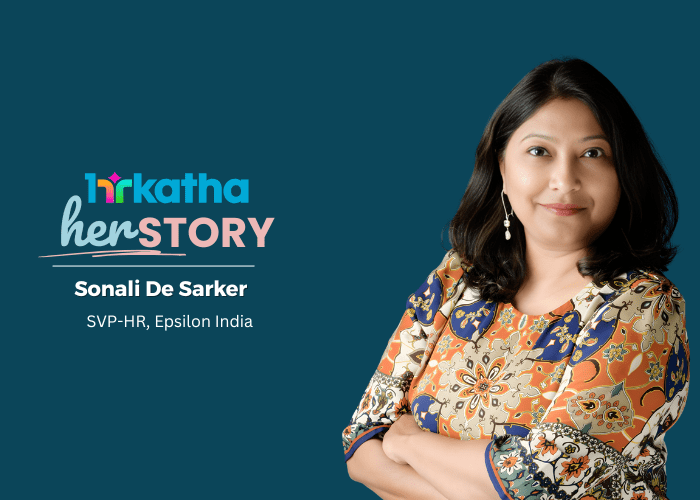
Leadership beyond labels
Sonali De Sarker has never viewed gender as a barrier to leadership.
Throughout her career, she has worked with exceptional leaders across genders and believes that strong leadership ultimately comes down to clarity of thought, integrity, authenticity and impact. Capability and intent matter far more than labels.

By staying focused on outcomes, making principled decisions and allowing her work to speak for itself, she has consistently converted challenges into opportunities.
Today, as senior vice president-human resources at Epsilon India, De Sarker leads with a philosophy shaped by experience: doing the right thing matters more than being liked, and unlearning matters as much as learning.
Choosing what is right
There have been moments in De Sarker’s career when she has had to choose between being liked and being respected.
What has consistently guided her is the ability to stand by her decisions long after the moment has passed.
“It’s not about choosing between the two. It’s about being able to look in the mirror and knowing I did the right thing. And while it’s easily said, it’s not always easy,” she says.
Over time, she has learnt that leadership is rarely about pleasing everyone. It is about making decisions with integrity, clarity and accountability, especially when situations are difficult or unpopular.
“Doing the right thing matters more than being liked.”
Learning to unlearn
Some of the toughest decisions in HR, according to De Sarker, are the ones where there is no perfect answer, especially when balancing business priorities with individual impact.
In such situations, she returns to a few simple questions: Is this fair? Is this transparent? And is it aligned with what the organisation stands for?
One of the most defining learning experiences of her career came when she moved from a large technology organisation into a late-stage startup environment.
The shift challenged almost everything she had grown accustomed to. Processes were questioned constantly. Established ways of working were no longer accepted simply because they had worked elsewhere.
Initially, she responded with familiar corporate HR answers, but the repeated questioning forced her to pause and reassess.
She realised that what had worked successfully for two decades in one environment did not automatically apply in another.
That experience fundamentally changed her perspective on leadership.
“Unlearning became essential, questioning old assumptions and being open to completely different, yet equally valid, answers became necessary,” she reflects.
The experience taught her that adaptability is not only about acquiring new skills. It is also about letting go of old certainties.
“Unlearning old assumptions can be one of leadership’s most valuable shifts.”
Culture in everyday moments
For De Sarker, culture is not created through programmes alone.
It comes down to whether people can bring their whole selves to work, feel respected, find opportunities to grow, contribute meaningfully and know that their impact is recognised.
If these elements are absent, no amount of policies or initiatives can compensate.
Culture, she believes, has to be lived in everyday moments, through behaviours, conversations, decisions and experiences that people encounter daily.
Strategic HR in practice
“Strategic HR in practice is about aligning people decisions directly with business outcomes,” says De Sarker.
That requires understanding organisational priorities deeply, whether around innovation, growth, client impact or capability building, and ensuring that hiring, development and culture actively support those goals.
For her, strategic HR is also about looking ahead and preparing the workforce for what the business will need next.
Building AI fluency, enabling internal mobility and creating strong learning ecosystems are therefore not standalone initiatives. They are part of a larger business strategy.
Preparing for the future of work
At Epsilon, De Sarker says the future of work is being shaped through a combination of technology, access and human experience.
Artificial intelligence is increasingly becoming embedded into everyday work as a baseline capability rather than a specialised skill.
Platforms such as Marcel are enabling hyper-personalised learning, global collaboration and internal mobility, allowing employees to take greater ownership of their careers.
The role of HR, she believes, is to create an ecosystem where learning is democratised, opportunities are visible and people feel confident navigating change.
Equally important is ensuring that as work evolves, employees continue to experience belonging, purpose and pride in what they do.
Learning, adapting and speaking up
To young women aspiring for a career in HR, De Sarker’s advice is straightforward: build strong fundamentals and understand the business, not just HR.
She encourages professionals to remain curious, continue learning and stay equally open to unlearning.
The external environment is evolving rapidly and adaptability is no longer optional.
At the same time, she believes authenticity matters deeply because there is no single definition of leadership.
“The more you understand your own strengths and values, the more effectively you will be able to lead,” she says.
She also urges young professionals to share their perspectives confidently, take ownership of opportunities and not shy away from difficult assignments.
Quick fire round
What’s the best career advice you’ve ever received?
Think like your manager. When you’re faced with a challenge, don’t just arrive with one solution. Pause and look at it through your manager’s lens.
One thing you wish people understood about being a woman in HR leadership?
Leadership isn’t defined by gender. It’s defined by how you think, how clearly you speak your mind, how strategic your decisions are, and how effectively you turn intent into action.
Morning ritual that sets you up for success?
I often work late into the night, so what helps me most is planning the next day in advance and preparing mentally for what lies ahead.
If not HR, what career path would you have pursued?
Sales. I enjoy the art of persuasion and the challenge of influencing people and ideas.
What energises you most about your work?
The ability to make a meaningful impact and seeing how collective effort creates lasting outcomes.