



Urban India appears, at first glance, to be getting healthier. Gyms are full. Meditation apps are booming. Protein consumption has become aspirational. Health insurance advertising now occupies the cultural territory once reserved for mutual funds and smartphones.
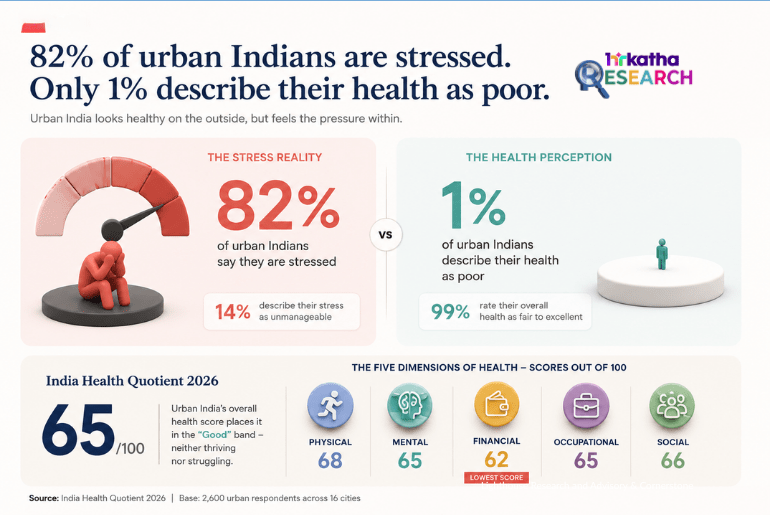
Yet beneath the visible architecture of wellness sits a more anxious reality. The India Health Quotient 2026, a study by ManipalCigna and YouGov India covering 2,600 respondents across 16 cities, finds that 82 per cent of urban Indians report experiencing stress, while only 1 per cent describe their health as poor.
That gap – between outward functionality and inward strain – may be the most revealing health statistic in the country today.
The overall India Health Quotient score stands at 65 out of 100, placing urban India in what the report diplomatically classifies as “good” health. Physical health scores highest at 68. Financial well-being scores lowest at 62.
The six-point difference matters more than it appears. It suggests that India’s health problem is no longer primarily about access to medicine or treatment. It is increasingly about the economic and psychological conditions under which people are trying to stay healthy.
The health-finance loop
The report’s most important contribution is conceptual. It identifies what it calls the “Health Debt Trap” – a self-reinforcing cycle in which financial stress damages health, deteriorating health creates additional expenses, and those expenses intensify financial anxiety further.
The numbers behind the loop are striking. Forty-one per cent of urban Indians say the pursuit of financial goals itself causes stress and anxiety. Thirty-six per cent say maintaining a healthy lifestyle – better food, supplements, diagnostics and preventive care – places pressure on their finances.
This is not simply a cost-of-living story. It is a structural shift in how health is experienced in middle-class India. Wellness has become simultaneously more visible and more expensive.
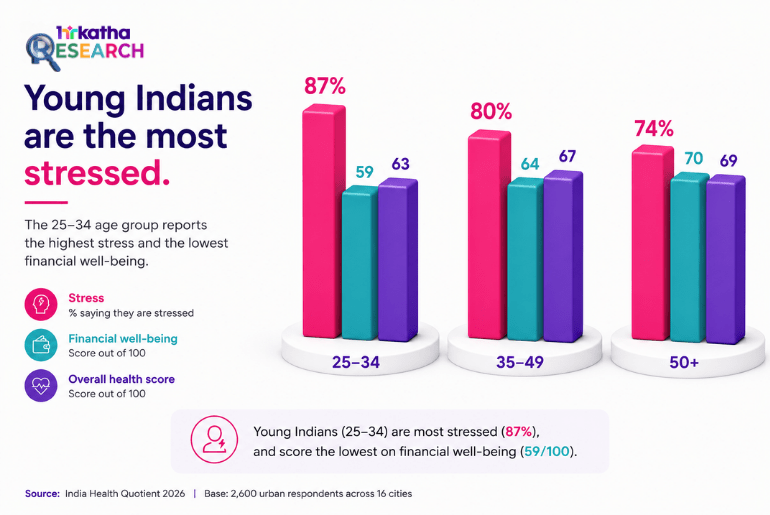
The pressure is concentrated most heavily among younger professionals. Indians aged 25 to 34 score 63 out of 100 overall – below both the 35–49 group and respondents above 50.
They report the highest levels of unmanageable stress at 20 per cent, compared with only 8 per cent among those over 50. Their financial well-being score stands at just 59.
This is the cohort typically imagined as India’s healthiest generation: digitally aware, fitness-conscious and highly engaged with preventive health culture. The data suggests otherwise. Younger urban Indians may be more health-aware than previous generations, but they are also more financially strained, more psychologically burdened and less secure.
The workplace effect
The occupational health findings should concern employers directly.
The occupational dimension scores 65 overall, but salaried employees consistently report worse outcomes than the self-employed or those outside the workforce. Sixty-five per cent of employees report losing motivation because of stress, compared with 59 per cent among others. Thirty-one per cent report difficulty concentrating, against 25 per cent elsewhere. Thirty per cent report physical symptoms linked to stress, compared with 25 per cent among non-salaried respondents.
The gaps are not dramatic individually. Their consistency across every measure is what makes them meaningful.
What employees want from employers is equally revealing. The four most requested workplace benefits are higher hospitalisation cover at 37 per cent, wellness and fitness support at 35 per cent, mental health counselling at 34 per cent, and preventive screenings at 32 per cent.
Three of the four extend well beyond the traditional logic of corporate medical insurance. Employees are no longer asking organisations merely to pay for illness. They are increasingly expecting employers to help preserve health before illness arrives.
That distinction matters because it changes the role of workplace benefits entirely – from financial protection to lifestyle infrastructure.
Mental health without behavioural change
Perhaps the clearest sign of changing social attitudes lies in how Indians now evaluate mental health itself.
For the first time, respondents assign equal importance to mental and physical health. Among those aged 25 to 34, mental health actually ranks higher, with 54 per cent saying it matters more than physical well-being.
The cultural shift is unmistakable. The behavioural shift is weaker.
Among the ten mental-health indicators measured, the lowest-scoring area is willingness to seek professional help when needed. Only 40 per cent rank it among their top priorities, while the performance score on this measure stands at just 60 out of 100 – the weakest result across the entire mental-health dimension.
India increasingly believes in mental health as an idea. It remains considerably less comfortable acting on it in practice. The variation by city is worth noting. In Kolkata, 50 per cent of respondents place seeking professional help among their top five mental health priorities – ten percentage points above the average for other eastern cities. For HR teams designing mental health benefit rollouts, that gap suggests a single national programme will likely underperform a city-calibrated one.
The regional patterns complicate some familiar assumptions. Southern India – often perceived as more educated and health-conscious – records the country’s lowest overall well-being score at 63. Only 44 per cent of respondents in the south report feeling secure in their jobs, compared with more than 50 per cent elsewhere.
The country’s most technologically advanced economic regions appear to be generating their own forms of psychological instability.
The metro myth
The report’s most counterintuitive finding concerns geography.
Non-metro cities outperform India’s major metros across every major health dimension. The twelve non-metro cities in the survey score 67 overall, compared with 63 for Delhi, Mumbai, Kolkata, Chennai, Bengaluru and Hyderabad combined.
The pattern holds consistently: physical health scores 69 versus 65, mental health 66 versus 63, financial well-being 64 versus 60, and occupational health 66 versus 63.
Mumbai performs particularly poorly, scoring 62 overall. Only 53 per cent of respondents there say they sleep well, compared with 62 per cent across the wider western region.
India’s largest cities continue to generate wealth and opportunity. They appear considerably less successful at generating sustainable well-being.
The insurance divide
One of the strongest statistical relationships in the report involves health insurance ownership.
Insured Indians score 68 overall on the Health Quotient, compared with 62 among uninsured respondents – a six-point difference larger than the gender gap, the age gap or the metro-versus-non-metro gap.
The financial well-being difference is especially sharp. Insured respondents score eight points higher financially than uninsured respondents.
Even stress appears to operate differently depending on insurance status. A stressed but insured Indian scores almost identically overall to an uninsured Indian reporting no stress at all.
The report is careful not to claim causation – insurance ownership correlates with income and education, which independently influence well-being. But the gap’s persistence even under high stress suggests something beyond income at work. Ownership of a policy appears to reduce the psychological weight of financial uncertainty in healthcare, independent of whether a claim is ever made.
Yet 38 per cent of urban Indians still neither own health insurance nor intend to purchase it. Among those planning to buy but delaying, 47 per cent cite affordability while 32 per cent say they do not understand which policy suits them.
The barrier, in other words, is not only economic. It is informational.
What the score really captures
One clarification matters.
The India Health Quotient is not a clinical assessment. It measures perceived well-being – the distance between how people want to live and how they believe they are actually living.
That distinction is important because subjective well-being often deteriorates long before formal health indicators do. A society can simultaneously improve life expectancy while worsening daily lived experience.
The report captures precisely that tension.
Urban India is not collapsing physically. It is functioning under mounting cognitive, financial and emotional pressure while still appearing outwardly productive. The country’s health challenge is becoming less about survival and increasingly about sustainability.
And the workforce carrying the greatest pressure is also the one expected to power India’s next phase of economic growth.
1 Comment
I would love to have a discussion with you regarding growing stress in India. Loved this article