

Close Menu
    Facebook X (Twitter) Instagram
    • Our Story
    • Partner with us
    • Reach Us
    • Career
    Subscribe Newsletter
    HR KathaHR Katha
    • Exclusive
      • Exclusive Features
      • Perspectives
      • Friday Features
      • herSTORY
      • Case-In-Point
      • Point Of View
      • Research
      • HR Pops
      • Dialogue
      • Movement
      • Profile
      • Beyond Work
      • Rising Star
      • By Invitation
    • News
      • Global HR News
      • Compensation & Benefits
      • Diversity
      • Events
      • Gen Y
      • Hiring & Firing
      • HR & Labour Laws
      • Learning & Development
      • Merger & Acquisition
      • Performance Management & Productivity
      • Talent Management
      • Tools & Technology
      • Work-Life Balance
    • Special
      • HR Forecast 2026
      • Cover Story
      • Editorial
      • HR Forecast 2024
      • HR Forecast 2023
      • HR Forecast 2022
      • HR Forecast 2021
      • HR Forecast 2020
      • HR Forecast 2019
      • New Age Learning
      • Coaching and Training
      • Learn-Engage-Transform
    • Magazine
    • Reports
      • Whitepaper
        • HR Forecast 2024 e-mag
        • Future-proofing Manufacturing Through Digital Transformation
        • Employee Healthcare & Wellness Benefits: A Guide for Indian MSMEs
        • Build a Future Ready Organisation For The Road Ahead
        • Employee Experience Strategy
        • HRKatha 2019 Forecast
        • Decoding and Driving Employee Engagement
        • One Platform, Infinite Possibilities
      • Survey Reports
        • Happiness at Work
        • Upskilling for Jobs of the Future
        • The Labour Code 2020
    • Conferences
      • Leadership Summit 2025
      • Rising Star Leadership Awards
      • HRKatha Futurecast
      • Automation.NXT
      • The Great HR Debate
    • HR Jobs
    WhatsApp LinkedIn X (Twitter) Facebook Instagram
    HR KathaHR Katha
    Home»Exclusive Features»HR Pops»Ghost jobs: The phantom listings that haunt modern hiring
    HR Pops

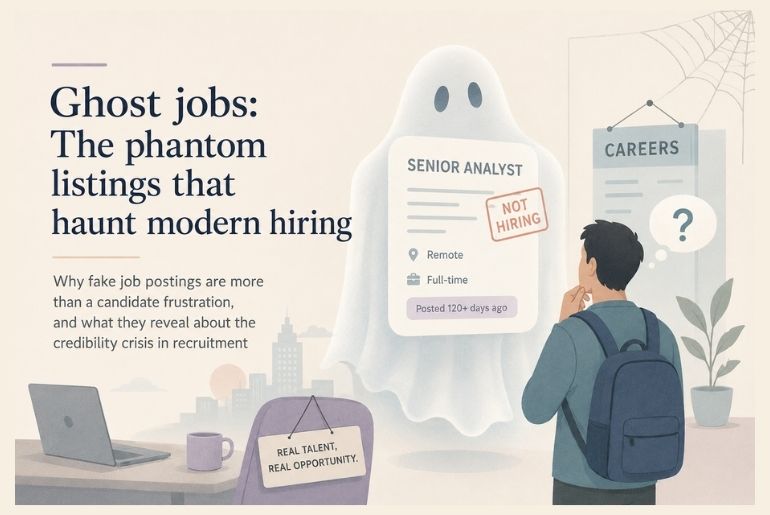
    Ghost jobs: The phantom listings that haunt modern hiring

    Why fake job postings are more than a candidate frustration, and what they reveal about the credibility crisis in recruitment
    mmBy Liji Narayan | HRKathaJuly 21, 2026Updated:July 21, 20263 Mins Read873 Views
    Share LinkedIn Twitter Facebook WhatsApp
    Ghost Jobs HR Pops
    Share
    LinkedIn Twitter Facebook WhatsApp

    What are ghost jobs?

    Ghost jobs are vacancies that appear genuine but are not actively being filled.

    They remain on company websites, LinkedIn, and job portals even though hiring has been paused, the position has already been filled, or no approval exists to recruit in the first place.
    Some are left online to build talent pipelines. Others simply linger because nobody removes them.

    For candidates, ghost jobs waste time and create false hope. For HR, they raise a more uncomfortable question: when does employer branding become misleading?

    Where did the idea come from?

    The practice predates social media.

    In the early 2000s, many organisations kept “evergreen” vacancies open to build candidate pipelines for future hiring. During economic downturns, some companies continued advertising roles to project stability, even when recruitment had slowed.

    Digital job platforms made the practice far easier. Posting a vacancy became inexpensive, instant, and visible to millions. Over time, some organisations also began using job advertisements to understand salary expectations, monitor talent availability, or keep recruitment pipelines warm.

    The pandemic accelerated the trend. Hiring freezes became common, but many listings remained online long after recruitment had stopped.

    Why is it relevant for HR?

    Ghost jobs create problems that extend far beyond disappointed candidates.

    Recruitment is built on trust. Every job advertisement is effectively a promise that an organisation is looking for talent. When candidates repeatedly apply for roles that never move forward, confidence in that promise begins to erode.

    The problem also affects recruiters. Genuine applications become harder to attract when candidates begin assuming vacancies are unlikely to be real. Employer branding suffers, application quality declines, and recruitment teams spend increasing time rebuilding credibility that should never have been lost.
    For HR leaders, the issue is no longer simply candidate experience. It is organisational reputation.

    The uncomfortable reality

    Ghost jobs rarely exist because HR wants to mislead candidates.

    More often, they reflect organisational dysfunction.

    Hiring managers seek approval before budgets are finalised. Finance delays headcount decisions after vacancies have already been advertised. Recruiters inherit requisitions that quietly disappear without being formally closed. In large organisations, job postings can remain live simply because no one owns the responsibility of taking them down.

    Some organisations, however, keep vacancies active deliberately. A long careers page signals growth. A steady flow of applications provides market intelligence on skills, salaries, and talent availability. In an era of AI-driven recruitment, candidate data has become valuable in its own right.

    Whatever the reason, the outcome is the same. Candidates invest time in opportunities that never really existed.

    Increasingly, they notice. Social media, Glassdoor, and LinkedIn have made recruitment far more transparent than it once was. Candidates compare experiences, track dormant vacancies, and publicly question employers that repeatedly advertise roles without hiring.
    The cost is no longer limited to frustrated applicants. It is measured in lost trust.

    The takeaway

    Ghost jobs reveal something larger than inefficient recruitment.

    They expose the gap between signalling and substance.

    A careers page should represent genuine hiring intent, not organisational aspiration or market research. If a company is building a talent pipeline, candidates deserve to know. If hiring is paused, transparency is better than silence.

    For HR, credibility is becoming one of recruitment’s most valuable assets.

    Because every vacancy is more than an advertisement. It is the first conversation between an organisation and a potential employee.

    And first impressions are difficult to rebuild once candidates realise the conversation was never meant to happen.

    advertise roles without hiring candidate data credibility Employee employer fake job postings frozen posts ghost jobs hiring paused HR HR Pops HRKatha pops HRPops Human Resources LEAD live job postings non-existent opportunities phantom job postings potential employee recruitment transparency remain live on websites even though hiring is paused talent availability unfilled posts Vacancy Workforce
    Share. LinkedIn Twitter Facebook WhatsApp
    mm
    Liji Narayan | HRKatha

    HRKatha prides itself in being a good journalistic product and Liji deserves all the credit for it. Thanks to her, our readers get clean copies to read every morning while our writers are kept on their toes.

    Leave A Reply Cancel Reply

    Related Posts

    LatentView appoints Sonal Ramrakhiani as CEO to drive next phase of AI-led growth

    July 21, 2026

    Amazon sued over alleged FMLA violations after employee’s dismissal

    July 21, 2026

    Intel plans fresh layoffs in data centre business amid ongoing restructuring

    July 21, 2026

    Deloitte consultant quits after 10 years, cites burnout, long hours and limited career rewards

    July 21, 2026
    zoha
    Editorial

    India’s IT services industry built the talent. Its biggest clients are now hiring it directly through GCCs

    Something significant is happening to India’s technology workforce in 2026. Most people are describing the…

    The interview was never measuring what we thought it was

    I was speaking recently to the HR Head of a mid-sized IT company about hiring.…

    EDITOR'S PICKS

    Newgen’s AI strategy starts with people, not technology  

    July 21, 2026

    Ghost jobs: The phantom listings that haunt modern hiring

    July 21, 2026

    India’s IT services industry built the talent. Its biggest clients are now hiring it directly through GCCs

    July 20, 2026

    POV: Should organisations hire for adaptability over expertise?

    July 20, 2026
    Latest Post

    Amazon sued over alleged FMLA violations after employee’s dismissal

    News July 21, 2026

    Amazon is facing a lawsuit in the US after a former employee alleged that the…

    Intel plans fresh layoffs in data centre business amid ongoing restructuring

    News July 21, 2026

    Intel is preparing another round of job cuts, this time in its Data Centre Group…

    Deloitte consultant quits after 10 years, cites burnout, long hours and limited career rewards

    News July 21, 2026

    A senior technology consultant has resigned from Deloitte after spending a decade with the firm,…

    Hyper gets Vineet Gambhir as CHRO

    Movement July 21, 2026

    Hyper, a US-based digital infrastructure partner specialising in mission-critical data centre solutions, has appointed Vineet…

    Asia's No.1 HR Platform

    Facebook X (Twitter) Instagram LinkedIn WhatsApp Bluesky
    • Our Story
    • Partner with us
    • Career
    • Reach Us
    • Exclusive Features
    • Cover Story
    • Editorial
    • Dive into the Future of Work: Download HRForecast 2024 Now!
    © 2026 HRKatha.com
    • Disclaimer
    • Refunds & Cancellation Policy
    • Terms of Service

    Type above and press Enter to search. Press Esc to cancel.