



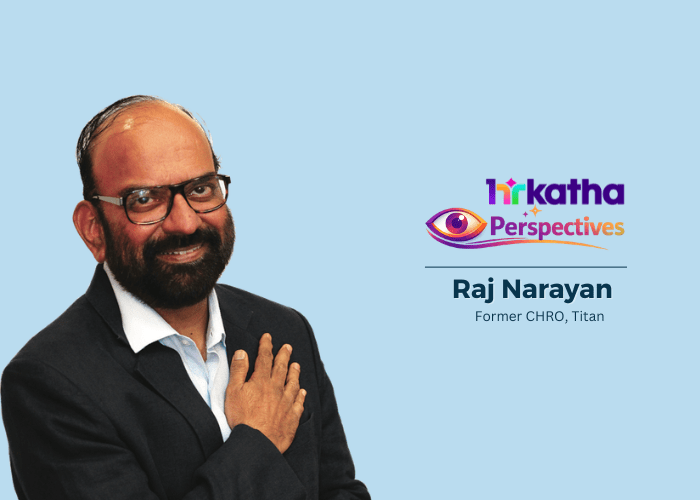
Titan shaped much of Raj Narayan’s leadership journey. Over decades as a people leader across industries and organisations, he observed at close quarters the difference between companies that genuinely live their stated values and those that merely display them.
In conversation with HRKatha, he reflects on what organisations consistently get right, what they consistently get wrong, and the few leadership behaviours he believes matter more than most executives are willing to admit – among them the distinction between kindness and softness, the organisational cost of cultures that discourage dissent, and why active listening remains one of the most undervalued capabilities in management.

Organisations that mean it
Many organisations say they encourage dissent and openness. In practice, very few genuinely do. What separates the organisations that mean it from the ones that merely claim to?
The difference becomes visible very quickly.
In organisations that genuinely welcome diverse viewpoints, employees speak openly because they have learned – through repeated experience – that disagreement does not carry a penalty. They challenge assumptions because they trust that their perspectives will be heard and respected.
Those organisations tend to become more innovative, more agile and more engaging places to work. Employees develop a stronger sense of ownership because they know their contributions matter. Performance improves as a result.
In contrast, some organisations communicate openness rhetorically while signalling something very different behaviourally – through meetings, promotions, visibility and leadership reactions. Employees quickly learn that dissent carries a cost. When that happens, people stop offering alternative perspectives – not because they have stopped thinking, but because they have learned that thinking out loud carries risk.
Psychologically safe cultures also strengthen customer focus. Employees become more willing to take ownership across the value chain rather than limiting themselves narrowly to role definitions. The performance gap between organisations that genuinely mean it and those that do not is often wider than leaders realise.
“When dissent carries a cost, people stop challenging assumptions — not because they have stopped thinking, but because they have learned that thinking out loud carries a price.”
Kindness is not softness
How do organisations balance meritocracy with inclusion without allowing either to become performative?
The starting point is leadership commitment – to both meritocracy and inclusion simultaneously. They are not competing priorities. In strong organisations, they reinforce each other.
That commitment has to become visible through systems: performance management, rewards, recognition and development opportunities. Employees need to see that merit genuinely matters and that access to opportunity is fair and transparent.
One distinction that leaders often misunderstand is the difference between kindness and softness.
Kindness means having difficult conversations honestly. It means addressing underperformance, holding people accountable and telling someone clearly where they stand. Avoiding those conversations is not kindness. It is softness, and softness becomes corrosive to both meritocracy and team morale.
Role modelling matters equally. Employees pay far more attention to what leaders do than what they say. If leaders speak about inclusion and meritocracy while making inconsistent decisions, credibility disappears quickly.
Exceptional performance must be recognised visibly. High-potential talent must be developed systematically. When leadership commitment, fair processes and inclusive behaviour operate together consistently, organisations stop seeing performance and inclusion as opposing goals. They strengthen both.
“Ignoring underperformance is not kindness. It is simply being soft, and it is corrosive to meritocracy.”
The most overlooked capability
What is the most undervalued leadership capability in organisations today?
Active listening.
The answer sounds deceptively simple, but organisations consistently underestimate its importance and pay the price in ways they do not always recognise.
Leaders need to listen deeply – not only to their teams, but to colleagues across functions, customers, vendors and other stakeholders. Listening is not merely about hearing concerns.
It is about understanding what people are experiencing and ensuring that meaningful action follows.
In periods of constant transformation, many voices risk getting drowned out. Organisations need mechanisms that ensure stakeholders feel heard and believe their feedback influences decisions meaningfully.
Too often, leaders focus heavily on directing, driving and delivering outcomes while underinvesting in listening. But leaders who do not listen are effectively operating with incomplete information.
Organisations that cultivate strong listening cultures build stronger relationships, make better decisions and respond more effectively to change. Despite that, active listening remains one of the least consciously developed leadership capabilities.
“Leaders who do not listen are running their organisations on incomplete information.”
What the rotation taught us
How should HR professionals build careers that develop both strategic breadth and genuine functional depth?
At Titan, we introduced a practice of rotating HR professionals every three to five years across centres of excellence, HR business partnering and specialist roles. People were encouraged to build both partnering capability and deep expertise in areas where they showed natural inclination – whether talent acquisition, compensation, leadership development or another domain.
The difference between professionals who experienced those rotations and those who did not became very visible over time.
People who had moved across roles were better equipped to handle ambiguity, connect with diverse stakeholders and approach problems from multiple perspectives. They developed greater strategic range and stronger resilience.
My advice to HR professionals today is to consciously build depth in one area while actively seeking breadth early in your career. Do not wait for the organisation to design that journey for you. Take ownership of it yourself.
Too many professionals resist role changes because they associate comfort with competence. But the discomfort of role change is often precisely where development happens.
Continuous learning matters equally. Formal programmes, digital learning, industry forums and cross-functional projects all contribute to perspective. Those who combine mobility, learning and business exposure build a capability range that becomes genuinely difficult to replicate.
“Too many professionals resist role changes because they associate comfort with competence. That is precisely where development stops.”
The trust gap
What has changed most in HR over the past two decades, and what remains unresolved?
One of the most important shifts has been HR’s evolution from a largely administrative function into a genuine strategic partner contributing to organisational direction while bringing deep people expertise to leadership discussions.
In many mature Indian organisations, HR practices today are remarkably sophisticated – in some cases comparable to or ahead of larger global organisations. That progress is real.
But one unresolved gap remains significant: trust.
I have seen organisations where HR is viewed as fair, balanced and genuinely supportive – a function employees trust during difficult moments. I have also seen organisations where HR is perceived as political, procedural and disconnected from employee reality. That gap still exists more widely than the profession likes to acknowledge.
As AI increasingly takes over transactional work, HR’s credibility will depend even more heavily on trust. Employees need to see HR leaders as fair, approachable and genuinely invested in their growth and wellbeing.
If the function fails to sustain that trust, no amount of technological sophistication will preserve its relevance.
“As AI takes over the transactional work, HR’s credibility will depend almost entirely on trust.”