

Close Menu
    Facebook X (Twitter) Instagram
    • Our Story
    • Partner with us
    • Reach Us
    • Career
    Subscribe Newsletter
    HR KathaHR Katha
    • Exclusive
      • Exclusive Features
      • Perspectives
      • Friday Features
      • herSTORY
      • Rising Stars
      • Case-In-Point
      • Point Of View
      • Research
      • HR Pops
      • Dialogue
      • Movement
      • Profile
      • Beyond Work
      • By Invitation
    • Brief News
      • Global HR News
      • Compensation & Benefits
      • Diversity
      • Events
      • Gen Y
      • Hiring & Firing
      • HR & Labour Laws
      • Learning & Development
      • Merger & Acquisition
      • Performance Management & Productivity
      • Talent Management
      • Tools & Technology
      • Work-Life Balance
    • Special
      • Editorial
      • HR Forecast 2026
      • Cover Story
      • HR Forecast 2024
      • HR Forecast 2023
      • HR Forecast 2022
      • HR Forecast 2021
      • HR Forecast 2020
      • HR Forecast 2019
      • New Age Learning
      • Coaching and Training
      • Learn-Engage-Transform
    • Studio
      • The CHRO Playbook
      • Quick HR Insights
      • The Corner Office
    • Reports
      • Whitepaper
        • HR Forecast 2024 e-mag
        • Future-proofing Manufacturing Through Digital Transformation
        • Employee Healthcare & Wellness Benefits: A Guide for Indian MSMEs
        • Build a Future Ready Organisation For The Road Ahead
        • Employee Experience Strategy
        • HRKatha 2019 Forecast
        • Decoding and Driving Employee Engagement
        • One Platform, Infinite Possibilities
      • Survey Reports
        • Happiness at Work
        • Upskilling for Jobs of the Future
        • The Labour Code 2020
    • Forums
      • HRKatha Inner Circle
      • HRKatha Futurecast
      • Leadership Summit 2025
      • Rising Star Leadership Awards
      • HRKatha Futurecast 2025
      • Automation.NXT
      • The Great HR Debate
    WhatsApp LinkedIn X (Twitter) Facebook Instagram
    HR KathaHR Katha
    Home»Recruitment»Evaluate BATNA before salary negotiations
    Recruitment

    Evaluate BATNA before salary negotiations

    HRK News BureauBy HRK News BureauFebruary 3, 2021Updated:February 3, 20214 Mins Read64131 Views
    Share LinkedIn Twitter Facebook WhatsApp
    Share
    LinkedIn Twitter Facebook WhatsApp

    Salary negotiation is tricky, for the employer as well as the candidate. More for the candidate, because a wrong estimation can mean losing out on an opportunity.

    From an organisation’s perspective, it is already negotiating with several candidates for that same position and would be ready to hire another person who will do the same job for a lower price – unless it’s the role of a specialist. This puts the employer at an advantageous position at the negotiating table. However, for the candidate, that particular job may be a make or break situation.

    It is important for candidates to rightly evaluate themselves, and that is where the BATNA score comes handy.

    Short for ‘best alternative to negotiated agreement’, the term BATNA was coined by Harvard authors, Roger Fisher and William Ury, in their book, Getting to Yes: Negotiating Agreement Without Giving In.

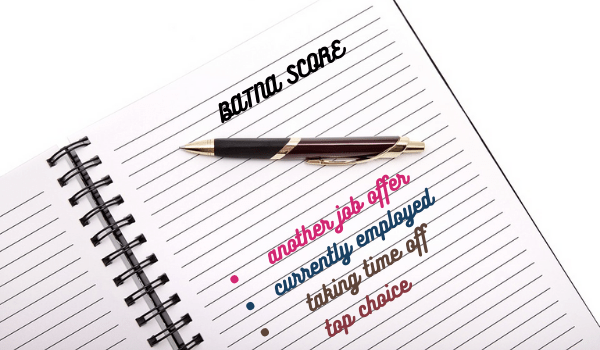
    BATNA provides four situations to the candidates as follows:

    • Do you have another job offer?
    • Are you currently employed?
    • Would you consider taking time off?
    • Is this job your top choice?

    Now for a positive answer to the first three questions, the candidates get one point, but for the fourth question, a negative answer gets one point. So the maximum score is four and minimum is zero.

    For candidates with a BATNA score of 0, it is advisable to take up the offer immediately, as they are on the weakest side. There is absolutely no scope for any negotiation. They will have to be prepared for the employer trying to cut costs and even offering below-the-market standards.

    Those who manage to get a BATNA score of one, may still try to negotiate, but they need to keep in mind that they have very limited strengths to negotiate. In this case, the negotiation will depend on the candidates’ negotiating prowess, and the ability to hold on to their stand. It can be a matter of sheer luck, and the decision can swing in either direction, so one has to be really careful.

    A BATNA score of two is good, and it provides some scope for negotiation. In this case, the outcome of the negotiation may depend on the external market situation, and the individual market value of the candidates. If both are favourable, the candidates may be somewhere near their aspirational salary.

    Those with a BATNA score of three and above, can be assured of having an upper hand at the negotiation table. They can actually call the shots during the negotiations. They are the ones companies will like to get on board even at a higher price.

    Salary negotiations require analytical thinking, clear communication, emotional intelligence, and context-specific knowledge. Candidates are advised to not go overboard. For any job, the employer has already fixed an upper limit of the salary before getting on to the negotiation table. Now, any attempt to cross the upper limit will be quashed by the employer, and he may just leave the negotiating table. This will only mean that the candidate has missed out on the opportunity. It’s good to be ambitious, but overambition may lead to the candidates failing to evaluate their own strengths and capabilities.

    BATNA has become even more relevant today, because many have lost their jobs during the pandemic. Yet, these job seekers expect a 30-40 per cent jump over their current salaries. It is good to be desirable, but being adamant and stuck on one’s previous salary can be devastating.

    Similarly, there could be a BATNA score for the employers and organisations as well. Both for the employers and the candidates, evaluating the opponent’s BATNA score can turn out to be a master stroke in terms of negotiating tactics.

    Some companies also use WATNA, or the worst alternative to a negotiated agreement at the negotiating table. Organisations pre-evaluate the situation and think of the worst outcome, if and when they need to leave the negotiating table.

    BATNA score best alternative best alternative to negotiated agreement candidates evluate candidates Interview self-evaluation WATNA worst alternative to a negotiated agreement
    Share. LinkedIn Twitter Facebook WhatsApp
    HRK News Bureau

    Leave A Reply Cancel Reply

    Related Posts

    70% festive jobs go to talent with up to 6 years of experience

    October 6, 2026

    224 engineering, IT, ops jobs waiting in India’s bullet train project

    June 26, 2026

    Emids to hire 1,000 AI context engineers for healthcare GCCs

    June 8, 2026

    Age limit raised for West Bengal government jobs

    May 19, 2026
    zoha
    Editorial

    Hard work built India’s global reputation. Availability cannot define its future

    I must have been in school when I first heard the slogan. I was passing…

    The rift between the corner office and the floor below

    A general manager at a large Indian steel conglomerate recently described an exchange with his…

    EDITOR'S PICKS

    Why professionals keep applying for jobs they don’t want

    November 10, 2026

    HITL: Why the human is still in the loop

    November 10, 2026

    The HR question that has no perfect answer

    November 6, 2026

    herSTORY: Nandini Matiyani, GCHRO, Strides

    November 5, 2026
    Latest Post

    MP to build awareness of Labour Codes with Shram Samvad

    Brief News November 10, 2026

    The Ministry of Labour and Employment (MoLE), Government of India, in collaboration with the Labour…

    Suman Saurav takes charge as head-HR at Hindustan Zinc’s Debari operations

    Movement November 10, 2026

    Hindustan Zinc has elevated Suman Saurav to head of HR at its Zinc Smelter Debari…

    Qantas plans to cut 850 jobs

    Brief News November 10, 2026

    Australian airline Qantas plans to eliminate around 850 jobs and outsource several corporate functions to…

    Why professionals keep applying for jobs they don’t want

    Exclusive Features November 10, 2026

    Lunch break, phone in hand, a scroll through vacancies. Another application goes out before bed.…

    Asia's No.1 HR Platform

    Facebook X (Twitter) Instagram LinkedIn WhatsApp Bluesky
    • Our Story
    • Partner with us
    • Career
    • Reach Us
    • Exclusive Features
    • Cover Story
    • Editorial
    • Dive into the Future of Work: Download HRForecast 2024 Now!
    © 2026 HRKatha.com
    • Disclaimer
    • Refunds & Cancellation Policy
    • Terms of Service

    Type above and press Enter to search. Press Esc to cancel.