

Close Menu
    Facebook X (Twitter) Instagram
    • Our Story
    • Partner with us
    • Reach Us
    • Career
    Subscribe Newsletter
    HR KathaHR Katha
    • Exclusive
      • Exclusive Features
      • Perspectives
      • Friday Features
      • herSTORY
      • Rising Stars
      • Case-In-Point
      • Point Of View
      • Research
      • HR Pops
      • Dialogue
      • Movement
      • Profile
      • Beyond Work
      • By Invitation
    • News
      • Global HR News
      • Compensation & Benefits
      • Diversity
      • Events
      • Gen Y
      • Hiring & Firing
      • HR & Labour Laws
      • Learning & Development
      • Merger & Acquisition
      • Performance Management & Productivity
      • Talent Management
      • Tools & Technology
      • Work-Life Balance
    • Special
      • HR Forecast 2026
      • Cover Story
      • Editorial
      • HR Forecast 2024
      • HR Forecast 2023
      • HR Forecast 2022
      • HR Forecast 2021
      • HR Forecast 2020
      • HR Forecast 2019
      • New Age Learning
      • Coaching and Training
      • Learn-Engage-Transform
    • Magazine
    • Reports
      • Whitepaper
        • HR Forecast 2024 e-mag
        • Future-proofing Manufacturing Through Digital Transformation
        • Employee Healthcare & Wellness Benefits: A Guide for Indian MSMEs
        • Build a Future Ready Organisation For The Road Ahead
        • Employee Experience Strategy
        • HRKatha 2019 Forecast
        • Decoding and Driving Employee Engagement
        • One Platform, Infinite Possibilities
      • Survey Reports
        • Happiness at Work
        • Upskilling for Jobs of the Future
        • The Labour Code 2020
    • Conferences
      • Leadership Summit 2025
      • Rising Star Leadership Awards
      • HRKatha Futurecast
      • Automation.NXT
      • The Great HR Debate
    WhatsApp LinkedIn X (Twitter) Facebook Instagram
    HR KathaHR Katha
    Home»Exclusive Features»Research»Enhancing capability; top priority for India Inc.
    Research

    Enhancing capability; top priority for India Inc.

    mmBy Dr. Prajjal Saha | HRKathaJanuary 27, 20153 Mins Read3906 Views
    Share LinkedIn Twitter Facebook WhatsApp
    Share
    LinkedIn Twitter Facebook WhatsApp

    McKinsey & Company’s follow-up study reveals that most companies continue to use traditional capability-building methods, even though their needs have evolved…

    More corporate employees in India and China, in comparison to their global counterparts, realise the importance of development of organisational and individual capabilities. Recently, management consulting firm, McKinsey & Company, did a follow up to their 2010 study on organisational capability-building.

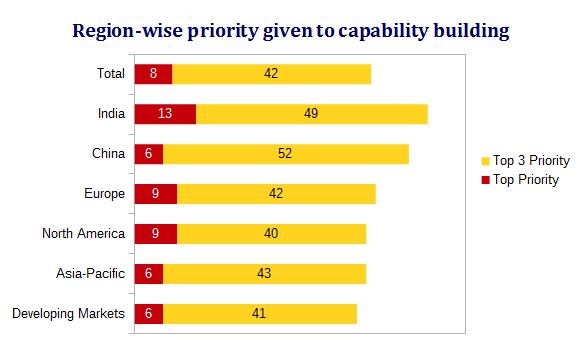
    The report revealed that 62 per cent of respondents in India and 58 per cent in China, claimed that organisational capability-building was top priority for them. This was higher than the global average of 50 per cent. Even for Europe and North America, the figure stands at 51 per cent and 49 per cent, respectively. Five years back, only 20 per cent of respondents in India and 16 per cent in China had listed this as top priority.

    With an increasing number of growing companies, India and China are believed to be facing significant capability gaps as their companies expand. This is the reason why more Indian and Chinese companies prioritise skill development.

    The report stated that while the capability needs of companies have evolved globally, their capability-building methods have not kept pace with the demand.

    Most companies still employ the same traditional tools, like on-the-job training. Offsite learning programmes, mobile learning exercises and group-based online courses are still to be explored as means of skill development by most companies.

    It is seen that companies prefer to focus on enhancing the competency of individual employees who are important for the organisation’s growth than on the overall development of all employees. When it comes to employee groups, companies put the frontline staff on top of the priority list followed by senior leadership. Technical staff and frontline supervisors are placed at the bottom of the list.

    To remain relevant, companies need to look at the long term. They not only need to integrate sustaining capabilities but also link learning to company performance for their capability-building programme.

    Enhancement of institutional and individual capabilities is given priority on the basis of two factors —customer demand and matters of strategic importance. The third significant factor is the need to match up to the capabilities of competitors.

    One of the biggest hindrances in adopting capability development measures has been the absence of a credible metrics for evaluation of the impact of skill development on business growth. Very few companies have been observed to have a robust approach to the assessment of their current capabilities and identification of skill gaps. Instead of a scientific approach, internal assessments are still the preferred methods for identification of capability needs.

    Lack of a clear vision and resources are the other reasons why companies are not so enthusiastic about capability development. Interestingly, organisations’ resistance to change and willingness to try new methods have been on the decline since 2010, at the global level.

    The demand for capability-building was given importance in the 2010 study as well, but in 2014, the respondents said there were changes in capability-related needs and challenges.

    Most respondents believed that the biggest contributor to a company’s business performance was leadership skills followed by functional capabilities. Executives ranked skills in strategy, operations, sales and marketing as the most important to business performance.

    The latest survey covering executives from all regions, sectors and company sizes has found that there is a need to focus on different sets of skills, tools and systems and different sets of employees in order to retain competitive edge.

    China India India Inc McKinsey Skill Development
    Share. LinkedIn Twitter Facebook WhatsApp
    mm
    Dr. Prajjal Saha | HRKatha

    Dr. Prajjal Saha is a business journalist and the editor-publisher of HRKatha. He writes on the realities of work and organisations, offering a clear-eyed view of how companies translate intent into action—often revealing the gap between the two. With over 25 years of experience, he focuses on interpreting workplace trends and leadership decisions in a way that is both insightful and accessible. He founded HRKatha in 2015 to create a platform for credible, insight-driven analysis of the evolving workplace.

    Leave A Reply Cancel Reply

    Related Posts

    UAE mandates worker insurance for new private sector hires

    July 24, 2026

    PepsiCo to cut 184 warehouse jobs at Tulsa facility

    July 24, 2026

    Delhi Police suspends routine leave amid heightened security deployment

    July 24, 2026

    Meghalaya signs revised SBI pact, enhances banking and insurance benefits for 43,000 government employees

    July 24, 2026
    zoha
    Editorial

    India’s IT services industry built the talent. Its biggest clients are now hiring it directly through GCCs

    Something significant is happening to India’s technology workforce in 2026. Most people are describing the…

    The interview was never measuring what we thought it was

    I was speaking recently to the HR Head of a mid-sized IT company about hiring.…

    EDITOR'S PICKS

    Career myths employees need to stop believing

    July 24, 2026

    Case-in-Point: The salary transparency trap

    July 23, 2026

    herSTORY: Priyanka Anand, VP & Head-HR, Ericsson Southeast Asia, Oceania and India

    July 23, 2026

    AI is not replacing workers. It is replacing the youngest ones first

    July 22, 2026
    Latest Post

    HCLTech’s Odisha AI data centre to create 6,000 high-skilled jobs

    News July 24, 2026

    HCLTech is set to build its first AI-optimised data centre in India in Bhubaneswar, Odisha,…

    UAE mandates worker insurance for new private sector hires

    Global HR News July 24, 2026

    Private-sector employers in the UAE will now be required to purchase worker insurance for every…

    PepsiCo to cut 184 warehouse jobs at Tulsa facility

    News July 24, 2026

    PepsiCo will eliminate 184 warehouse positions at its Tulsa, Oklahoma, facility, with employee separations scheduled…

    Delhi Police suspends routine leave amid heightened security deployment

    News July 24, 2026

    The Delhi Police has temporarily suspended routine leave for its personnel to ensure adequate manpower…

    Asia's No.1 HR Platform

    Facebook X (Twitter) Instagram LinkedIn WhatsApp Bluesky
    • Our Story
    • Partner with us
    • Career
    • Reach Us
    • Exclusive Features
    • Cover Story
    • Editorial
    • Dive into the Future of Work: Download HRForecast 2024 Now!
    © 2026 HRKatha.com
    • Disclaimer
    • Refunds & Cancellation Policy
    • Terms of Service

    Type above and press Enter to search. Press Esc to cancel.