



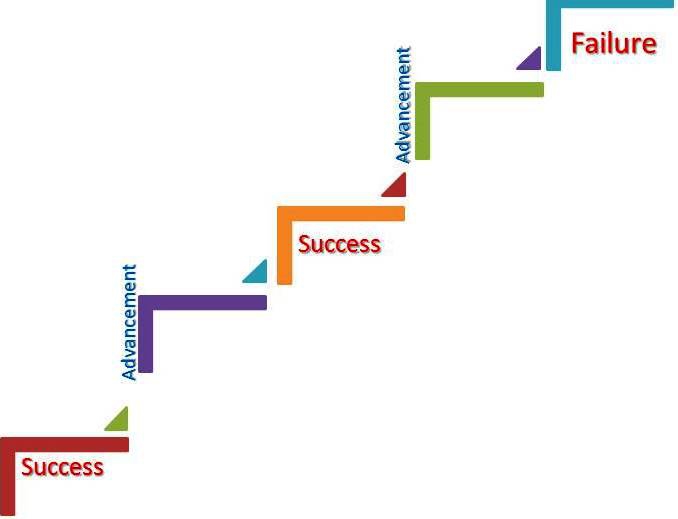
The Principle was definitely applicable when individual careers were typically stable, linear and mostly confined to one company. Surprisingly, in the new workplace, the rule still holds true, though the context has changed.
The Peter Principle, formulated by Laurence J Peter in 1968, observes that in an organisational hierarchy, every employee will rise or get promoted to his or her level of incompetence.

What it implies is that in a hierarchical environment, people will receive promotions so long as they work competently. Eventually, they will be promoted to a position at which they are no longer competent—their level of incompetence. This will lead to a situation where they are unable to get further promotions, and eventually, they clog the pipeline for those who can still move up. Over time, every position in the hierarchy will be filled by someone who is not competent enough to carry out his or her new duties.
If we go back in time, we will observe that the Peter Principle was relevant when businesses were largely local and competition was significantly low. Besides, individual careers were mostly stable, linear, and in the majority of cases, confined to one company. And lastly because ‘seniority’ was a dominant consideration over potential, and capability was equated to experience as learning happened mostly ‘on-the-job’.
Much has changed over the last decade or so. So, the question is whether the Peter Principle is relevant today?

The answer is arguably ‘no’ in the present context. The workplace environment which formed the basis of the premise of Laurence Peter’s philosophy isn’t relevant today.
Having said that, it’s also true that the core of the Peter Principle—that incompetency finally takes the lead— is relevant even today, though the reasons can be varied.
“This observation was made years before the word ‘attrition’ entered into the HR Manager’s lexicon, signifying the changed paradigm of the increasing power of an employee to choose another employer over the current one,” says Lalit Kar, head-HR, Mumbai International Airport.
“The personnel manager always expressed this phenomenon in terms of a more benign ’employee turnover’. In the same token, the companies did not plot their employees’ performance over a normal distribution curve for differential rewards,” explains Kar.
True, but it is relevant in the current socioeconomic and employment context in India.
“The way some people-intensive industry sectors have grown in the recent past, the promotion decisions seem to have overlooked the ‘candidate’s preparedness’ part,” Sanjeev Parkar, executive director, human capital, PricewaterhouseCoopers.
“The way some people-intensive industry sectors have grown in the recent past, the promotion decisions seem to have overlooked the ‘candidate’s preparedness’ part.”
The employers of millennials are increasingly adopting the aggressive growth target, recognising the employees’ expectations through a commensurate rewards mechanism which also includes a fast-tracked career path.
“The fast-track promotions at the senior level also snow-ball/ cascade down, and therefore, the ‘vacuum at the next-level role’ gains more weightage over the ‘candidature’, says Parkar.
It all started in the late 1990s and thereafter, when the world became globalised and connected, and seamless talent flow became a phenomenon.
With many emerging businesses mainly driven by IT and Internet technologies, there was a shortage of talent. If earlier jobs were scarce; now talented people were scarce.
In such a situation, even if employees were not fully ready, they were offered jobs because that was the best the market could offer.

On the other hand, high mortality of the companies — partly due to competition and partly due to the inability to adopt change— made them less tolerant to suboptimal performance.
“It’s a VUCA time. Changes in the business model typically carve out a niche, which may not be supported by corresponding suitable talent in the market. We are going through too many changes at this stage. Any employee, who is the nearest match, gets picked up for the role,” Parkar asserts.
In addition, we all accept that it is difficult to get a ‘full-fledged’ employee for the requisite role within or outside the organisation. This sheer fear of losing the key resources to the market keeps the managers from holding and handling difficult career/promotion conversations with the employees.
This has led to a situation where many yet-to-be-competent managers still hold many important positions, for the sheer reason that they are the best from the available talent for the company.
“Whether we like it or not, the above factors have given rise to a set of employees who have been promoted to their level of incompetence in today’s context. Peter Principle does look relevant today,” quips Parkar.
Admittedly, these factors may change with the efflux of time, changes in the market conditions and classical demand-supply format. “However, it is too ideological to assume that the above factors would go away on its own without organizational intervention,” states Parkar.
It is really a catch-22 situation in which both, the employee and the business, are intolerant.
“Companies expect loyalty from the top performers, who have a market outside. Similarly, the middle-level performers —the so called solid pros—look for opportunities beyond their company,” says Kar.
“This observation was made years before the word ‘attrition’ entered into the HR Manager’s lexicon, signifying the changed paradigm of the increasing power of an employee to choose another employer over the current one.”
In this VUCA world, the companies know that ‘émployee loyalty’ is a thing of the past. Similarly, employees consider frequent ‘job change’ as a vehicle to growth — staying long with a company is clearly taboo today.
So how can we try and minimise the effect of Peter Principle?
1) By using potential assessment tools to predict the suitability for the next level role as opposed to relying upon the past performance as the measure to promote employees. By using the classical nine box performance – potential matrix to manage your talent
2) By providing essential and crucial career coaching to the stagnated employees so as to help them with reality check. Let them know ‘what got them here may not keep them here’. By taking them out of their comfort zones so that they are open to alternate career options.
3) By devising an alternate career path mechanism so that the employees who are incompetent for their current roles can pursue a different career path and make way for their successors; by creating an ecosystem to bring respect for flexible/ alternate career paths so that the employees availing the same can experience the grace in it.
4) By revisiting the training and development plan regularly; and reskilling the employees in order to improve retention and career certainty, and also enhance employee motivation.
The Peter Principle constitutes a good directional work/ guidance and may not hold true in all situations. While we are experiencing an upswing in some industry sectors, and they are propagating the bold action of an aggressive career path model, this principle will make them pause for a moment to think about the long-term sustenance of the business and the careers of the people associated with them.
Besides, it is important to remember that incompetence is more a function of technology and market, than individual ability. Therefore, the best can also lose their jobs just because business is no more relevant to the market.
5 Comments
Great insights; Lalit Kar and Sanjeev.
I have been in the business of HR for the last 40 years. And I can see that Mr Peter is right, and there is always that element of stagnancy at some level, even at the CEO level, which make a competent incompetent.
Relevance can be seen with number of top head rolling, or quitting to a new organization, whether it is in India or US or Germany, the base story remains same. Some tell the same story slightly differently for their own advantage. Nothing wrong in it, but PETER is still alive.
Very good write-up. Peter principle applies every where. It effects more in the stagnant organisation and less in to the dynamic organisation. The solution is to make the promotion policy linked with the vacancy and job enrichment, not to the length of service and contribution at the same position.
Some times Selection process also responsible for this kind of blockage for the successors…selection error is costly error…measure of competency in one or two round of interview is not an easy task…..
Great article. So relevant. When you combine the Peter Principle with the fact that people leave managers, not companies. we begin to see why attrition happens.