


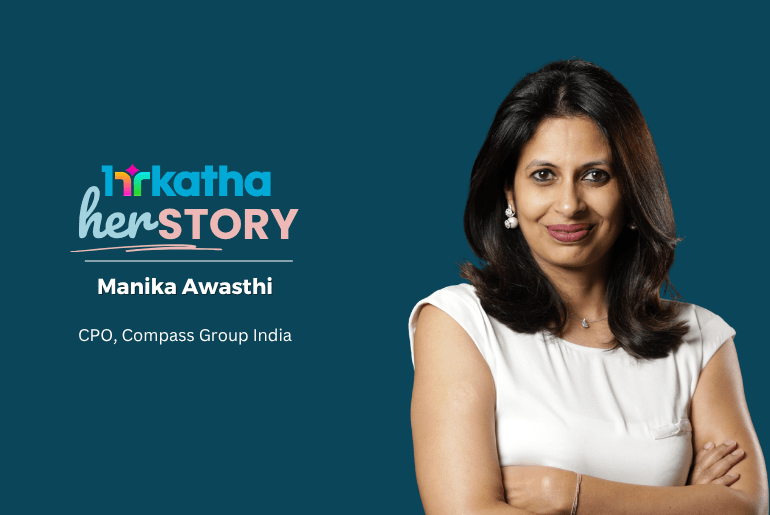
Walking away from certainty
After 14 years at Sapient, Manika Awasthi had built credibility, strong relationships and a career that felt comfortable. She knew the business inside out, people knew her, and she could probably have stayed for many more years.
But somewhere along the way, a difficult question began surfacing. Was she still growing, or had she simply become comfortable?
She left to join the aviation industry, stepping into an unfamiliar business with a very different pace and environment. It meant learning a new industry, adapting to an Indian setup and proving herself all over again. During those first few months, there were moments when she wondered whether she had made the right decision.
Today, as chief people officer at Compass Group, Awasthi is glad she trusted her conviction. Years later, when she joined Compass, she found herself at another crossroads and recognised it for what it was: another opportunity to stretch herself.
“For me, the biggest risk wasn’t changing companies. It was choosing to walk away from certainty,” she says.
Those leaps taught her that growth rarely happens when everything feels familiar.
“You’ll never feel 100 per cent ready for the opportunities that truly change you. Sometimes you simply have to take the leap and trust that you’ll learn along the way,” she says.
Every time Awasthi has stepped outside her comfort zone, she has discovered capabilities she did not know she possessed. But she is equally clear that growth is not about chasing change merely for the sake of it.
“Growth isn’t about chasing change for the sake of it. It’s about having the confidence to challenge yourself, the humility to start learning again, and the faith that every new experience will leave you better than before,” she observes.
“The biggest risk wasn’t changing companies. It was choosing to walk away from certainty.”
People initiatives that enable business
For Awasthi, strategic HR begins with a simple question: what business problem are we trying to solve?
If that question cannot be answered, she believes an initiative is unlikely to create the impact intended.
She has never believed in creating HR programmes merely because other organisations are doing them. Whether the task is building leadership capability, introducing technology or strengthening culture, the starting point has to be the business. What is the organisation trying to achieve? What is holding it back? How can people enable that growth?
She points to the Samarth App, Compass Group’s multilingual digital learning platform, as an example. It was not built because the organisation wanted another learning platform. The need came from having a large, geographically dispersed frontline workforce.
“We needed a scalable way to build capability, ensure consistent learning, and make development accessible to every employee on the go, regardless of where they are or the language they speak,” she says.
Today, the platform allows learning to reach thousands of employees.
That, for Awasthi, is what strategic HR looks like in practice: people initiatives that do not sit alongside business strategy but actively enable it.
She also reminds her team that strategy does not happen in meeting rooms alone. It requires staying close to the business, spending time with leaders, visiting sites, listening to employees and understanding what is actually happening on the ground.
When HR earns the trust to solve business challenges, rather than only people challenges, she believes its relationship with the organisation fundamentally changes.
Paying it forward
Over the years, Awasthi has watched women she has mentored go on to lead teams, take on larger responsibilities and build successful careers of their own.
“Watching them grow in confidence and become leaders is one of the most fulfilling parts of my job,” she says.
Her team has consciously invested in creating opportunities for talent to grow, including leadership development programmes for high-potential employees and a global women’s leadership programme that brings women from different countries together to learn, network and gain exposure to senior leaders.
But Awasthi believes some of the most consequential mentoring happens outside formal programmes.
It can be a conversation over coffee, a debrief after a difficult meeting, or simply encouraging someone to accept an opportunity they are not entirely convinced they are ready for.
She has benefited from leaders who trusted her with opportunities that stretched her long before she felt completely prepared for them. That is something she now consciously tries to pay forward.
“Sponsorship is about creating opportunities, backing people when they’re not in the room, and trusting them with responsibilities that help them grow. Sometimes all someone needs is another person saying, ‘I think you’re ready’,” she says.
An evolving understanding of HR
Awasthi has long been fascinated by the untapped potential people carry and how dramatically that potential can emerge when someone believes in them or gives them the right environment.
She remembers seeing this during her early years at GE. A thoughtful conversation, timely feedback or simply a leader demonstrating belief in someone could change how that individual viewed themselves and their career.
It made her realise that HR was never simply about policies and processes. It was also about creating the conditions in which those moments could happen.
As her career evolved, so did her understanding of the profession.
“The best HR leaders don’t choose between people and business. They just connect the two,” she says.
Build capable leaders, create the right culture and enable people to perform at their best, she believes, and business results follow.
More than two decades into her career, that possibility still excites her.
“Every day is an opportunity to shape careers, strengthen organisations, and hopefully leave people a little more confident than they were before we met,” she says.
Being kinder to herself
One of the more difficult pressures Awasthi encountered in her career did not come from the organisation. It came from herself.
After becoming a mother, she returned to work much sooner than she now believes she should have, worried that stepping away for even a few months might slow her career.
Looking back, she recognises that the fear was largely her own.
Over time, she learnt to see a career as a marathon rather than a sprint.
“A few months don’t define your journey, but the choices you make for yourself and your family during those moments stay with you forever,” she observes.
The experience taught her to be kinder to herself and stop measuring success solely by how quickly she was moving.
It also changed the way she leads. Today, she encourages people, particularly young women, to understand that asking for support, taking a pause when life demands it, or choosing a different pace for a period does not diminish ambition.
“Leadership isn’t about constantly proving yourself. It’s about making choices that are true to who you are and having the confidence to own them,” she says.
Awasthi describes herself today as a more grounded, authentic and empathetic leader, comfortable with the idea that no one is running the same race. Everyone has a different journey, pace and set of priorities.
“The best HR leaders don’t choose between people and business. They connect the two.”
Quick fire round
If HR were a movie genre, which one would your career story fit into: drama, comedy or action thriller?
Definitely an action thriller, with a lot of heart. HR is never predictable. There are constant twists, challenges, and moments that push you to learn and adapt. I have had a journey of building, transforming, and most importantly, understanding myself better with every chapter.
One leadership mantra you swear by when things get tough?
Lead with empathy, act with courage. When things get tough, focus on understanding people, staying grounded, and making decisions that are right in the long term.
An HR practice you would instantly retire if you had the power?
The traditional approach of HR being the sole owner of employee development. Managers play the most important role in shaping people’s growth. HR can enable, but real development happens through everyday conversations and experiences.
Coffee, meditation or power walk, what’s your go-to ritual before a big decision?
Chanting. It’s my way of pressing pause. It helps me silence the noise, find clarity, and approach decisions with a calmer mind. It reminds me to respond thoughtfully rather than react quickly.
A person who shaped your success the most, and what unforgettable lesson did they leave you with?
I think my dad shaped my success the most. He taught me that with hard work and grit, you can achieve anything in life. Having lost his father when he was four, he studied hard, under a lamp post on some days, and made it to the first batch of IIT in Powai. I am hugely proud of him, and I carry that lesson with me every day.
Earning a seat at the table
Whenever an organisation faces a defining challenge, whether rapid growth, transformation, crisis or cultural change, the conversation eventually comes back to people.
A strategy succeeds only if people believe in it, have the capability to deliver it and are willing to move with it.
That conviction has grown stronger for Awasthi over the years.
“The most effective HR leaders don’t just build policies or manage talent. They challenge assumptions, bring a people lens to business strategy and help organisations make decisions that are both commercially sound and sustainable,” she says.
For her, that is when HR earns its place in the leadership conversation, not because someone has formally invited the function in, but because the business cannot move forward effectively without its perspective.
An empowering workplace culture
Awasthi’s biggest cultural non-negotiable is creating an environment where people feel seen, heard and valued, irrespective of their role, background or where they sit in the organisation.
She has come to believe that empowerment is about much more than giving people opportunities. People must also feel trusted, respected and confident enough to use those opportunities.
An empowering workplace, in her view, is one where people believe they matter because of the contribution they make, rather than their designation.
Do people feel they belong? Does their voice matter? Do they have room to grow?
For Awasthi, those questions reveal far more about a culture than any statement of organisational values.
Lessons that stayed
Among the leaders who influenced Awasthi’s career, Raj Raghavan played a defining role. From him, she learnt the value of authentic leadership, of having the team’s back and remaining humble regardless of how senior one becomes.
But her deepest influence came from her father.
Having lost his own father at the age of four, he studied through difficult circumstances, sometimes under a lamp post, and eventually made it into the first batch of IIT Powai.
His journey left her with a lesson she still carries: hard work and grit can change the trajectory of a life.
1 Comment
Thanks for sharing Manika Awasthi’s story. Empathy, courage and a challenger mindset stands out here. This is inspiring and real.