


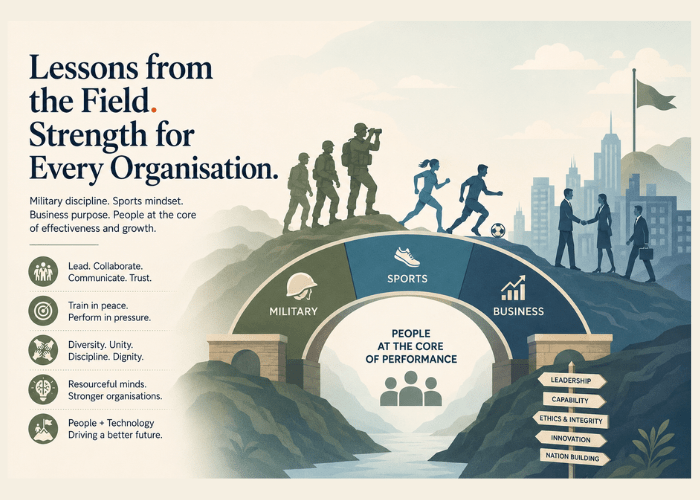
Human Resources needs to research and study different forms of organisations, such as the military, and understand how sports-based capability interventions can enhance productivity by driving effectiveness across a wide range of management areas.
Across the world, at every point in history, every national armed force has been a source of pride for its people. Though the armed forces differ widely from any other form of organisation – they are responsible for protecting national sovereignty – they set an example of the direction, standards and quality that any organisation should strive to attain, particularly in how to manage and develop people.

Leadership in the military is something that has been widely written about and researched for learning and adapting broad models into business management.
At the foundational level, both military and business organisations are built around the people factor. Businesses need to provide goods and services to the communities they serve. Products and services should be delivered ethically, with quality and integrity, while generating wealth and profit. Both the military and business have reputations to protect.
Just as the Army is responsible for upholding national sovereignty, businesses must uphold the national interests of the country and its people on the economic and business front – through their contributions towards CSR, sustainability initiatives, the environment, health and safety, financial and accounting integrity, and quality standards. When it comes to nation-building, people and profit need to go hand in hand.
The ability to navigate a complex geopolitical world and create economic opportunities requires knowledge of a wide range of subjects. People are at the core of every business, as all development comes from the human mind. For the military, it is the soldier who is at the core of its efforts and strategy. For businesses as well, the workforce is at the core of wealth creation. Just as the military is built on training, business is built on capability building.
“The more you sweat in peace, the less you bleed in war.” My father, who served in the Air Force, shared this with me as a guiding principle when planning any initiative. Doing the homework is critical before undertaking any crucial endeavour.
The military has a vast range of learning to offer. It is one of the oldest forms of organisation, and almost every civilisation and nation-state has adopted concepts and organisational structures from military models of working, organising, logistics, communication and hierarchy. The field of management in India has much more to research and learn from different forms of organisations – such as the military and sports – to create solutions for enhancing productivity across a wide range of management areas. This cross-learning is useful not only in providing different perspectives but also in enabling the creation of better HR initiatives.
Research highlights areas of concern regarding how effectiveness and outcomes are impacted by factors such as the inability to lead, collaborate, make decisions, communicate, and build trust and relationships, as well as a toxic work culture. A simple attribute such as a lack of sense of humour has a correlation with workplace stress. Opaque policymaking leads to ethical issues, poor quality and a toxic organisational culture.
Business is all about trust, quality and engaged employees who are happy. These take years to build, and that is one reason why the defence forces are people-centric organisations.
Defence forces are organisations where people live, eat, play and celebrate together, creating a culture of unity in diversity. One gets to thrive with one’s uniqueness while remaining an integral part of the force.
Discipline, human dignity, diversity, inclusiveness and organisational culture are a few areas from which management specialists can learn a great deal. Military- and sports-based concepts can also be successfully amalgamated into instructional design, benefiting participants in leadership development and management development programmes.
We are often too fixed on what our functional, industry and business models have done in the past, and invest significant effort, time and resources in replicating what has traditionally been done. This is easy because we have templates and metrics to measure outcomes. The limitation of this model is that it overlooks effectiveness and focuses only on efficiency – missing the effectiveness-versus-efficiency gap entirely.
We also view the same work activity repeated by someone for five years as five years of experience. It is actually the same experience repeated for five years. We create organisations with people who are not necessarily resourceful enough to make an impact.
Resourcefulness is perhaps the most important concept that learning from the military brings into the corporate boardroom. At its core lies the T-shaped talent model – requiring a resource to have depth in one functional area while possessing the knowledge and ability to integrate other functions into their domain. It requires deep experiential insight and the ability to collaborate.
The defence forces can teach simple and cost-effective ways to solve complex business problems.
Apart from the defence forces as disciplined organisations, two important areas of learning for business leaders are military battles and the strategies and leadership styles of great military figures such as Field Marshal Sam Manekshaw (Bangladesh Liberation War, 1971), General George S. Patton Jr., , and Tomoyuki Yamashita from the World War II period.
A fitting example to conclude with comes from our own national freedom struggle during World War II, led by Netaji Subhash Chandra Bose. He built the Indian National Army from scratch and advanced right up to the Andaman and Nicobar Islands and northeast India. The INA fought some of the toughest battles of the World War II period, including the 1944 Arakan Offensive, which encompassed the Battles of Imphal and Kohima.
The INA built an effective organisation with a distinct cultural identity, and achieved all this within a short span of time and with limited resources. It had one of the most ethnically and culturally diverse groups of soldiers, yet was one of the most united and professional bodies of fighters. Together, they accomplished something historic during difficult times, something people will continue to draw inspiration from while building institutions and organisations that make a difference.
Today, we need good leaders who know how to create opportunities and guide their teams, and we need team members who can be resilient, collaborative and eager to learn — just like soldiers. Future organisations will use AI in much the same way that modern armies use drones. People and technology will co-create, while human intelligence will continue to drive innovation and growth. Failing to learn and develop capability will lead to an existential crisis.
The author, Anirban R Banerjee is vice president, human resources at Goodrich Maritime.
