


Close Menu
    Facebook X (Twitter) Instagram
    • Our Story
    • Partner with us
    • Reach Us
    • Career
    Subscribe Newsletter
    HR KathaHR Katha
    • Exclusive
      • Exclusive Features
      • Perspectives
      • Friday Features
      • herSTORY
      • Rising Stars
      • Case-In-Point
      • Point Of View
      • Research
      • HR Pops
      • Dialogue
      • Movement
      • Profile
      • Beyond Work
      • By Invitation
    • Brief News
      • Global HR News
      • Compensation & Benefits
      • Diversity
      • Events
      • Gen Y
      • Hiring & Firing
      • HR & Labour Laws
      • Learning & Development
      • Merger & Acquisition
      • Performance Management & Productivity
      • Talent Management
      • Tools & Technology
      • Work-Life Balance
    • Special
      • Editorial
      • HR Forecast 2026
      • Cover Story
      • HR Forecast 2024
      • HR Forecast 2023
      • HR Forecast 2022
      • HR Forecast 2021
      • HR Forecast 2020
      • HR Forecast 2019
      • New Age Learning
      • Coaching and Training
      • Learn-Engage-Transform
    • Studio
      • The CHRO Playbook
      • Quick HR Insights
      • The Corner Office
    • Reports
      • Whitepaper
        • HR Forecast 2024 e-mag
        • Future-proofing Manufacturing Through Digital Transformation
        • Employee Healthcare & Wellness Benefits: A Guide for Indian MSMEs
        • Build a Future Ready Organisation For The Road Ahead
        • Employee Experience Strategy
        • HRKatha 2019 Forecast
        • Decoding and Driving Employee Engagement
        • One Platform, Infinite Possibilities
      • Survey Reports
        • Happiness at Work
        • Upskilling for Jobs of the Future
        • The Labour Code 2020
    • Forums
      • HRKatha Inner Circle
      • HRKatha Futurecast
      • Leadership Summit 2025
      • Rising Star Leadership Awards
      • HRKatha Futurecast 2025
      • Automation.NXT
      • The Great HR Debate
    WhatsApp LinkedIn X (Twitter) Facebook Instagram
    HR KathaHR Katha
    Home»Exclusive Features»HR Pops»The Sakai Principle: When excellence becomes a threat
    HR Pops

    The Sakai Principle: When excellence becomes a threat

    How the pressure to conform can suppress individual success, and why organisations that claim to value innovation often struggle to sustain it
    mmBy Liji Narayan | HRKathaApril 14, 20263 Mins Read17634 Views
    Share LinkedIn Twitter Facebook WhatsApp
    Sakai Principle: the pressure to conform, HR Pops
    Share
    LinkedIn Twitter Facebook WhatsApp

    What does the Sakai Principle mean?

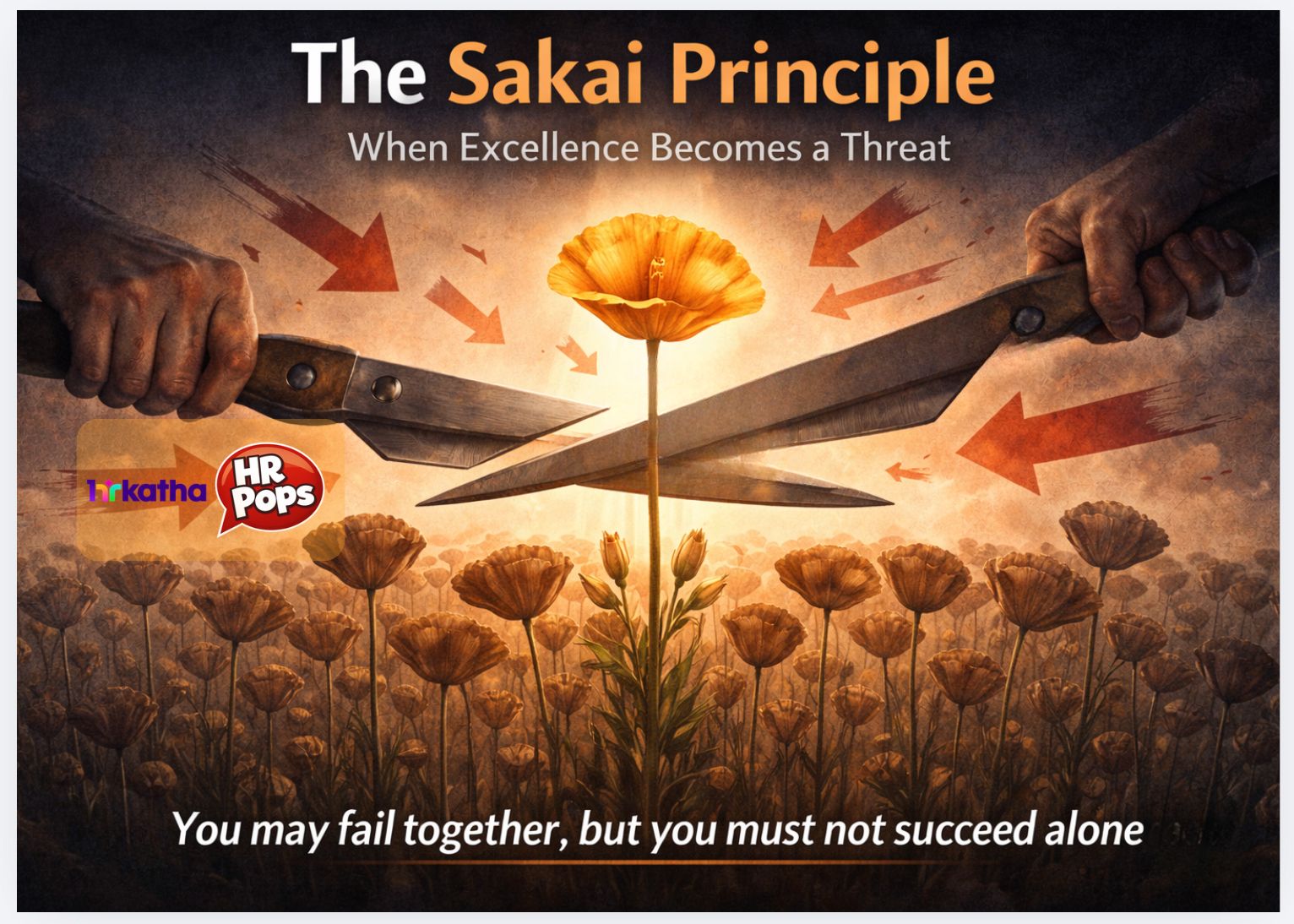
    The Sakai Principle, a term sometimes used to describe group dynamics at work, refers to the tendency within organisations to resist individual success when it outpaces the group.
    It can be summarised simply: you may fail together, but you must not succeed alone.

    The idea highlights a paradox. Whilst organisations claim to reward excellence, group dynamics often favour uniformity over standout performance.

    Employees who exceed expectations, challenge norms, or introduce new ideas may be met with subtle resistance rather than support. Over time, this pressure to conform discourages innovation and limits individual contribution.

    Where did the idea come from?

    The concept draws from broader behavioural patterns observed in both social and organisational settings.

    In psychology, similar dynamics are captured by ideas such as groupthink and tall poppy syndrome, where individuals who stand out are often pulled back by the group.

    In organisations, this tendency is amplified by hierarchy, performance systems, and cultural expectations. Individual success can disrupt the status quo, expose gaps in others’ performance, and challenge established power structures.

    The result is a quiet but persistent force that encourages conformity over excellence.

    Why is it relevant for HR?

    The Sakai Principle has significant implications for workplace culture and performance. Innovation becomes constrained when employees hesitate to propose bold ideas if standing out invites resistance. Collaboration weakens as teams prioritise fitting in over contributing meaningfully. Mediocrity becomes normalised when average performance is accepted whilst excellence feels risky. Talent exits when high performers disengage or leave because they feel held back. In environments that require agility and creativity, this dynamic can quietly undermine competitiveness.

    The uncomfortable truth

    Organisations often reinforce the very behaviour they claim to resist.

    Performance systems that overemphasise team outcomes can discourage individual initiative. Promotion criteria based on “cultural fit” may favour conformity over constructive challenge. Recognition programmes that celebrate collective success but overlook individual contribution send mixed signals.

    Even everyday language reflects this bias. Terms such as “team player” and “collaborative” can sometimes be interpreted as expectations to avoid disruption.

    In such environments, high performers may be managed rather than enabled. Their contributions are diluted, redirected, or deferred in the name of alignment.

    The outcome is predictable. Organisations speak of innovation, but struggle to sustain it.

    What HR can do

    Addressing this dynamic requires deliberate cultural design. HR must balance recognition by rewarding both team outcomes and individual contribution. Creating space for challenge without social or professional penalty protects dissent and encourages healthy debate.

    Collaboration should be redefined to encourage contribution, not just consensus. Leaders need training to support high performers without isolating them from their teams. Performance, promotion, and reward structures should be audited to ensure they do not unintentionally discourage excellence.

    Most importantly, HR must examine whether its own frameworks enable conformity more than capability.

    The takeaway

    The Sakai Principle highlights a fundamental tension in organisations.

    The desire for cohesion often conflicts with the need for excellence.

    Left unchecked, this tension leads to cultures where standing out feels risky and fitting in feels safe.

    For HR, the task is not to eliminate cohesion, but to ensure it does not come at the cost of innovation.

    Because organisations do not fail for lack of talent.

    They fail when talent learns to hold back.

    Collaboration collaborative discourages innovation discouraging individual initiative discouraging innovation disengagement encouragng conformity over excellence ensure cohesion favouring uniformity over excellent individual performance groupthink high performers disengage HR Pops limits individual contribution. normalising mediocrity pressure to conform pressure to fit in quality talent exits Sakai Principle standing out feels risky and fitting in feels safe tall poppy syndrome team players tendency within organisations to resist individual success when it outpaces the group The Sakai Principle when excellence becomes a threat you may fail together but not succeed alone
    Share. LinkedIn Twitter Facebook WhatsApp
    mm
    Liji Narayan | HRKatha

    HRKatha prides itself in being a good journalistic product and Liji deserves all the credit for it. Thanks to her, our readers get clean copies to read every morning while our writers are kept on their toes.

    1 Comment

    1. MK Parameswaran on April 20, 2026 8:50 am

      A group behaviour slightly similar to this is what is described as “the pathology of satisfactory underperformance”

      Reply
    Leave A Reply Cancel Reply

    Related Posts

    The GRPI model: Why team problems are not always people problems

    October 13, 2026

    Affinity bias: The comfort trap in HR

    October 6, 2026

    Dominant anxiety: The fear that follows every AI rollout

    September 29, 2026

    Managerial augmentation vs managerial substitution: When technology helps managers and when it replaces them

    September 22, 2026
    zoha
    Editorial

    The rift between the corner office and the floor below

    A general manager at a large Indian steel conglomerate recently described an exchange with his…

    Can India become a skills-first economy while remaining a collar-conscious society?

    Consider two employees beginning their careers. One joins a technology company as a junior analyst.…

    EDITOR'S PICKS

    POV: Are organisations mistaking visible passion for genuine commitment?

    October 26, 2026

    The rift between the corner office and the floor below

    October 26, 2026

    What your first job teaches you that no classroom can

    October 23, 2026

    Case-in-Point: The manager everyone wants to leave

    October 22, 2026
    Latest Post

    Tata Elxsi to restructure work allocation as it targets higher productivity

    Brief News October 26, 2026

    Tata Elxsi is reviewing how responsibilities are distributed across experience levels, with plans to shift…

    Generali to cut 9% of German workforce, consolidate offices

    Brief News October 26, 2026

    Italian insurer, Generali, plans to reduce its workforce in Germany by around 9 per cent…

    MCL appoints Rekha Pandey as director-HR

    Movement October 26, 2026

    Mahanadi Coalfields (MCL) has appointed Rekha Pandey as director – human resources, bringing over three…

    Essar Power appoints Soumiya Venkateswaran as head-HR

    Movement October 26, 2026

    Essar Power has appointed Soumiya Venkateswaran as head of human resources, effective August 2026. She…

    Asia's No.1 HR Platform

    Facebook X (Twitter) Instagram LinkedIn WhatsApp Bluesky
    • Our Story
    • Partner with us
    • Career
    • Reach Us
    • Exclusive Features
    • Cover Story
    • Editorial
    • Dive into the Future of Work: Download HRForecast 2024 Now!
    © 2026 HRKatha.com
    • Disclaimer
    • Refunds & Cancellation Policy
    • Terms of Service

    Type above and press Enter to search. Press Esc to cancel.