


What does the ‘GRPI model’ mean?
When a team stops performing, the explanation often comes quickly. People are not communicating. Personalities are clashing. Trust has broken down.
The GRPI model suggests looking somewhere else first.
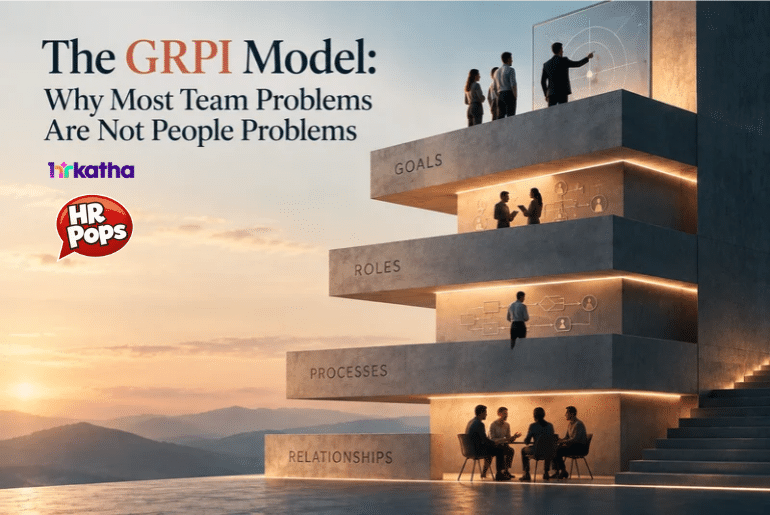
GRPI stands for Goals, Roles, Processes and Interpersonal Relationships. It is a framework for diagnosing team effectiveness by examining four interconnected elements, usually in that order.
Goals establish what the team is trying to achieve. Roles clarify who is responsible for what. Processes determine how decisions are made, work is coordinated and disagreements are resolved. Interpersonal relationships concern the trust, communication and behaviour that allow people to work together.
The sequence matters. A team cannot easily agree on responsibilities without understanding its objectives. Even clearly defined roles can create friction if decision-making processes are confused. And relationships can deteriorate when people repeatedly encounter problems created by unclear goals, overlapping responsibilities or ineffective processes.
The model does not suggest that relationships are unimportant. It suggests that some relationship problems may be symptoms of something more fundamental.
That distinction changes where HR should begin looking.
Where did the idea come from?
The GRPI framework emerged from organisational development thinking in the 1970s. Richard Beckhard, an influential figure in the field, is associated with its early development, while Rubin, Plovnick and Fry are commonly credited with further developing the framework.
The underlying concern was straightforward. As organisations increasingly relied on teams to coordinate complex work, managers needed a way to understand why groups of capable individuals sometimes performed poorly together.
Traditional explanations often focused on personalities, communication styles and interpersonal compatibility. GRPI encouraged a broader diagnosis by examining whether the conditions for effective teamwork had been established in the first place.
The framework’s enduring appeal lies in its simplicity. It offers managers a way to distinguish between problems arising from what a team is expected to achieve, how responsibilities are distributed, how work gets done and how people relate to one another.
More than five decades later, those distinctions remain relevant.
Why is it relevant for HR?
HR is often called into a team situation after relationships have already deteriorated.
A manager complains that employees are not collaborating. Two colleagues accuse each other of interfering in their work. A project team struggles with repeated disagreements. The immediate response may be coaching, conflict resolution or a team-building intervention.
GRPI suggests that the presenting problem may not be the underlying problem.
Consider a recruitment panel repeatedly disagreeing over candidates. The issue may appear interpersonal, but perhaps the panel never agreed on what the role requires. That is a goals problem.
A project team may experience friction because two members believe they own the same decision. That is primarily a roles problem.
A global team may struggle with delays and accusations of poor responsiveness because decisions depend on meetings that employees across time zones cannot attend. That is a process problem.
In each case, relationships may genuinely have suffered. But improving communication alone will not necessarily resolve the conditions that produced the friction.
For HR, the value of GRPI is that it encourages diagnosis before intervention. Rather than immediately asking why people cannot get along, it asks whether the organisation has made it possible for them to work effectively together.
The uncomfortable reality
Organisations are often more comfortable addressing behaviour than questioning their own design.
A difficult employee can be coached. A dysfunctional team can attend a workshop. Managers can be encouraged to communicate better.
Examining whether objectives are contradictory, responsibilities poorly allocated or decision-making authority unclear is considerably more uncomfortable. Those problems may originate with senior leadership, organisational structures or management decisions rather than with the employees experiencing the consequences.
GRPI exposes that possibility.
But the framework has limitations of its own.
Clear goals do not guarantee genuine agreement. Employees may understand what the organisation wants while disagreeing with its priorities. Roles may be documented without providing the authority needed to fulfil them. Processes may look efficient on paper while informal power relationships determine how decisions are actually made.
There is also a danger in treating the framework too mechanically. Not every interpersonal conflict originates in structural ambiguity. Bullying, exclusion, disrespect and breaches of trust require direct attention. HR should not use GRPI to explain away behaviour that needs to be addressed.
The four elements are interconnected rather than isolated compartments. Poor relationships can undermine goal alignment just as unclear goals can damage relationships.
And even when a team achieves clarity, that clarity has a limited shelf life.
Priorities change. People move. Responsibilities expand. Technology alters workflows. Hybrid and global teams develop new coordination challenges. A structure that worked six months earlier may no longer suit the work being performed.
The real challenge is not establishing clarity once.
It is recognising when yesterday’s clarity has become today’s confusion.
What HR should do
GRPI works best as a set of diagnostic questions rather than an implementation checklist.
When a team struggles, HR should first examine whether its members share an understanding of what success looks like. If they do, the next question is whether responsibilities, authority and decision rights are sufficiently clear. Only then should attention turn to how work moves between people, how decisions are made and where coordination breaks down.
Interpersonal dynamics remain part of the diagnosis throughout. The sequence helps organise the investigation; it should not prevent HR from responding immediately to serious behavioural concerns.
The distinction between documented arrangements and actual practice is particularly important. A RACI matrix may identify who is accountable, but that means little if someone else routinely makes the decisions. A team charter may promise collaboration while performance incentives reward individual competition.
HR also needs to recognise that team effectiveness cannot be separated from organisational design. If two functions are rewarded for conflicting outcomes, no amount of relationship-building will fully resolve the resulting tension.
Sometimes the most useful intervention is not another workshop.
It is changing the conditions under which the team works.
The takeaway
The GRPI model remains useful because it challenges an assumption that organisations rarely examine closely: when people struggle to work together, the problem must lie with the people.
Sometimes it does.
But conflict can also be the visible consequence of unclear goals, confused responsibilities and processes that make cooperation unnecessarily difficult.
For HR, the discipline is to distinguish between the two before deciding what needs fixing.
Because when an organisation repeatedly creates the conditions for conflict, asking employees to get along better is not a solution.
It is asking people to compensate for a problem the organisation has yet to acknowledge.