


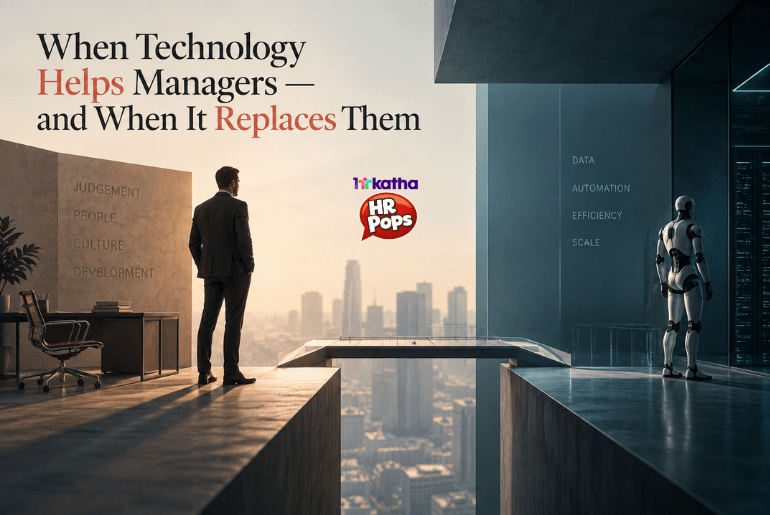
What do ‘managerial augmentation’ and managerial substitution’ mean?
Managerial augmentation and managerial substitution describe two different ways technology can change management.
Augmentation makes managers more capable. Artificial intelligence (AI) can summarise information, identify patterns, automate administration, surface workforce risks and help managers coordinate increasingly complex teams. The manager remains responsible for interpreting that information and deciding what to do. Technology assists; judgement remains human.
Substitution goes further. Tasks previously performed by managers are transferred to technology, processes or employees themselves. Algorithms allocate work. Platforms monitor performance. Automated systems schedule shifts. Self-managed teams make decisions that once travelled upwards for approval.
The distinction sounds straightforward until both happen at once.
A manager may use AI to improve a performance conversation while the same technology removes much of the reporting and monitoring that once occupied the role. Technology is augmenting the manager and substituting parts of management simultaneously.
The question, therefore, is not whether augmentation or substitution will win.
It is what remains of management after technology has taken everything it can do reasonably well.
Where did the idea come from?
The tension between augmentation and substitution is much older than AI.
Industrial automation raised essentially the same question about manual work. Machines could either make workers more productive or perform enough of their tasks to reduce the need for workers altogether. Much of the history of workplace technology has involved some combination of the two.
Management appeared relatively protected for longer. Technology initially strengthened managers rather than replacing their functions. Enterprise software, spreadsheets, dashboards and communication systems gave them more information and greater reach, but managers still interpreted the information, coordinated the work and exercised authority.
Digital platforms began changing that equation. Scheduling, workflow management, task allocation, performance tracking and routine reporting could increasingly happen without a manager actively coordinating every step.
Artificial intelligence pushes the argument further because it can operate on tasks involving information and analysis, precisely the territory on which much managerial work has traditionally rested.
For the first time, organisations are not simply asking how technology can help managers manage.
They can ask how much management they still need humans to perform.
Why is it relevant for HR?
The distinction matters because it changes what organisations should look for in managers.
If technology handles more administration, information gathering and routine coordination, those capabilities become less important as reasons for having managers. What remains becomes more distinctly human: judgement, coaching, conflict resolution, context, motivation and difficult decisions for which there is no obvious answer.
That should change management development. Teaching managers primarily to administer processes makes little sense if systems increasingly administer those processes for them.
Developing their ability to interpret information, challenge algorithmic recommendations, exercise judgement and manage human complexity becomes more valuable.
Substitution raises a different problem.
If organisations need fewer managers, they may also remove some of the roles through which future leaders traditionally learnt to manage. Middle management has often been where people first learn to give difficult feedback, resolve conflict, make trade-offs, manage budgets and discover that decisions involving people rarely arrive with complete information.
Remove enough of those developmental roles and an organisation can reduce today’s management cost while weakening tomorrow’s leadership pipeline.
The consequences also reach employees. Technology can remove unnecessary supervision and give people genuine autonomy. But removing supervision is not the same as removing the need for support.
A workflow system can tell someone what needs to happen next.
It cannot necessarily tell them what to do when none of the available choices feels right.
The uncomfortable reality
The language of augmentation is considerably more attractive than that of substitution.
Organisations would rather say technology is empowering employees and freeing managers for higher-value work than say that some managerial work, and perhaps some managers, are no longer required.
Sometimes the first description is entirely accurate. Sometimes it disguises the second.
This matters because managerial tasks do not disappear neatly. When a layer is removed or a function automated, its visible work may move to technology while its invisible work moves elsewhere. Employees resolve more problems themselves. Senior managers absorb more escalations. Informal leaders emerge inside teams. HR inherits issues that a line manager once handled.
The organisation may have substituted the manager without substituting management.
Augmentation has its own danger. Better information can produce worse judgement when managers mistake algorithmic confidence for certainty. An attrition model may identify someone as a flight risk, but it cannot know everything happening in that person’s career or life. A performance dashboard may reveal a decline in output without explaining its cause.
The more convincing the technology becomes, the easier it is to forget what it cannot see.
Human judgement does not become less important when managers receive better data.
Its purpose changes from filling information gaps to questioning what the information appears to say.
What should HR be asking?
The useful starting point is not the number of managers an organisation can remove. It is the work management performs.
Coordination, scheduling, reporting, information distribution and routine monitoring may increasingly lend themselves to substitution. Coaching, conflict resolution, development, contextual judgement and human accountability are harder to transfer cleanly to systems.
That distinction should inform organisational design.
If technology removes administrative work from managers, HR should ensure the time released genuinely moves towards higher-value human work rather than simply expanding spans of control until managers are overloaded again.
If technology substitutes managerial positions, HR needs to identify where the remaining human functions will go. Someone still has to develop employees, resolve ambiguity, transmit context and take responsibility when rules do not provide an answer.
And if organisations remove entry points into management, they need another way for future leaders to acquire managerial judgement before being placed in senior roles.
Technology can redesign management.
It cannot absolve organisations from deciding who will actually manage.
The takeaway
Managerial augmentation and managerial substitution are not competing futures. Most organisations are likely to experience both.
Technology will take over some managerial work, improve other parts and expose activities that perhaps never required a manager in the first place.
The harder decisions concern what remains.
For HR, the task is not to preserve management because organisations have always had managers, nor to eliminate it simply because technology makes flatter structures possible. It is to understand which parts of management create value precisely because a human being is performing them.
Because the risk is not that technology replaces managers.
It is that organisations discover too late that they replaced the manager without replacing what people needed from one.