


There is an obvious problem with a health insurance company that does not take its employees’ health seriously.
The gap between what the business sells and how it treats its own people is the kind of contradiction employees notice quickly. For ManipalCigna Health Insurance, that makes wellbeing more than another item on the HR agenda. There is an uncomfortable expectation of consistency built into the business itself.
“Employee wellbeing has evolved far beyond the traditional conversation around benefits,” says Richa Chatterjee, chief human resources officer. “People do not separate their health, growth, sense of belonging and purpose at work; they experience them as one employee journey.”
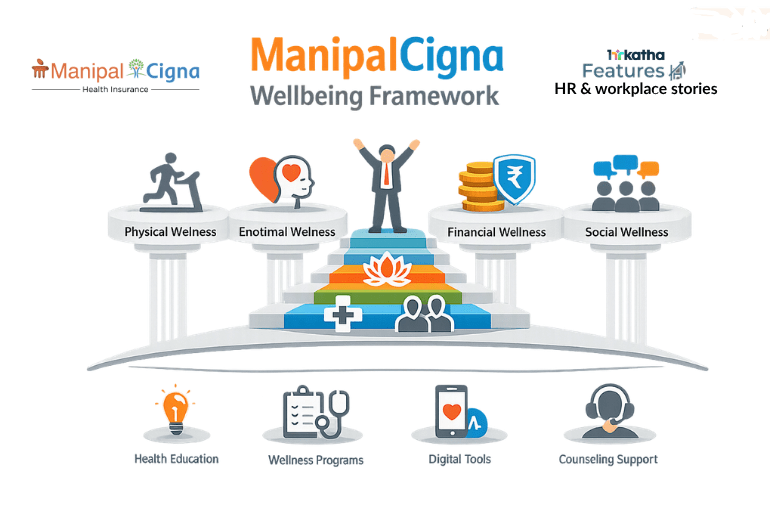
ManipalCigna has responded with a framework spanning preventive healthcare, mental health, manager development, employee communities and life-stage support.
The breadth is deliberate. The harder task is making those different interventions feel like one employee experience rather than an expanding catalogue of benefits.
Prevention before treatment
The most obvious place for a health insurer to begin is healthcare itself.
Employees receive free annual health check-ups and access to tele-consultation services. The logic mirrors the insurance business: problems identified earlier are generally easier to manage than those allowed to worsen.
Mental health receives similar attention through an Employee Assistance Programme, stress-management workshops and webinars covering subjects that cross the boundary between professional and personal life, including parenting and navigating uncertainty.
The India Health Quotient 2026 found that urban Indians now place equal importance on mental and physical health, at 50 per cent each. Yet seeking help remains one of the weaker behaviours measured.
“The role of organisations today is not just to talk about wellbeing, but to make support accessible enough that seeking help feels normal rather than exceptional,” Chatterjee says.
Accessibility, however, is only part of the equation.
An EAP can exist. A counselling service can be available. Employees still have to trust its confidentiality, feel comfortable using it and believe that seeking support will not alter how they are perceived at work.
That makes normalisation less a benefits question than a cultural one. Employees learn whether it is genuinely acceptable to seek help from what happens around them, particularly from how managers behave when someone actually does.
The ecosystem around the employee
ManipalCigna’s approach also recognises that employees do not arrive at work as isolated individuals.
Parenting, caregiving, financial pressures and responsibility for ageing parents increasingly travel into the working day.
Chatterjee describes a “new dependency curve” among younger employees who can find themselves managing career expectations while simultaneously supporting parents and raising children.
The India Health Quotient data reflects some of that pressure. Twenty-nine per cent of employees aged 25 to 34 want workplace health policies to cover their parents, while 23 per cent want maternity and newborn-care support.
“The challenge is not capability; it is cognitive overload,” Chatterjee says.
That is an important distinction.
An employee can be perfectly capable of doing a job while carrying enough competing responsibilities to make sustained performance increasingly difficult. In that context, wellbeing is not simply about helping someone recover from stress. It is also about examining the conditions producing it.
Benefits can cushion pressure. They cannot compensate indefinitely for work designed in ways that continuously recreate it.
Culture does the work benefits cannot
Some of ManipalCigna’s interventions have little to do with healthcare in the conventional sense.
Health Week, Shakti, its women’s network, and intra-organisation cricket and football tournaments are intended to create connection and belonging.
“Benefits support wellbeing, but culture determines whether people actually feel well,” Chatterjee says.
That may be the more consequential distinction in the company’s approach.
Benefits are comparatively easy to design. Culture emerges from thousands of smaller experiences: whether colleagues make space for one another, whether employees can speak candidly, whether flexibility survives an inconvenient deadline, and whether managers respond differently when someone says they are struggling.
An organisation can create the conditions for connection. It cannot programme belonging.
Which is why the manager becomes important.
Managers as early warning systems
Leadership behaviour sits close to the centre of ManipalCigna’s wellbeing strategy.
The company invests in manager and leadership development through programmes including Executive Presence, Pinnacle Path, Women Leadership Program and Break, Rise and Lead. The intention is to develop leaders who are more self-aware, empathetic and capable of noticing changes in their teams.
“Burnout rarely appears overnight. The most effective managers are often the ones who stay connected enough to notice when something has changed,” Chatterjee says.
That moves the manager’s role beyond responding when an employee formally asks for help.
Someone who knows a team well may notice declining participation, unusual irritability, withdrawal or a change in working patterns before any of those becomes an HR issue.
But noticing is only useful if managers have room to respond.
A manager carrying substantial business pressure cannot be expected to become a counsellor. Nor should one. The more practical requirement is to create enough connection for a conversation to happen and enough organisational support for the manager to know what to do next.
Wellbeing therefore becomes another test of managerial quality, not another responsibility
HR can outsource to managers through training.
What survives when business pressure arrives?
Chatterjee does not see wellbeing and performance as competing objectives.
“Wellbeing and business performance are not competing priorities; they are directly connected,” she says.
Over time, the logic is persuasive. Healthy employees who can sustain performance should be better for the business than exhausted ones.
The short term is where the proposition becomes harder.
Deadlines still arrive. Targets still have to be met. Customers still need answers. Protecting boundaries and maintaining conversations require time precisely when time becomes scarce.
Chatterjee recognises the tension.
“It is easy to prioritise wellbeing when business is doing well. What matters is whether leaders continue to have honest conversations, protect healthy boundaries and support their teams when the pressure increases,” she says.
That may be a better test of a wellbeing culture than participation in any individual programme.
Policies reveal what an organisation intends. Pressure reveals which intentions have become habits.
Fewer programmes, not more
Perhaps the more interesting part of ManipalCigna’s approach is what Chatterjee thinks should happen next.
Not another wellbeing programme.
As organisations respond to every emerging employee need, wellbeing ecosystems can become crowded with platforms, initiatives, communities, workshops and benefits. Each may be useful individually while the overall experience becomes increasingly difficult for employees to navigate.
ManipalCigna’s stated direction is therefore towards greater connection between what already exists: preventive healthcare, mental health support, employee communities, leadership development and life-stage interventions.
That is less visible than launching something new.
A new programme has a name, an announcement and participation numbers. Integration is harder to photograph. Its success is experienced instead through whether an employee can find the right support at the right moment without first understanding the architecture HR has built around it.
For a health insurer, there is an appropriate symmetry in that idea.
ManipalCigna’s business is built around protecting health, but health itself is rarely produced by a single intervention. It accumulates through prevention, behaviour, environment, support and decisions repeated over time.
Employee wellbeing works much the same way.
The harder task is not giving employees more things called wellbeing. It is making the way they work healthier.