


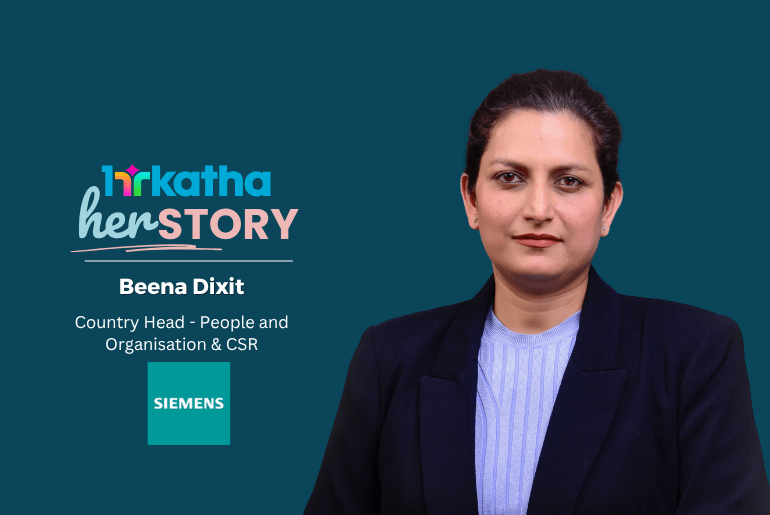
An accidental HR professional
Beena Dixit began her career as a structural designer, the only woman in an otherwise all-male engineering team. After completing an MBA, she moved into HR more by circumstance than design.
“HR chose me, and I am grateful it did,” she says.
The line captures something essential about her career. Little of it was carefully planned, yet each experience eventually led her somewhere meaningful.
One pattern caught her attention early. There were plenty of women at entry level, but their numbers thinned sharply as she looked higher up the organisation. In business discussions, she was often one of the few women at the table. Sometimes, she was the only one.
Today, as country head, people and organisation and CSR at Siemens Energy India, Dixit leads with a philosophy shaped by those experiences: directness does not need to be softened when it is backed by clarity, consistency and outcomes.
When directness gets misread
One barrier followed Dixit through much of her career. Her clear and straightforward communication style was sometimes perceived differently because she was a woman.
She noticed early on that directness could be read as aggression or difficulty. There was often an initial hesitation, an unspoken question about whether she would collaborate effectively or fully understand the business.
Dixit did not soften herself to ease that discomfort. Instead, she allowed her work to change the perception.
Over time, as colleagues saw her unwavering focus on business outcomes, clarity and follow-through, the narrative shifted. What had once been read as toughness came to be recognised as transparency, decisiveness and consistency.
“Perceptions do evolve, and strengths do get recognised,” she says.
“What was once read as difficult became recognised as transparency, decisiveness and consistency.”
The six months before the six hours
Dixit is candid that some of the hardest decisions a leader must make cannot be delayed simply because they are uncomfortable.
When a decision becomes unavoidable, she anchors herself to two questions. Is it aligned with the organisation’s priorities and values? And how can it be implemented with fairness and sensitivity towards every stakeholder it affects?
She recalls one of the toughest such moments from an earlier organisation, when she had to manage the closure of a manufacturing facility.
The business case was unavoidable. The employees, however, had remained deeply committed and hopeful about the plant’s future.
The closure itself took only a few hours. The preparation took nearly six months.
“We carefully considered every aspect, from business continuity to employee support. When the decision was finally communicated, we spent time explaining the reasons behind it and helping employees navigate the transition,” she recalls.
A cross-functional team spent months preparing for those few difficult hours. It was an emotional day, filled with hard conversations. What stayed with Dixit, however, was that employees understood the rationale, even if they did not agree with the outcome.
“Difficult decisions can be executed responsibly when they are rooted in fairness, transparency and empathy,” she says.
Business enabler, not just HR leader
“I do not see myself simply as an HR leader. I see myself as a business enabler,” says Dixit.
For her, strategic HR has never been about running a function in isolation. It is about enabling business outcomes.
That begins with understanding the organisation’s priorities, whether around growth, profitability, transformation or capability building, and then asking a sharper question: how should the people strategy enable those goals?
Dixit has seen how that shift changes the way HR is treated in the room.
When HR consistently helps business leaders deliver what they have set out to achieve, it earns something policy documents alone cannot create: credibility and a genuine place in strategic decision-making.
Building for what comes next
At Siemens Energy India, transformation has been a constant over the past few years, and Dixit expects it to remain so.
“Our focus begins with talent strategy, ensuring we have the capabilities required not only for today but also for the next few years. We are also continuously evaluating work models across offices and manufacturing locations to ensure they remain relevant and effective,” she says.
Leadership capability and culture remain high on her agenda. Achieving future business goals, she believes, requires leaders who are agile, adaptive and equipped to lead through uncertainty.
Succession planning matters just as much. As the organisation grows, Dixit wants a strong pipeline of future leaders ready to step into increasingly complex roles, rather than scrambling to catch up when the need arises.
Industrial relations also remains central to her work. In a growing manufacturing organisation, with labour regulations continuing to evolve, workplace stability, compliance and preparedness cannot be treated as secondary concerns.
For Dixit, all of these priorities form part of the same agenda: building an organisation capable of meeting the demands of both the present and the future.
Doing the right thing, consistently
Across her stints at Tata Steel, Novartis, Honeywell and Siemens Energy, one principle has guided Dixit through difficult decisions: do the right thing, even when it is hard.
When a decision is grounded in strong values and a clear sense of purpose, she finds it easier to stand behind, whether or not it is popular.
She is equally clear that how a decision is implemented matters as much as the decision itself. Empathy, respect and transparent communication are not optional additions.
People may not always agree with a decision, but they should understand the reasoning behind it and feel respected throughout the process.
For Dixit, the question was never whether a leader should choose between being liked and being respected. The real goal is to do the right thing consistently while treating people fairly and preserving their dignity.
“The goal was never to choose between being liked and being respected. It was to do the right thing consistently while treating people with dignity.”
What needs to retire
One mindset that needs to disappear, in Dixit’s view, is the belief that HR is merely a support function.
She has often seen HR professionals underestimate the value they bring to business outcomes. That underestimation quietly limits both their confidence and their ability to influence decisions that matter.
What deserves far greater attention is HR as a genuine strategic business partner.
Dixit wants HR leaders to see themselves as business enablers, change agents and advisers who help shape outcomes, rather than simply execute decisions made elsewhere.
When HR approaches the role with that level of ownership, she believes, it creates far greater impact for both the business and its people.
Quick fire round
One thing you wish younger professionals stopped worrying about?
Career growth is a marathon, not a sprint. Focus on creating impact, and the opportunities will follow.
A stereotype about women leaders you love proving wrong?
That being assertive is the same as being aggressive.
A piece of advice you would give your 25-year-old self?
Have more self-confidence.
One workplace ritual you will never skip?
Saying hello to people and connecting with colleagues when I arrive at work.
The most inspiring woman leader you have met, and why?
Anne-Laure de Chammard, executive board member of Siemens Energy AG, responsible for the Transformation of Industry business. Her clarity of thought, belief in femininity as a leadership strength and ability to inspire others left a lasting impression on me.