


Close Menu
    Facebook X (Twitter) Instagram
    • Our Story
    • Partner with us
    • Reach Us
    • Career
    Subscribe Newsletter
    HR KathaHR Katha
    • Exclusive
      • Exclusive Features
      • Perspectives
      • Friday Features
      • herSTORY
      • Case-In-Point
      • Point Of View
      • Research
      • HR Pops
      • Dialogue
      • Movement
      • Profile
      • Beyond Work
      • Rising Star
      • By Invitation
    • News
      • Global HR News
      • Compensation & Benefits
      • Diversity
      • Events
      • Gen Y
      • Hiring & Firing
      • HR & Labour Laws
      • Learning & Development
      • Merger & Acquisition
      • Performance Management & Productivity
      • Talent Management
      • Tools & Technology
      • Work-Life Balance
    • Special
      • HR Forecast 2026
      • Cover Story
      • Editorial
      • HR Forecast 2024
      • HR Forecast 2023
      • HR Forecast 2022
      • HR Forecast 2021
      • HR Forecast 2020
      • HR Forecast 2019
      • New Age Learning
      • Coaching and Training
      • Learn-Engage-Transform
    • Magazine
    • Reports
      • Whitepaper
        • HR Forecast 2024 e-mag
        • Future-proofing Manufacturing Through Digital Transformation
        • Employee Healthcare & Wellness Benefits: A Guide for Indian MSMEs
        • Build a Future Ready Organisation For The Road Ahead
        • Employee Experience Strategy
        • HRKatha 2019 Forecast
        • Decoding and Driving Employee Engagement
        • One Platform, Infinite Possibilities
      • Survey Reports
        • Happiness at Work
        • Upskilling for Jobs of the Future
        • The Labour Code 2020
    • Conferences
      • Leadership Summit 2025
      • Rising Star Leadership Awards
      • HRKatha Futurecast
      • Automation.NXT
      • The Great HR Debate
    • HR Jobs
    WhatsApp LinkedIn X (Twitter) Facebook Instagram
    HR KathaHR Katha
    Home»Exclusive Features»HR Forecast 2026»HRForecast 2026: Skills will rise, but degrees will remain relevant – Vinod Nair, CHRO, Aadhar Housing Finance 
    HR Forecast 2026

    HRForecast 2026: Skills will rise, but degrees will remain relevant – Vinod Nair, CHRO, Aadhar Housing Finance 

    Why AI adoption, hybrid talent models and evolving career paths will reshape—but not replace—traditional structures
    mmBy Liji Narayan | HRKathaMarch 30, 20264 Mins Read186 Views
    Share LinkedIn Twitter Facebook WhatsApp
    Share
    LinkedIn Twitter Facebook WhatsApp

    The future of work is often framed in extremes.

    Skills versus degrees. AI versus human judgement. Agility versus structure.

    zoha

    But the reality may be more nuanced.

    As organisations experiment with new models, 2026 may not mark a clean break from the past—but a gradual recalibration.

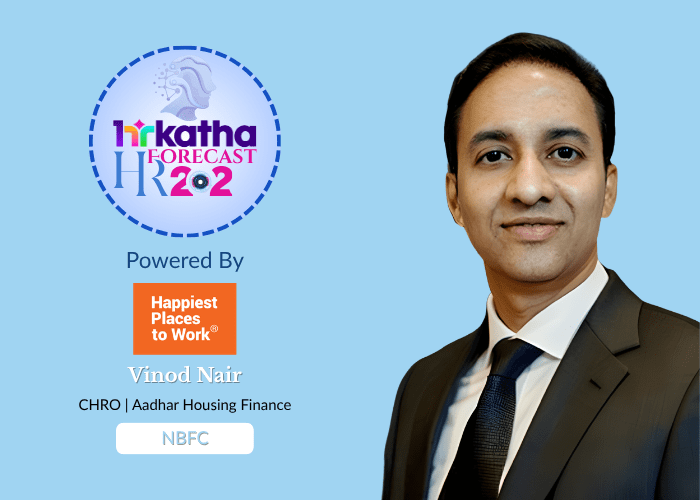
    Vinod Nair, CHRO at Aadhar Housing Finance Ltd, believes the next phase of HR evolution will be shaped as much by validation and balance as by disruption.


    Signal 1: AI adoption will accelerate after validation, not hype

    While HR leaders are increasingly participating in AI implementation, strategic ownership remains limited.

    According to Nair, this is not hesitation—it is caution.

    “AI adoption is currently in its nascent stage because most HR leaders are seeking final validation of credibility,” he notes.

    zoha

    As more use cases emerge and prove their value, adoption is likely to accelerate. But the journey will not be linear.

    Organisations will move through phases of experimentation, change management and gradual institutionalisation before AI becomes embedded in HR strategy.


    Signal 2: Skills will grow—but degrees will not disappear

    The debate around skills versus degrees often assumes a zero-sum outcome. Nair sees it differently.

    “Skills are essential for getting the job done well, but academic qualifications still play an important role,” he says.

    Degrees signal discipline, foundational understanding and structured thinking—qualities that continue to matter, especially in decision-making roles.

    At the same time, as digitisation, AI adoption and evolving workflows reshape work, skills will play a larger role in hiring decisions.

    The future, therefore, is not skills replacing degrees—but skills complementing them.


    Signal 3: Career lattices will emerge through structural evolution

    The rise of agile teams and project-based work is already reshaping how organisations operate.

    While still experimental in many sectors, these models are gaining traction—particularly in new-age and customer-driven industries.

    “With the emergence of agile work teams, career lattices will be automatically driven in organisations,” Nair observes.

    As roles become more fluid, traditional linear career paths will give way to more dynamic structures—enabling lateral movement, role pivots and diverse growth trajectories.

    This shift will be critical in addressing employee motivation and long-term engagement.


    Signal 4: Workplace disengagement will trigger continuous reinvention

    Post-pandemic realities—combined with the pace of work and rapid advancements in AI—are redefining employee experience.

    Burnout and emotional disengagement are likely to persist, even as organisations introduce new engagement initiatives.

    “With the pace of work and technological change, burnouts and disengagement are bound to increase,” Nair notes.

    The response will not be a single solution, but continuous innovation.

    Organisations will need to keep evolving engagement strategies, creating more responsive and adaptive workplace cultures.


    Signal 5: Compensation models will evolve gradually, not radically

    Rising cost-of-living pressures and shifting workforce expectations are pushing organisations to rethink compensation.

    However, Nair does not see an immediate overhaul of traditional models.

    Instead, innovation is likely to emerge through experimentation.

    “Compensation and engagement methods will have to keep pace with the growing needs of the workforce,” he says.

    As AI enables greater flexibility and faster decision-making, organisations may test dynamic pay structures and new reward mechanisms—some of which could eventually become mainstream.


    The evolution, not disruption, story

    These signals—measured AI adoption, hybrid talent models, evolving career paths, continuous engagement innovation and gradual compensation shifts—point to a different kind of transformation.

    Not disruption. Evolution.

    Organisations are not abandoning traditional systems overnight.

    They are adapting them—layer by layer.

    The future of work, in this view, is not about replacing what exists.

    It is about making it more relevant.


    Three Strategic Imperatives

    Validate Before Scaling: Adopt AI with a focus on proven use cases—moving from experimentation to institutionalisation through structured change management.

    Balance Skills and Credentials: Design hiring frameworks that integrate demonstrated capability with academic foundations, rather than treating them as substitutes.

    Enable Flexible Growth Paths: Build career architectures that support lateral movement, project-based roles and evolving employee aspirations.


    The Pragmatism Test

    The question for 2026 is not how fast organisations can disrupt themselves.

    It is how effectively they can evolve.

    Because in a world of constant change, the winners may not be those who abandon the past — but those who adapt it intelligently for the future.

    AI in HR career development Compensation Trends Employee Engagement Future of work HR leadership HRForecast 2026 Organisational design skills-based hiring talent & strategy workforce transformation
    Share. LinkedIn Twitter Facebook WhatsApp
    mm
    Liji Narayan | HRKatha

    HRKatha prides itself in being a good journalistic product and Liji deserves all the credit for it. Thanks to her, our readers get clean copies to read every morning while our writers are kept on their toes.

    Leave A Reply Cancel Reply

    Related Posts

    The certainty tax: Why uncertainty makes bad decisions inevitable

    March 30, 2026

    Nokia plans workforce reduction; begins India restructuring

    March 27, 2026

    KnitWell Group names Sarah Evans as CHRO

    March 27, 2026

    Revolut to scale India workforce to 40% of global headcount by 2026

    March 27, 2026
    Editorial

    The certainty tax: Why uncertainty makes bad decisions inevitable

    The conflict in West Asia has introduced real uncertainty into global markets. Oil supply routes…

    Companies say retention matters. Their budgets say otherwise

    Every company declares that retaining talent is a strategic priority. Annual reports emphasise culture and…

    EDITOR'S PICKS

    HRForecast 2026: Skills will rise, but degrees will remain relevant – Vinod Nair, CHRO, Aadhar Housing Finance 

    March 30, 2026

    The certainty tax: Why uncertainty makes bad decisions inevitable

    March 30, 2026

    Corporate buzzword detox: Say it simply, get it done

    March 27, 2026

    HRForecast 2026: HR will move from AI adopter to AI strategist – Paramjit Singh Nayyar, CHRO, Hero FinCorp

    March 27, 2026
    Latest Post

    HRForecast 2026: Skills will rise, but degrees will remain relevant – Vinod Nair, CHRO, Aadhar Housing Finance 

    HR Forecast 2026 March 30, 2026

    The future of work is often framed in extremes. Skills versus degrees. AI versus human…

    The certainty tax: Why uncertainty makes bad decisions inevitable

    Editorial March 30, 2026

    The conflict in West Asia has introduced real uncertainty into global markets. Oil supply routes…

    Nokia plans workforce reduction; begins India restructuring

    News March 27, 2026

    Finnish telecom major Nokia is preparing for a significant workforce reduction as part of a…

    KnitWell Group names Sarah Evans as CHRO

    Movement March 27, 2026

    KnitWell Group has appointed Sarah Evans as its chief human resources officer (CHRO), placing her…

    Asia's No.1 HR Platform

    Facebook X (Twitter) Instagram LinkedIn WhatsApp Bluesky
    • Our Story
    • Partner with us
    • Career
    • Reach Us
    • Exclusive Features
    • Cover Story
    • Editorial
    • Dive into the Future of Work: Download HRForecast 2024 Now!
    © 2026 HRKatha.com
    • Disclaimer
    • Refunds & Cancellation Policy
    • Terms of Service

    Type above and press Enter to search. Press Esc to cancel.