


For decades, organisations built talent systems around stability.
Roles were clearly defined. Careers progressed in predictable steps. Performance was assessed once a year. Leadership programmes produced broadly similar managerial archetypes.
That model is breaking down.
Work has become more fluid. Skills evolve faster than job descriptions can capture. Employees increasingly expect organisations to recognise individual aspirations rather than enforce uniform policies.
As companies navigate these shifts, HR leaders are rethinking the fundamental architecture of talent management.
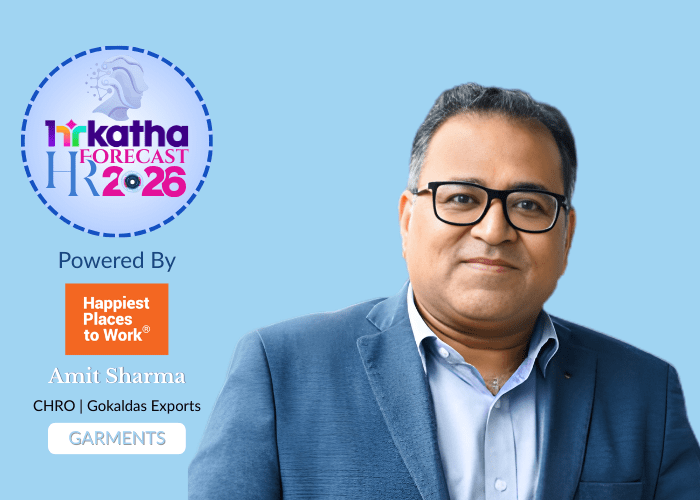
Amit Sharma, CHRO at Gokaldas Exports, believes the coming years will mark a decisive turning point. The organisations that succeed will abandon rigid structures and embrace talent fluidity—an operating model where skills, careers and opportunities move dynamically across the enterprise.
“In many organisations, talent is still managed through static roles and annual cycles,” Sharma observes. “That approach no longer reflects how work actually happens.”
Four signals point to how this transformation may unfold.
Signal 1: Inclusive leadership will move from awareness to accountability
For years, organisations have invested heavily in diversity training—raising awareness of bias, promoting inclusion through workshops and declaring commitment to belonging.
Yet systemic inequities persist in hiring, promotions and everyday workplace experiences.
Sharma believes the problem lies not in intent but in design.
“Traditional diversity training focused on awareness. Leaders attended workshops, acknowledged the concepts, and returned to unchanged systems and behaviours,” he says.
The training created knowledge. It did not create capability or accountability.
By 2026, Sharma expects a decisive shift. Inclusion must be embedded directly into leadership competency frameworks—measured, evaluated and rewarded like any other critical capability.
“Belonging and equity cannot remain optional values. They must become measurable leadership competencies integrated across succession planning, performance evaluation and leadership development.”
Experiential learning will replace theoretical instruction. Leaders develop inclusive instincts not through presentations but through practice—handling exclusion in real time, navigating power dynamics and redesigning team rituals.
“Leaders learn far more effectively through live simulations, peer labs and scenario-based coaching than through slide decks.”
People analytics will introduce new accountability mechanisms. Increasingly, organisations analyse team sentiment, promotion patterns and voice distribution within meetings—making inclusion visible and measurable.
“When leaders can see the impact of their decisions on team experience and opportunity, inclusion becomes real.”
The real breakthrough will come when inclusion stops being treated as an HR initiative and becomes recognised as a driver of innovation, engagement and performance. That requires CEO sponsorship and business ownership— not just diversity programmes.
Signal 2: Segmented flexibility will replace one-size-fits-all policies
The workforce has never been more generationally diverse.
Baby Boomers delay retirement. Gen X occupies leadership roles. Millennials dominate middle management at 74 per cent of the workforce by 2030. Gen Z reshapes expectations around purpose and flexibility. Early Gen Alpha entrants are arriving.
Traditional HR policies—designed for uniformity—struggle to accommodate such varied expectations around work styles, learning preferences, communication and career progression.
Yet complete individualisation creates fragmentation and perceived inequity.
Sharma believes organisations will move toward “principle-based personalisation”—flexible frameworks anchored in shared principles like fairness, accountability and performance, whilst allowing meaningful choice.
“Instead of uniform policies or unlimited customisation, organisations will create clear guardrails and allow teams to decide how work gets done.”
For example, flexibility policies can define outcome expectations whilst letting teams determine the specific arrangements. This honours generational differences without creating perceptions of special treatment.
Technology enables this at scale. AI-driven workforce analytics and adaptive learning platforms allow organisations to understand employee preferences, working patterns and development needs—delivering personalised experiences without fragmenting culture.
Equally important: building cross-generational fluency.
“Rather than emphasising differences, leaders must help employees learn from each other—through reverse mentoring, mixed-age teams and collaborative problem-solving.”
When designed thoughtfully, generational diversity becomes strategic strength rather than management challenge.
By 2026, the question is not whether one-size-fits-all policies are outdated—it is whether organisations can balance diverse needs without fragmenting culture.
Signal 3: Continuous performance conversations will finally become standard
Few management practices face as much criticism as annual performance reviews.
Designed for stable environments, yearly appraisals now appear misaligned with modern work pace. Projects evolve quickly. Priorities shift rapidly. Employees expect regular feedback on growth and development—not retrospective judgement once a year.
Sharma believes organisations are finally approaching the tipping point.
“Employees—especially younger generations—expect ongoing dialogue about development, not annual reviews.”
Technology has removed many practical barriers. Modern performance platforms integrate with collaboration tools and project systems, capturing behavioural signals, contributions and development milestones in real time.
This enables more frequent, meaningful check-ins.
The benefits are clear. Regular conversations reduce surprises, improve clarity around expectations and enable faster course correction. They strengthen manager-employee relationships—one of the strongest predictors of engagement and performance.
Yet technology alone will not guarantee success.
“Without coaching skills and comfort with frequent dialogue, even the best performance systems will fall short,” Sharma notes.
Building manager capability is the critical factor. Managers must develop comfort with ongoing conversations, coaching mindsets and growth orientation rather than evaluation mentality.
“Organisations that invest in developing managers as coaches rather than evaluators will see the greatest impact.”
But widespread adoption depends on cross-functional buy-in. “Many firms cling to annual appraisals due to inertia. CHROs must demonstrate ROI through retention and productivity metrics. Without CXO sponsorship, scaling stalls.”
If these elements converge—technology, manager capability and executive commitment—2026 could be the year continuous performance management moves from aspiration to standard practice.
Signal 4: Skills visibility will determine workforce agility
The shift toward skills-based organisations has been widely discussed. Yet many companies still lack clear, real-time understanding of capabilities within their workforce.
Skills data sits scattered across HR systems, learning platforms and performance tools—making enterprise-wide visibility difficult. Inconsistent terminology blocks cross-department matching. Traditional job descriptions, too static for today’s pace, mask real capabilities.
Sharma identifies several persistent barriers:
Data fragmentation: Only 24 per cent of firms use unified skills platforms. Multiple systems prevent holistic visibility.
Trust gaps: Employees hesitate to share skills, fearing surveillance or job displacement. Surveys show 86 per cent struggle to showcase competencies effectively.
Static job descriptions: Annual reviews fail to capture quarterly skill evolution, creating misalignment that drives unnecessary external hiring despite internal assets.
Under-resourced initiatives: Executives prioritise AI investment but under-resource skills infrastructure. Without C-suite champions, projects stall.
However, several trends point toward meaningful progress.
AI-enabled talent intelligence platforms now infer skills from project work, performance data, learning behaviour and collaboration patterns—reducing reliance on self-reported profiles.
“This shifts the burden from self-reporting to continuous, evidence-based skill sensing.”
Business leaders increasingly understand that skill mobility is essential for agility and cost efficiency, creating stronger top-down sponsorship.
But success requires more than technology.
“CHROs must build cultures where skills are discussed openly, mobility is encouraged rather than penalised, and career paths are fluid rather than hierarchical.”
Managers must evolve from “owners” of talent to stewards of enterprise capability.
If organisations combine technology, cultural shifts and strong governance, 2026 could bring enterprise-wide skill visibility and mobility. Without integration, skill mapping remains conceptual aspiration—promising but unrealised.
The fluidity imperative
These signals—inclusive leadership accountability, generational flexibility, continuous performance and skills visibility—converge on a broader shift in how organisations think about talent.
“In a world of accelerated change, talent fluidity is not ‘nice to have’—it is competitive advantage.”
Traditional workforce models assumed roles were stable and careers followed predictable paths. That assumption no longer holds.
Skills evolve rapidly. Projects form and dissolve quickly. Employees expect dynamic career experiences rather than fixed ladders.
“Holding onto static structures slows organisations down, frustrates employees and prevents talent from being deployed where most needed.”
The alternative: talent fluidity as strategic operating model.
This requires organisations to embrace continuous performance conversations, skills-based deployment with transparent architecture, internal marketplaces that match people to opportunities in real time, and leaders who empower mobility rather than gatekeep it.
When organisations allow people to move to where their skills create most value, they unlock innovation, resilience and faster adaptation.
Three Strategic Imperatives
Inclusive Leadership Capability: Embed belonging and equity into core leadership competencies—measured through people analytics, developed through experiential learning, and rewarded like any critical capability.
Principle-Based Flexibility: Design flexible frameworks anchored in shared values—enabling meaningful choice across generations without fragmenting culture or creating perceived inequity.
Skills-Based Orchestration: Build transparent skills architecture, internal talent marketplaces and AI-enabled capability sensing—treating skills mobility as strategic infrastructure, not HR programme.
The adaptability advantage
The world of work is entering a period defined less by stability and more by continuous reinvention.
Technological disruption, shifting workforce expectations and accelerating skill cycles are reshaping how organisations compete.
In this environment, rigid talent structures increasingly act as constraints rather than enablers.
Companies clinging to static roles, uniform policies and annual cycles may struggle to keep pace. Those embracing talent fluidity—building systems where people, skills and opportunities move dynamically across the enterprise—will adapt faster.
In 2026, the divide will be structural.
Some organisations will operate with fluid talent models: continuous development conversations, skills-based deployment, inclusive leadership and generational flexibility.
Others will maintain traditional architectures designed for stability—whilst the environment demands constant adaptation.
The real advantage in the future of work may not come from having the most talent.
It may come from how quickly organisations can move that talent to where it matters most.
In a world where work has become fluid, talent systems must become fluid too.