


For the past three years, the debate around artificial intelligence (AI) and employment has revolved around one question: will entry-level jobs disappear?
According to a new survey by Cognizant and Pearson, that is increasingly the wrong question.
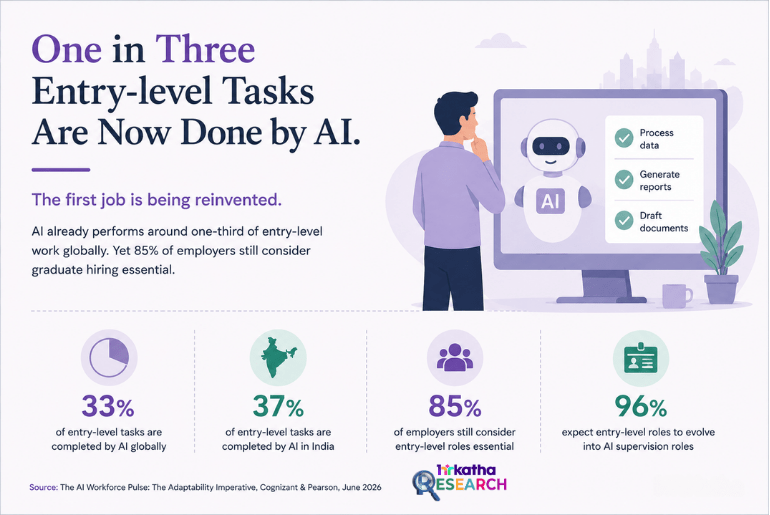
Artificial intelligence already performs around one-third of entry-level work globally. In India, the figure reaches 37 per cent, higher than both the global average and the US. Yet, 85 per cent of employers still consider graduate hiring essential. Almost all expect those roles to change dramatically. Ninety-six per cent believe entry-level employees will increasingly supervise AI systems rather than perform the routine tasks that once defined the first rung of a career. Ninety-four per cent expect entirely new entry-level roles to emerge within five years.
The entry-level job is not disappearing. It is being redesigned.
From operator to supervisor
Perhaps the report’s most useful insight is its description of what the new graduate employee looks like.
Increasingly, the role resembles an air traffic controller rather than a traditional operator. Instead of producing work directly, employees monitor AI outputs, validate decisions, intervene when judgement is required and escalate situations machines cannot resolve.
That represents a fundamental shift in what organisations expect from someone at the beginning of their career.
For decades, entry-level roles served an important developmental purpose. Graduates handled repetitive work, learnt how organisations functioned, absorbed professional norms and gradually built the judgement needed for more complex responsibilities. The work itself was often mundane. The learning was not.
AI is steadily removing much of that routine work.
The question organisations have yet to answer is what replaces it. If graduates no longer learn through repetitive execution, where do they acquire commercial judgement, organisational understanding and practical decision-making?
The survey makes clear that employers recognise the shift. It is far less clear that they have redesigned early-career development to match it.
Why liberal arts are quietly returning
For much of the past decade, recruitment favoured increasingly specialised technical qualifications. Artificial intelligence may be beginning to reverse that trend.
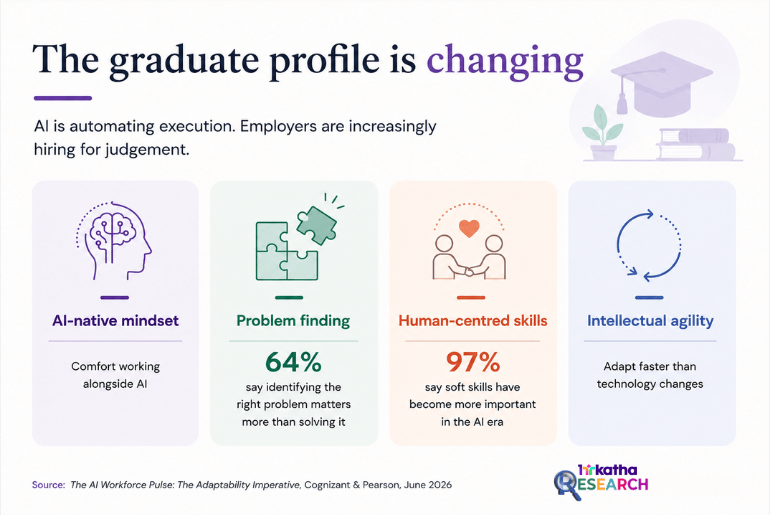
Sixty-seven per cent of HR leaders say they now place greater value on graduates with liberal arts backgrounds than they did previously. Nearly seven in ten prefer interdisciplinary education over narrow specialisation for entry-level hiring, while 97 per cent believe soft skills have become more important as AI adoption accelerates.
As AI takes over more routine technical work, the remaining human advantage lies in capabilities machines still struggle to replicate: judgement, communication, ethical reasoning, contextual understanding and the ability to connect ideas across disciplines. The shift is practical rather than philosophical.
The survey also captures another subtle shift. Sixty-four per cent of employers now value problem-finding more highly than problem-solving.
Yes, AI has become remarkably effective at answering questions. But it is still considerably less effective at recognising that organisations may be asking the wrong questions in the first place.
That ability, identifying emerging risks, challenging assumptions and reframing problems, increasingly distinguishes human contribution from machine execution.
The learning gap
The report’s most uncomfortable findings lie not in recruitment, but in learning.
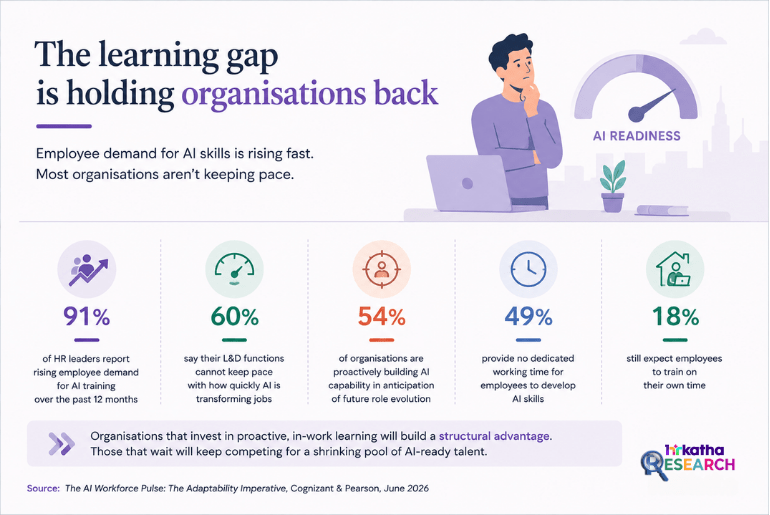
Employee demand for AI training is rising rapidly. Ninety-one per cent of HR leaders say requests for AI learning have increased over the past year.
Yet 60 per cent admit their learning and development functions cannot keep pace with the speed at which AI is changing jobs. Only 54 per cent say their organisations are proactively building AI capability before roles evolve. Nearly half provide no dedicated working time for employees to develop AI skills, while 18 per cent still expect people to learn outside working hours.
This is less a content problem than a design problem.
The capability of AI is not built through occasional workshops or certification programmes. It develops through continuous experimentation, application and feedback inside everyday work.
Organisations increasingly describe AI as a strategic priority while continuing to treat AI learning as optional. The data makes the contradiction visible: 91 per cent report rising demand for AI training, while 60 per cent admit their L&D functions cannot meet it. Declaring something strategically important while systematically underinvesting in the capability it requires is not a difficult position to sustain. It is simply an inconsistent one.
It is, therefore, unsurprising that 64 per cent of HR leaders report difficulty finding AI-ready talent externally. Organisations are competing for skills they are often not developing internally.
The return of the middle manager
For years, organisational design has favoured flatter structures. Middle management was widely viewed as an unnecessary coordination layer that digital systems could eventually replace.
The survey suggests AI is reversing that assumption.
Ninety-five per cent of HR professionals identify middle managers as the single most important factor in helping employees use AI effectively. Ninety-two per cent say they will play the central role in redefining work as AI changes day-to-day responsibilities.
The manager of the AI era looks less like a supervisor and more like a coach.
They demonstrate new tools, redesign workflows, encourage experimentation, answer practical questions and help teams develop confidence working alongside AI.
AI strategy may be developed in the boardroom and enabled through technology. It succeeds or fails with the manager sitting between them.
Why India should pay attention
India illustrates the transition more clearly than most countries.
Artificial intelligence already performs 37 per cent of entry-level work, above both the global average and the US. That is hardly surprising for an economy built around large-scale process work, where many graduate roles depend on repetitive cognitive tasks.
For Indian employers, this makes the redesign of entry-level work an immediate rather than future challenge.
The country’s talent model has traditionally relied on graduates learning through execution before moving into decision-making roles. If routine work disappears without new forms of structured development replacing it, organisations risk weakening the very leadership pipeline they depend on.
The challenge is therefore not simply adopting AI. It is redesigning how people learn.
The capabilities that remain
The survey identifies four capabilities that increasingly define successful employees: an AI-native mindset, problem-finding, intellectual agility, and human-centred skills such as communication, empathy and ethical judgement.
None of these capabilities is entirely new.
What has changed is their position in the value chain.
For years they complemented technical expertise. Increasingly, they are becoming the core of human work while AI handles routine execution.
An AI-native mindset is not about mastering technology. It is about knowing when to trust AI, when to question it and when human judgement must override machine output.
Intellectual agility allows people to adapt as work changes faster than job descriptions.
Problem-finding ensures organisations solve the right issues rather than merely finding faster answers.
Human-centred skills enable collaboration, influence and trust in environments where AI participates in everyday decisions.
Together, they represent adaptability rather than expertise alone.
The question organisations should be asking
The report presents an optimistic picture of AI’s impact on graduate employment.
Entry-level work is becoming more analytical, more collaborative and potentially more meaningful.
That optimism is justified, but only if organisations redesign early careers with the same urgency that they are redesigning workflows.
For decades, the first job was never simply about productivity. It was about preparation.
Now, AI is steadily removing much of the work that prepared people for what came next.
The organisations that replace those learning experiences with deliberate coaching, structured development and AI-enabled judgement-building will produce stronger future leaders.
Those that merely automate routine work may discover they have optimised away the very pipeline on which their future leadership depends.
The entry-level job has not disappeared. It has simply been handed a supervisor’s clipboard.