



DCB Bank is a mid-sized private sector bank competing for talent against larger banks, fintechs and technology firms. It cannot rely on brand recognition alone. It has to offer careers that grow, leaders who remain accessible and development pathways employees believe in.
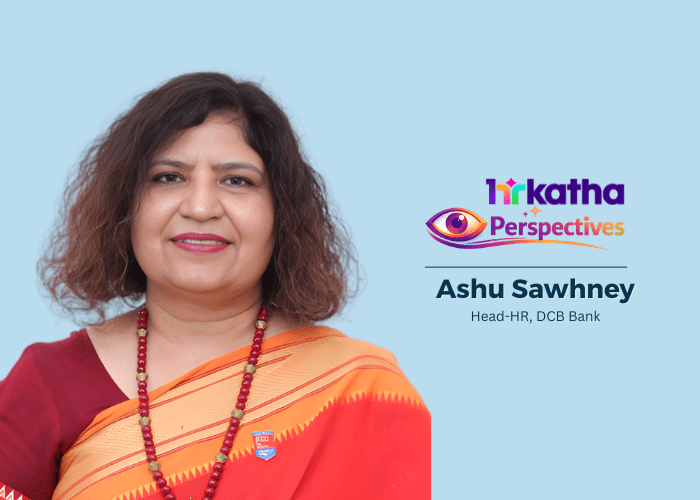
Ashu Sawhney has been shaping that experience as Head-HR. In conversation with HRKatha, she explains why attrition in banking is rarely about salary alone, why internal mobility is one of the strongest signals an organisation can send to its workforce, and why the immediate supervisor still shapes more of an employee’s experience than any policy or programme.
What exit interviews miss
Beyond compensation, what usually causes employees to leave, and how do you spot those signals before they resign?
Attrition is rarely just about compensation. Salary may be the reason employees cite when they resign, but the underlying causes are usually much deeper. People leave when they cannot see a meaningful career path, when they feel disconnected from their manager, when their strengths are poorly matched to the role, or when the work environment no longer supports their growth and well-being.
In banking, where frontline roles combine constant customer expectations with sustained performance pressure, those issues build quickly. The challenge is not understanding why people leave. It is recognising the warning signs before they decide to.
That is why we do not depend primarily on exit interviews. By the time someone resigns, responses are often shaped by the circumstances of the departure and the desire to leave on good terms.
Instead, we invest in listening earlier. Our employee connect programme, Each One Reach One, enables HR to have open conversations with employees, understand concerns first-hand and track actions every month. Because HR is seen as a neutral function, employees often share issues they might hesitate to raise with their immediate manager.
We also use digital sentiment analysis to identify patterns across the employee lifecycle. Together, conversations and data help us move from reacting to attrition to preventing it.
Retention is not about making employees stay. It is about creating an environment where they choose to.
“The most honest HR metric is whether the organisation becomes stronger because of its people practices.”
Careers built from within
Why do employees still leave before exploring opportunities inside the organisation, and how do you make internal mobility genuinely visible?
Internal mobility is one of the strongest signals an organisation can send. When employees believe their next opportunity exists inside the organisation rather than outside it, the conversation about leaving changes completely.
Making that happen requires overcoming familiar barriers: limited visibility of opportunities, managers reluctant to release strong performers and the belief that external hires always bring something new.
At DCB Bank, we have deliberately challenged the idea that talent belongs to a function or an individual manager. Through our Internal Job Watch framework, employees can see opportunities across businesses and geographies and take ownership of their own careers.
In FY2026 alone, more than 400 employees moved into new roles through this framework. The number matters less for its scale than for what it represents: careers being built within the bank rather than bought from outside.
We also run Career Wise, where employees can discuss their aspirations with senior leaders outside their own function. Those conversations provide objective guidance without the natural tension that sometimes exists within reporting lines.
The goal is simple: employees should never feel they have to leave the bank in order to grow.
“True inclusion is when a woman never has to choose between being a successful professional and being a mother.”
The manager is the real differentiator
Many organisations promote strong performers into management without testing whether they can actually lead people. How do you avoid that mistake?
Employees do not leave organisations. They leave managers. In banking, where employee engagement directly influences customer experience and business performance, manager quality becomes one of the most important variables in the entire organisation.
Strong business performance does not automatically create strong people leaders. Someone may excel commercially or technically yet struggle to coach others, build trust, give meaningful feedback or develop talent. Those capabilities should never be assumed simply because someone delivers results.
Our Supervisor Survey, S-Peak, captures employee feedback on the day-to-day manager experience. Those insights sit alongside business performance, compliance standards and leadership behaviours to provide a much more complete picture of managerial effectiveness.
Managers then receive structured feedback and targeted development based on those findings.
The expectation is clear. Every manager is accountable not only for today’s results but also for the engagement, capability and future readiness of the people they lead.
“Future-ready talent combines technical capability with human judgement.”
Learning agility and AI together
How are you preparing talent for a future where AI increases the value of both technical expertise and human judgement?
The conversation has moved beyond choosing between technical capability and human skills. Both have become more important.
Technical capability matters even more in an AI-enabled world. At the same time, qualities such as judgement, empathy, relationship management and customer trust become harder to replicate and therefore more valuable. Future-ready talent combines both.
Our Under 45 programme reflects that philosophy. High-potential leaders are mentored directly by the Managing Director and senior leadership team with the objective of preparing them for genuine leadership responsibility rather than simply giving them exposure.
On AI, we have seen very little resistance. Employees recognise that the real question is not whether AI will change their work but how.
Our Techfluence initiative makes that change tangible. Employees, including members of our Board, see how emerging technologies improve business outcomes instead of hearing abstract discussions about AI’s potential.
The future will not belong to humans or AI. It will belong to people who know how to use AI better than others. Our responsibility is to ensure our employees are among them.
“The future will belong to people who know how to use AI better than others.”
Inclusion that people can feel
Beyond representation targets, how do you know whether employees genuinely feel included, and what barriers still hold women back after maternity?
Diversity can be counted. Inclusion has to be experienced.
The first signs of an inclusion problem rarely appear in representation reports. They emerge in quieter indicators: slower career progression, lower engagement, higher attrition at particular career stages or inconsistent manager support.
Our listening architecture, supported by Each One Reach One and digital sentiment analysis, helps surface those issues before they become visible in the numbers. Acting on those conversations, rather than waiting for dashboards to confirm them, is where inclusion becomes real.
For working mothers, the biggest challenge is rarely policy. Most organisations already have policies.
The harder issue is assumption. A returning mother may quietly be viewed as less available, less ambitious or less ready for larger responsibilities. Those assumptions influence who gets stretch assignments, who is considered for promotion and who is seen as leadership material. They are rarely spoken aloud, which makes them harder to challenge.
Real progress comes when managers are held accountable not only for representation but also for the career progression of women in their teams.
Our YOUnity forums and mentoring initiatives create visibility and community. Leadership behaviour creates lasting change.
True inclusion is when a woman never has to choose between being a successful professional and being a mother.
“Employees should never feel they have to leave the bank in order to grow.”
The metrics that actually matter
Which people metrics best convince the CEO and Board that HR is strengthening business performance rather than simply measuring activity?
The metrics that matter are the ones that connect people decisions directly to business outcomes.
The first is internal mobility. More than 400 employees moved across roles through Internal Job Watch during FY2026. That demonstrates an organisation building capability from within rather than depending on external hiring.
The second is capability readiness. We look beyond learning completion to whether people are actually becoming ready for larger roles. Learning hours are inputs. Readiness is the outcome that matters.
The third is feedback resolution: the proportion of employee concerns raised through our listening channels that lead to meaningful action. Organisations that listen but fail to respond eventually lose credibility. Closing that loop is what turns listening into trust.
Ultimately, the most honest HR metric is whether the organisation becomes stronger because of its people. When employees continue to grow, build new capabilities and believe they are genuinely heard, HR is contributing directly to business performance, not simply managing a function.
“Retention is not about making employees stay. It is about creating an environment where they choose to.”
1 Comment
Totally Agree Attrition is Rarely about Compensation. Various aspects as stated by the H.R.Head Ms.Ashu govern the Attrition. Creation of a Work Conducive Environment were Employees feel Good to work at office and Create an Atmosphere of Enthusiasm…