



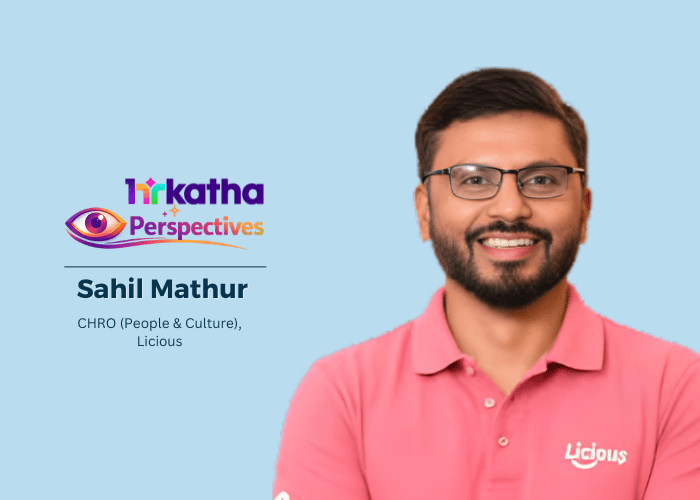
Licious is a food-tech company built around fresh meat and seafood, with a workforce that spans corporate professionals, meat technicians, processing centre staff and delivery partners. These groups have little in common when it comes to their workday, relationship with technology, career expectations or the pressures they face. Yet the people question is remarkably similar across all of them: what makes someone feel they belong here?
Sahil Mathur has been working on that question as CHRO. In conversation with HRKatha, he explains why belonging has different vectors for different employees, why low variable pay can sometimes be a more effective retention tool than high incentives, and why HR needs to move beyond consuming dashboards built by technology teams to designing workforce decisions alongside them.

Belonging, not benefits
Attrition looks very different among corporate employees and frontline workers. At Licious, what has surprised you most about why people stay or leave?
What surprised me most is that across all our Licians there is a sense of belonging, but it has different vectors. For corporate teams, attrition usually comes down to growth and challenge. On the frontline, it is more closely linked to the personal phase of life and individual circumstances.
In our Bangalore Processing Centre, we have siblings, spouses and cousins working together at Licious. That shared ecosystem is one of the things that keeps people engaged. It is not a perk we designed. It is a reality we recognised and chose to work with rather than around.
We do not rely on a single retention lever. We use benefits, engagement mechanisms and daily-vesting ESOPs so people feel a sense of ownership from day one. Our compensation is also weighted heavily towards fixed pay rather than incentives. That weighting signals trust.
We also run an attrition-prediction model that picks up behavioural signals early, rather than looking only at tenure. Retention for us is not a number we manage. It is trust we keep earning.
“HR should show up with hypotheses and questions, not pre-packaged answers.”
Trust, not identical policies
Much of your workforce must be physically present while corporate teams have greater flexibility. How do you prevent that from becoming two very different employee experiences?
We have to be flexible about being flexible. Flexibility looks different depending on the role, and that is fine. What has to remain consistent is how much we trust people, not the hours they keep.
For processing centre, hub, store and delivery teams, flexibility shows up differently: uncapped well-being leave, shift design built around real life, and safety and comfort treated as basics rather than perks. Corporate teams get flexibility in different ways.
What makes this fair across both groups is a culture where leave is not something people have to negotiate for. They feel comfortable telling us the real reason they need time off, and we respond with understanding rather than a checklist of approvals.
The same principle of trust shapes how we think about pay. Our philosophy is intentionally contrarian. We keep variable pay low and weight compensation heavily towards fixed pay because we do not want to engineer a carrot-and-stick culture. We would rather hire people who share our intent and then trust them than build elaborate incentive structures to manufacture the right behaviour.
Where we want people to feel genuine ownership, we use our ESOP structure: a one-year cliff followed by daily vesting. Every day someone contributes, they are building equity rather than chasing a quarterly number. That combination of low variability, high trust and daily-felt ownership encourages collaboration rather than competition for a bonus pool.
We also invest deliberately in communication. We recently launched an organisation-wide newsletter so that a meat technician in a processing centre feels as informed about the company’s direction as someone in our corporate office. Two different rhythms, but one experience of being trusted and heard. That is the real settlement, not identical policies.
“The next opportunity is translating ground-level diversity into our decision-making tables.”
Data tells you what, conversations tell you why
Where has data genuinely changed a people decision at Licious, and where does human judgement still matter more?
Our onboarding redesign is the clearest example.
Data initially told us a reassuring story: faster onboarding meant quicker earnings for our meat technicians, and everyone appeared satisfied. But direct conversations on the floor revealed something different. Speed was creating anxiety rather than confidence because the craft itself demands depth.
We rebuilt onboarding into a 30 to 45-day immersive journey. It looked slower on paper, but it improved quality, confidence and retention.
That is where human judgement still wins. No dashboard can tell you whether someone feels equipped to represent your brand.
Data tells you what is happening. Conversations tell you why. We use both, but we never let the former override the latter.
“Potential in operations often looks like judgement under pressure, not polish in a room.”
Potential looks different on the processing floor
High-potential programmes often favour employees who are more visible and articulate. How do you ensure potential on the processing floor is not overlooked?
High-potential programmes often unconsciously reward visibility and articulation, which corporate roles naturally offer more of. We have therefore built capability frameworks where operational leaders get full ownership of business outcomes for a geography, not just execution mandates.
Our City CEO structure is one example. It gives leaders on the ground genuine business accountability rather than task-level responsibility.
Our 3E approach, education, exposure and experience, is designed to surface potential wherever it exists, including on the processing floor, by giving people exposure beyond their immediate roles. Career pathways are transparent for every Lician so growth is not reserved for a curated shortlist.
Potential in operations often looks like judgement under pressure, not polish in a room. If your systems reward only the latter, you are leaving some of your best people undiscovered.
“Data tells you what is happening. Conversations tell you why.”
Diversity at the point of strategy, not just delivery
Beyond gender, which dimensions of diversity have shaped Licious most, and where is the next gap you want to close?
Gender is where we are most visible, with around 40 per cent female representation at senior leadership level and strong representation across our processing centres. But the diversity that has shaped our business more quietly is socioeconomic and regional.
Our frontline hiring is deeply local. We look at proximity to the processing centre, family ecosystems and whether children’s schooling is nearby because those are often the factors that determine whether someone stays and thrives rather than leaves after three months.
We also lean on vendor and gig-hiring networks that bring in people from very different educational and economic starting points.
We build capability internally when it is core to what makes Licious what it is. Quality on the meat side is never outsourced in spirit, which is why we run 30 to 45-day academies for meat technicians rather than simply looking for finished talent.
We bring in external capability when speed and specialised expertise matter more than institutional context, with engineering and product talent being the clearest examples. The deciding factor beyond cost and speed is culture absorption: can this capability be built quickly enough internally, or does the market already have it in a form we can trust and integrate?
The next opportunity is translating ground-level diversity into our decision-making tables. Right now, it is strongest at the point of delivery and production. I want it equally strong at the point of strategy.
“Low variability, high trust and daily-felt ownership encourage collaboration rather than competition.”
The conversation HR is not having
What is the people-leadership conversation HR should be having more urgently, but rarely does?
I rarely get asked how HR should change its own operating rhythm, not just its programmes.
We moved from reporting to diagnosis: HR showing up with hypotheses and questions rather than pre-packaged answers, and metrics tied directly to business outcomes such as output per shift or quality error rate, not just engagement scores. That shift changed how business leaders perceive the function.
The more urgent conversation is about co-architecture with technology leaders. Not HR consuming dashboards that others build, but both functions designing workforce decisions together from the outset.
Our attrition-prediction work became useful because analytics teams and frontline managers interpreted it jointly. That convergence, not another wellness policy, is where the next real gain in workforce leadership sits.
The same spirit runs through how we think about access and voice internally. Our founders personally respond to customer messages, and that openness is expected inside the organisation too. Hierarchy here is far less protective than people assume. Visibility and voice are earned by clarity of thought, not seniority.
“Retention for us is not a number we manage. It is trust we keep earning.”