



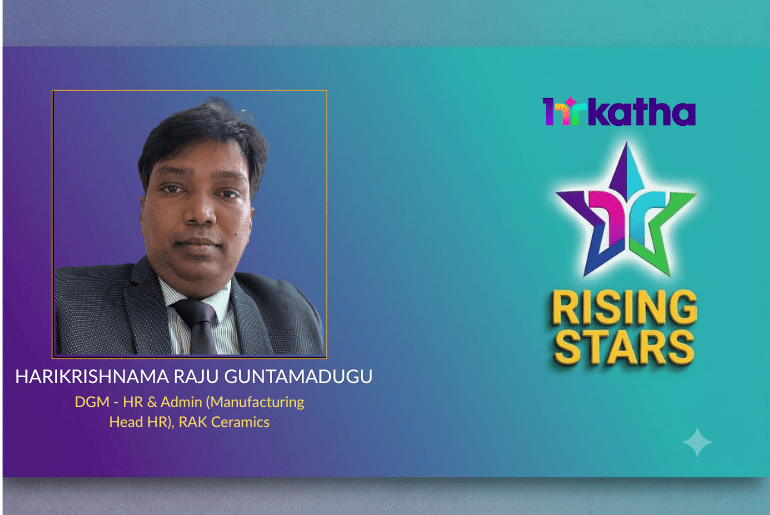
Finalist | HRKatha Rising Star Leadership Award 2025
Manufacturing HR rarely gets the glamour of its consulting or technology-sector counterparts. Its realities are contract labour, industrial relations, shift operations and greenfield project timelines rather than culture decks and employer-branding campaigns. Harikrishnama Raju Guntamadugu has spent more than eighteen years inside exactly this world, across glass, steel, pharma, cement and interiors, and it has shaped a decidedly practical view of what makes an HR leader credible: not visibility, but consistency demonstrated over years rather than campaigns.

“Credibility is earned through consistency over many years,” he says. It is perhaps the closest thing to a thesis running through his career.
Guntamadugu was named a winner of the HRKatha Rising Star Leadership Award 2025, which recognises emerging HR leaders whose work reflects where the profession is heading rather than where it has traditionally stood.
Business fluency over HR fluency
Guntamadugu is candid about what he would tell his younger self: “Spend more time understanding the business than understanding HR”. Early in his career, his attention was where many HR careers begin, on processes, policies and compliance. What changed his trajectory was recognising that the HR leaders who carried the most influence understood production, finance, safety, quality and operations as fluently as they understood the people function itself.
That shift is visible in his work, not merely in his philosophy. At RAK Ceramics and previously at JSW Cement, he has worked across HRIS deployments, contract labour digitisation, workforce restructuring and greenfield project establishment, the kind of infrastructure work that rarely attracts attention but can determine whether a manufacturing operation functions efficiently.
His view of leadership follows the same logic. Authority may come with hierarchy, but influence has to be earned through listening, fairness and an understanding of business realities deep enough for managers to seek HR’s advice rather than have it imposed on them.
Feedback as partnership, not evaluation
Guntamadugu believes feedback should build capability without diminishing confidence. When giving it, he focuses on behaviours and outcomes rather than personalities, on the premise that people are more receptive when they feel respected rather than judged.
Receiving feedback, he believes, is the harder discipline. He sees leadership growth as something that often begins where comfort ends, and credits some of his most important professional improvements to difficult feedback from managers and mentors, feedback he had to learn to hear with curiosity rather than defensiveness.
“Today, I view feedback as a partnership for growth rather than an evaluation,” he says, not a verdict on past performance but an investment in future capability.
Betting on young talent
The experience Guntamadugu returns to most readily is not a policy intervention or technology implementation, but mentoring young talent. At RAK Ceramics, he has helped create structured development pathways for young technical professionals, several of whom entered with limited industry exposure and have since assumed responsible operational roles through training and sustained managerial support. The company’s Unnati programme similarly focuses on career progression and performance development across a wider employee population.
For Guntamadugu, the test of whether such efforts have worked is unusually personal: can employees look back and identify someone in the organisation who saw their potential before they fully saw it themselves? It is a quieter measure of success than the cost-saving metrics manufacturing HR is often judged by. He considers it no less important.
Making careers visible
One gap Guntamadugu has repeatedly observed across manufacturing organisations is the imbalance between the effort devoted to acquiring talent and the discipline applied to developing it once people are inside. His response would be an integrated skills-to-career framework connecting role-based skill mapping, individual development plans, internal mobility, succession planning and transparent career progression.
The argument is straightforward. Employees are more likely to stay when they can see a credible future inside the organisation rather than having to guess whether one exists. For manufacturing companies, where specialist capabilities often take years to build, the absence of that visibility becomes a business problem, not simply a retention one.
Where HR is heading
Guntamadugu expects the next generation of HR leaders to operate as business strategists, change agents and workforce architects rather than administrators, with AI, predictive analytics and integrated digital systems increasingly shaping workforce decisions. He does not see that as diminishing the human side of HR. If anything, he believes it raises its importance: as routine work automates, the leaders who distinguish themselves will be the ones who combine data fluency with empathy rather than treat them as competing strengths.
For Guntamadugu, the longer-term measure of an HR leader’s success is not the title they eventually hold but what remains after they move on: systems that continue to work, cultures that remain credible, and people who have grown because the organisation invested in them.
Quick Takes
An unpopular HR opinion: Performance management should prioritise development over ratings.
Dinner with any HR leader, living or dead: He would ask how HR leaders can remain deeply human while leading increasingly digital workplaces.
Coffee break or brainstorm: Brainstorm, with coffee.
A surprising skill that makes him better at HR: Stakeholder negotiation and government liaison management.
Why he is a Rising Star
Guntamadugu represents a quieter kind of HR leadership, built not around high-profile transformation programmes but through nearly two decades inside manufacturing, across industrial relations, contract labour, digital systems, greenfield projects and talent development. The same philosophy runs through all of it: understand the business before trying to influence it, build systems that outlast individual leaders, and treat feedback and talent development as long-term investments rather than short-lived interventions.
That combination matters particularly in manufacturing, where credibility is tested not in boardrooms but on shop floors, across shifts, against the operational realities of productivity, quality, safety and cost. Guntamadugu sees no contradiction between operational rigour and empathy, or between understanding a balance sheet and understanding the people whose work produces it, and that is what makes him an HRKatha Rising Star. In manufacturing, credibility is rarely won in a single presentation. It is built floor by floor, year by year.
Rising Stars is HRKatha’s editorial series profiling the next generation of HR leaders shaping the future of the profession. The series features winners of the HRKatha Rising Star Leadership Awards alongside emerging professionals whose work, ideas and leadership potential deserve wider recognition.