


Corporate AI training has created an odd new metric: the number of people who have been trained.
It is an attractive number because it is large, easy to measure and reassuringly precise. It is also of limited use. An employee can complete an AI course, earn a certificate and return to working exactly as before.
Genpact is trying to make that distinction central to its AI-skilling strategy. The business process and technology company, which employs people globally, wants its entire workforce operating as AI Practitioners by 2027. But its definition of a practitioner deliberately has little to do with course completion.
“Becoming an AI Practitioner is not about completing a certification or learning a new tool,” says Shalini Modi, senior vice president and global leader for employee learning and skilling. “It means building role-relevant AI capability, using AI responsibly and applying it to real business problems.”
That turns a training target into a much harder organisational challenge. Teaching people how AI works is one thing. Getting them to use it appropriately in finance, operations, technology, sales and client services is another.
Two kinds of AI talent
Genpact divides its workforce broadly into AI Builders and AI Practitioners.
Builders create and scale AI products, platforms and solutions. They require technical depth in areas such as data platforms, generative AI development, solution architecture and agentic systems.
Practitioners are the much larger population. They may work in finance, operations, sales or client services and do not need to understand everything happening beneath an AI model.
They do need to know how to use it, question it and exercise judgement around its outputs.
“Learning cannot remain confined to formal courses or periodic certifications. It must be continuous, contextual and closely connected to daily work.”
Shalini Modi, SVP & global leader, employee learning and skilling, Genpact

That distinction is particularly relevant to Genpact. Much of its work sits inside complex enterprise processes where judgement remains difficult to automate. An AI system may identify an exception in a financial workflow. Deciding whether to accept the recommendation, override it, escalate it or redesign the process still requires someone who understands the business context.
The company’s Pathfinder programme is designed around precisely this transition. As AI takes over more repetitive and transaction-heavy work, employees move towards exception handling, workflow supervision and outcome improvement.
“The emphasis is on developing the judgement required to supervise AI-enabled workflows, understanding when to question an output, what to escalate and where processes themselves can be improved,” Modi says.
Senior leaders follow a different learning route, including programmes at MIT, Berkeley and Kellogg alongside Genpact’s own leadership initiatives. Their requirement is less about operating AI tools and more about understanding what AI changes in businesses, operating models and decisions.
Learning moves into the work
The more interesting change is not what Genpact teaches, but where it expects learning to happen.
“Learning cannot remain confined to formal courses or periodic certifications,” Modi says. “It must be continuous, contextual and closely connected to daily work.”
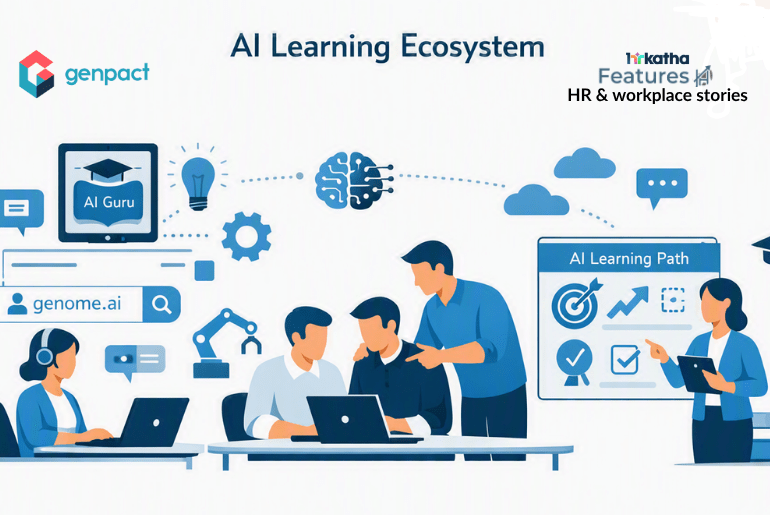
Genpact has built an ecosystem around that idea. Genome.ai provides AI-powered learning. AI Guru offers continuous coaching. Scout functions as an enterprise AI assistant, while an AI Readiness App helps employees understand their preparedness. AI Practice Labs provide browser-based environments in which employees can experiment.
Hackathons, simulations, immersion studios and applied innovation challenges extend the learning into actual problem-solving.
The principle is straightforward. Someone learning to handle an AI-generated exception while dealing with a real workflow is likely to build a different capability from someone watching a module explaining exception management.
The scale of learning is already considerable. In 2025, Genpact employees recorded more than 12.5 million learning hours, of which more than five million were devoted to technology and AI.
But Genpact itself appears to recognise the limitation of that number. Learning hours measure activity. They do not necessarily measure capability.
What happens after the course?
That is why Genpact is attempting to measure AI readiness across three dimensions: capability, adoption and impact.
Capability asks whether employees possess the skills their roles require. Adoption looks at whether those skills are actually being used in workflows. Impact asks the uncomfortable final question: did any of it improve productivity, client outcomes or decision quality?
“Course completion only shows participation, but not whether people are applying what they have learned or creating business value,” Modi says.
This is where Genpact’s experiment becomes more consequential than another large-scale reskilling exercise.
Completion is easy to count. Application is harder. Impact is harder still.
An employee may use an AI tool regularly without becoming more productive. A team may automate parts of a workflow while creating new layers of checking elsewhere. Faster output does not necessarily mean better output.
Genpact’s 2027 target therefore depends not merely on how many employees acquire AI skills, but on whether the company can distinguish use from productive use.
Managers become the multiplier
Between enterprise ambition and employee behaviour sits the manager.
Genpact recognises that employees are unlikely to change how they work simply because a learning platform tells them to. Managers determine which tools are encouraged, which experiments receive time, which mistakes are tolerated and whether AI becomes part of normal work or remains an additional task layered onto it.
“When leaders use tools such as Scout or Chat with Data for workforce insights, AI becomes more visible as part of everyday work rather than a separate corporate initiative,” Modi says.
The company is therefore putting managers through leadership programmes, AI immersion studios and experiential learning.
This may prove one of the more important parts of the strategy. Corporate transformation programmes often concentrate on employee capability while underestimating the middle layer responsible for converting corporate intent into daily behaviour. If managers continue to allocate work, assess performance and make decisions in the old way, employee training can only travel so far.
Skills that lead somewhere
The AI push also connects to Genpact’s broader talent architecture.
The company has developed skill taxonomies, role-skill frameworks and an enterprise skills inventory to understand what capabilities already exist and where gaps are emerging. More than 52 per cent of staffing is enabled through internal mobility and targeted build programmes.
That figure gives the learning infrastructure a practical purpose. Skills are not merely being recorded; they are being used to move people into work.
This matters particularly as AI changes roles faster than traditional job architectures can comfortably accommodate. If work shifts from transaction processing towards supervising AI-enabled processes, companies can either recruit new talent for each new requirement or attempt to move existing employees with the work.
Genpact is betting heavily on the latter.
The harder 100%
The obstacle now is unlikely to be awareness. Employees hardly need convincing that AI is changing work. The greater problem is confidence, followed closely by fatigue.
Workforces have already lived through waves of digital transformation, automation and reskilling. Another compulsory course is unlikely to produce much enthusiasm. Genpact’s emphasis on simulations, labs, hackathons and work-based experimentation is an attempt to make employees participants in the change rather than recipients of it.
Modi describes AI capability as “a muscle that must be strengthened continuously, not a certification earned once and treated as permanently relevant.”
That may ultimately be the more useful way of understanding Genpact’s 100 per cent target.
Reaching employees with AI learning is largely a problem of scale. Turning over 140,000 people into employees who know when to use AI, when not to use it, when to distrust it and how to produce better work with it is a problem of organisational behaviour.
By 2027, counting practitioners will be relatively easy.
Proving that they practise will be harder.