



The great reshuffling appears to be running out of steam. Globally, 24 per cent of workers intend to switch jobs in the first half of 2026, according to the Employer Brand Research 2026 report by Randstad. Intentions to move have declined for the second consecutive year, even as actual job-switching has remained relatively stable.
For employers, that sounds reassuring. After several years of unusually high mobility, a workforce that wants to stay put might reasonably be read as evidence that retention is improving and the turbulence of recent years is finally subsiding.

The rest of the data makes that interpretation harder to sustain.
The things workers value most have changed remarkably little. Pay remains critical. Career progression matters. Management quality matters. Work-life balance matters. And employers continue to underperform on several of precisely those dimensions. What has fallen is the willingness to move.
That distinction matters. Lower attrition can be produced by two very different conditions: employees wanting to stay, or employees becoming less willing to leave. They look identical on a retention dashboard. They mean very different things for the health of an organisation.
The youngest workers are still moving
The global slowdown in mobility is not evenly distributed.
Gen Z remains the most mobile generation, with 30 per cent intending to switch jobs and 24 per cent actually doing so. Older workers show progressively lower levels of movement.
Some of that is unsurprising. Early-career workers generally have less tenure invested in an employer and more of their working lives ahead of them. Career experimentation is also a more natural feature of the first years of employment than of the last.
However, the generational split creates a particular problem for employers. The workers most willing to move are also those organisations are trying to develop into their next layer of experienced talent. Retention, therefore, becomes less about preventing the loss of accumulated institutional knowledge and more about ensuring that enough people remain long enough to acquire it.
The regional picture is equally uneven. North America stands apart from the broader trend, with job movement considerably higher than in Europe, Latin America and APAC. The report does not establish whether that reflects greater opportunity, greater dissatisfaction or some combination of the two. What it does show is that the apparent global cooling in mobility is not happening everywhere at the same speed.
What workers still want
The criteria employees use to judge employers offer the first clue as to why declining mobility should not automatically be mistaken for rising satisfaction.
Salary and benefits remain at the top of the global list, while work-life balance has become almost equally important, cited by 55 per cent of respondents. Job security and a pleasant working environment follow at 50 per cent, with career progression at 48 per cent.
Age changes the weighting considerably. Salary becomes more important as workers get older, rising from 47 per cent among Gen Z to 72 per cent among Baby Boomers. Career progression moves in the opposite direction, carrying greater weight earlier in a career. Job security also becomes progressively more important with age.
The broader point is not that different generations want entirely different things. They largely want variations of the same things, but in different proportions and at different stages of their careers. A universal employer proposition therefore becomes less useful precisely as organisations try to manage increasingly multigenerational workforces.
Regional preferences vary too. Europe places particular weight on a pleasant working atmosphere. Latin American workers give greater importance to career progression and equal opportunities. North America places more emphasis on management quality and employer reputation. APAC respondents tend to rate employers more positively across several dimensions.
Employer attractiveness, in other words, is becoming harder to reduce to a single global proposition.
The delivery gap
The more revealing part of the research is the distance between what employees value and what they believe employers actually provide.
Job security and equal opportunities receive some of the strongest satisfaction scores, at 74 per cent. Pay and career progression, two of the factors most closely associated with decisions about whether to stay or leave, perform considerably less well.
That gap matters because retention programmes often concentrate on what organisations can readily provide rather than what employees value most. Benefits are expanded, engagement programmes proliferate and employer-brand campaigns become more sophisticated, while the harder questions of compensation, mobility and career architecture remain unresolved.
Management deserves particular attention. Satisfaction with direct management remains relatively weak in several regions. In Europe, only 53 per cent of workers express satisfaction with their direct management. Yet, managers influence far more than employees’ views of leadership. They shape access to opportunity, perceptions of fairness, day-to-day flexibility, recognition and whether career progression feels plausible.
Improving management, therefore, does not address one retention variable. It changes the employee’s experience of several at once.
Why people actually leave
When workers explain departures, the hierarchy is familiar.
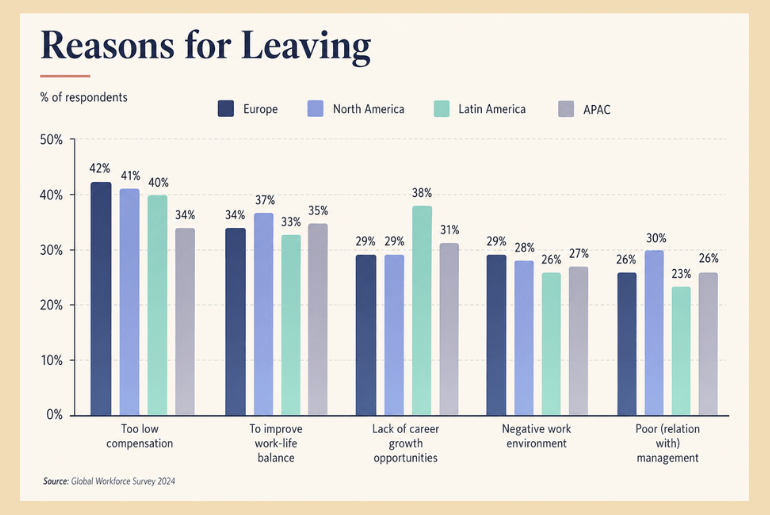
Compensation remains one of the most important triggers across markets. Work-life balance carries particular weight in APAC, while limited career progression is more prominent in Latin America and management quality plays a larger role in North America.
What is striking is not that these factors differ by region. It is how little the fundamental reasons for leaving have changed even as intentions to move have declined.
That is where the apparent contradiction in the data becomes useful. If employees were becoming substantially more satisfied with their employers, one might expect the underlying sources of dissatisfaction to weaken alongside switching intentions. They have not done so to the same extent.
A more cautious labour market is therefore one plausible explanation for at least part of the decline in mobility, although the survey does not establish that causally.
For employers, the distinction is more than academic. Employees who stay because they prefer their organisation behave differently from employees who stay because alternatives look uncertain.
The first represents retention. The second represents inertia.
Retention can flatter to deceive
For years, organisations have treated voluntary attrition as one of the simplest measures of workforce health. When resignations rise, something is wrong. When they fall, something must be improving.
The survey exposes the weakness in that logic.
Turnover measures movement. It does not measure attachment.
A falling resignation rate can coexist with frustration over pay, disappointment with career opportunities and dissatisfaction with management. It can even coexist with an employee population that would leave readily if labour-market conditions became more favourable.
That makes the current period particularly deceptive. Organisations may be receiving the retention numbers they wanted without having solved the problems that produced high turnover in the first place.
What the numbers are really saying
The data ultimately describes a workforce that appears to have paused rather than one that has necessarily settled.
Job-switching intentions are falling, but many of the factors that make employees consider leaving remain firmly in place. The temptation for employers will be to interpret lower mobility as evidence that retention strategies are working.
The more useful question is what kind of staying the organisation is seeing.
Employees who stay because they see opportunity, trust their managers, feel fairly rewarded and can imagine a future with the organisation create stability. Employees who stay because moving feels less attractive create something much more fragile.
Both populations appear identical in an attrition report. They reveal themselves only when the labour market improves.
That is the paradox in the numbers: a workforce that has stopped moving is not necessarily a workforce that wants to stay.