



What does ‘change agility’ mean?
Change agility is the ability to adapt quickly and constructively when circumstances shift. It is not simply about surviving disruption, but about continuing to learn, decide, and move while that disruption is still unfolding.
In HR, the term describes both an individual capability and an organisational one. Employees need to adjust when technologies, roles, markets, or expectations change. Organisations need systems that allow them to do so without waiting for stability that may never arrive.

It is useful to distinguish change agility from resilience. Resilience is largely about recovering from adversity. Change agility is about adjusting while conditions are still changing. The distinction matters because an organisation can have remarkably resilient employees and still be remarkably poor at change.
Indeed, that combination is more common than many organisations would care to admit.
Where did the idea come from?
Agility has long been associated with the ability to manoeuvre quickly in unpredictable conditions, particularly in military thinking. Business adopted the language more enthusiastically in the 1990s as globalisation, technological change, and faster competitive cycles made rigid organisational structures increasingly difficult to defend.
By the early 2000s, ideas around learning agility, strategic agility, and change agility had entered leadership development and organisational psychology. The underlying proposition was straightforward: in an environment where yesterday’s knowledge can lose relevance quickly, the ability to learn and adapt becomes as important as what someone already knows.
The vocabulary has evolved since then, but the problem it describes has become more acute. AI, hybrid work, regulatory shifts, demographic change, and geopolitical uncertainty have made change less of an occasional organisational event and more of a permanent operating condition.
Why is it relevant for HR?
Much of traditional HR was designed for relative stability. Organisations recruited people for defined jobs, developed them against established competency frameworks, moved them along recognisable career paths, and measured them against objectives set months earlier.
That architecture becomes harder to sustain when jobs themselves are changing.
Recruitment increasingly needs to assess how candidates learn, not merely what they already know. Learning and development has to become part of everyday work rather than an intervention delivered periodically. Succession planning must identify leaders capable of making decisions without perfect information, while performance systems need enough flexibility to recognise that an objective agreed in January may make little sense by September.
This changes the meaning of talent too. Deep expertise still matters, but so does the ability to abandon an approach that has stopped working. An employee who has performed brilliantly under one set of conditions is not automatically the person best equipped for the next.
For HR, therefore, change agility is not another competency to add to a leadership framework. It affects how talent itself is identified, developed, and rewarded.
The uncomfortable reality
Most organisations describe themselves as agile. Far fewer are designed to be.
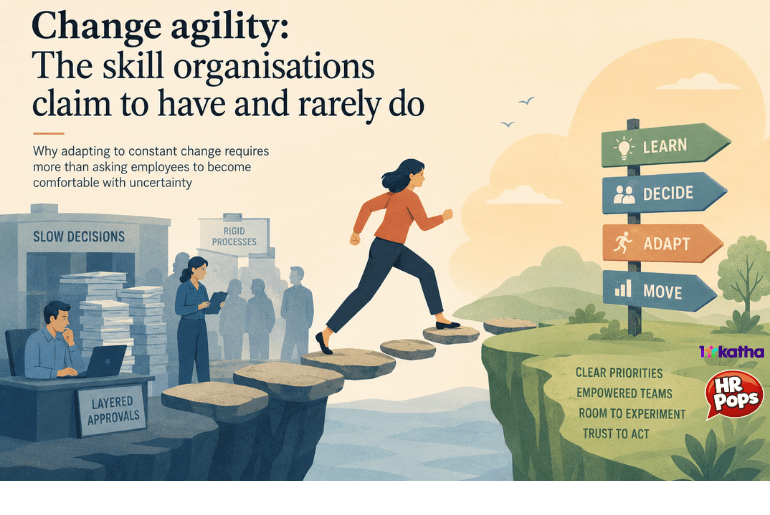
Employees are told to embrace change while decisions queue through layers of approval. Leaders encourage experimentation but performance systems punish failure. Teams are asked to move faster while processes, budgets, and reporting structures remain stubbornly slow.
The contradiction is difficult to miss. Organisations want agile people inside systems built for predictability.
There is also a human limit to how much change people can absorb. Continuous transformation programmes, restructurings, new technologies, shifting priorities, and repeated demands to “embrace uncertainty” eventually exact a cost. Employees who are asked to adapt constantly without clarity, support, or time to recover do not necessarily become more agile. They can simply become tired.
This is where change agility is easily confused with endurance. If every organisational inefficiency is pushed downwards and employees are expected to compensate by becoming more adaptable, agility becomes a convenient way of transferring the cost of change from the institution to the individual.
Real change agility requires the organisation to adapt too. Approval chains have to shorten. Priorities need to become clearer. Managers must be able to make decisions closer to the work. Experiments need room to fail without every failure becoming a career event.
Otherwise, HR is not building change agility. It is asking employees to become better at navigating organisational inertia.
The takeaway
Change agility matters because stability can no longer be the assumption around which organisations design work.
However, it cannot be created through workshops, competency models, or repeated exhortations to embrace change. It emerges from the way organisations hire, develop, reward, decide and respond when people try something that does not work.
For HR, that creates a more demanding question than whether employees are ready for change:
Is the organisation itself ready to let them change?
A workforce can move only as quickly as the systems around it allow.