



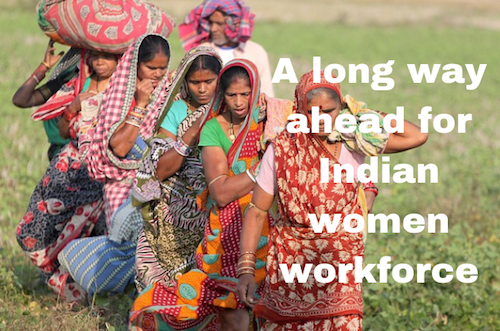
Going by the revelations of the State of Working India 2018 report, the country’s women are a long way from enjoying what they truly deserve. The Report by the Centre for Sustainable Environment (CSE), Azim Premji University, reveals many interesting facts about the state of work and workers in the country. It is a mixed bag — of positives and negatives alike. Let us take a look at what it has to say, especially about women workers in the country.
The brighter aspects first — Between 2010 and 2015, wages, factoring in inflation, grew at two per cent per year for the organised manufacturing sector and four per cent for the unorganised manufacturing segment. Similarly, wages grew by five per cent for unorganised services. Although it grew seven per cent for the agriculture sector, the growth has fallen since 2015. In the past 17 years, real wages have grown at approx. three to four per cent in most sectors, except agriculture. But all is not well.
A field survey in West Bengal revealed that women are barely able to make ends meet even after taking up several informal jobs at a time. Despite multiple jobs, they fail to earn a living wage. For instance, a woman who stitched clothes, worked at a brick kiln, slogged as a daily labourer, and also cooked mid-day meals managed to earn just Rs 2700 a month. Yet another daily labourer, who also worked at a brick kiln, and at a sand mine, in addition to toiling in the fields, earned Rs 6800 a month.
The income of 92 per cent of women workers is less than Rs 10,000 a month, whereas the minimum salary recommended by the Seventh Central Pay Commission (CPC) is Rs 18,000 per month. Clearly, a significant number of Indians, including women are not getting paid even a living wage. Even in the organised manufacturing sector, 90 per cent of the industries pay wages below the CPC minimum recommendation. The wages are far worse in the unorganised sector.
A field survey in West Bengal revealed that women are barely able to make ends meet even after taking up several informal jobs at a time. Despite multiple jobs, they fail to earn a living wage. For instance, a woman who stitched clothes, worked at a brick kiln, slogged as a daily labourer, and also cooked mid-day meals managed to earn just Rs 2700 a month. Yet another daily labourer, who also worked at a brick kiln, and at a sand mine, in addition to toiling in the fields, earned Rs 6800 a month. A similar field study in the state of Rajasthan revealed that skilled stone cutters earned a lot less than the already low state minimum wage, despite the work being extremely hazardous.
On the whole, women earn 65 per cent of what men earn.
There is a wide gap in wages between genders. Based on the nature of work and education level of the worker, women earn between 35 and 85 per cent of what men do. But such disparities have decreased. In the organised manufacturing sector, the percentage shrank from 35 per cent in 2000 to 45 per cent in 2013. The discrepancy is the widest amongst own-account women workers, and the smallest among the more educated and regular workers.
In the state of Rajasthan skilled stone cutters earned a lot less than the already low state minimum wage, despite the work being extremely hazardous.
While the participation of women in the paid workforce is low, some states show better figures than others. In Uttar Pradesh, for every 100 men in paid employment, there are merely 20 women. In Tamil Nadu, on the other hand, there are 50 women in paid employment for every 100 men. The figure is highest in the North-East, with 70 women for every 100 men.
Even amongst the developing nations, India’s position is not too good. The percentage of women of working age who are either employed or seeking work is lower in India than in many other developing countries. Worse still, this figure has been falling with the passage of time.
However, women in the states of South India and those of the North East participate in the workforce in more numbers than women of the North Indian and western states. The ratio of rate of participation of men workers to women workers in the workforce varies from less than 0.2 in Uttar Pradesh and Punjab to 0.5 in Tamil Nadu and Andhra Pradesh. The same exceeds 0.7 in Mizoram and Nagaland.
In Uttar Pradesh, for every 100 men in paid employment, there are merely 20 women. In Tamil Nadu, on the other hand, there are 50 women in paid employment for every 100 men. The figure is highest in the North-East, with 70 women for every 100 men.
While the disparities in gender remain high, the good news is that it is falling in some states.
Women comprise 16 per cent of all service-sector workers, but 60 per cent of domestic workers.
The falling participation of women in the labour force can be attributed to the shortage of available work, and not merely due to social restrictions on women, or the rising enrollment in educational institutions. Government programmes, such as anganwadis and ASHA have played a significant role in trying to increase women’s participation in the paid labour force.
Interestingly, the Report reveals that employment actually fell by seven million between 2013 and 2015, which resulted in the rate of unemployment among the youth and those with higher education going up to 16 per cent. In the 2000s, GDP growth has increased to seven per cent, but employment growth has decreased to one per cent or even less. In fact, the ratio of GDP growth to employment growth is now less than 0.1 now.
Apparently, it is not unemployment that plagues the country, but underemployment and low wages.