



There is a seductive belief shaping corporate strategy today: that artificial intelligence will separate winners from losers based on how much of it they adopt. Buy the tools, deploy them widely, and performance will follow.
The evidence suggests otherwise.

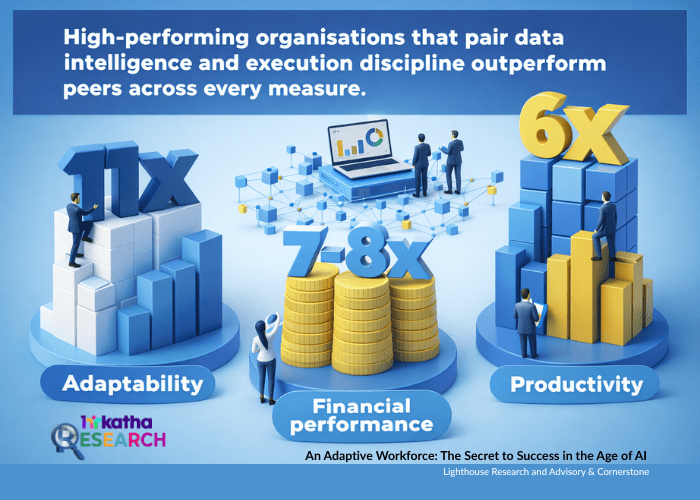
A 2026 study by Lighthouse Research and Advisory, conducted in partnership with Cornerstone and drawing on responses from more than 1,000 executives and employees, points to a different dividing line. Organisations that combine workforce intelligence with the ability to act on it are 11 times more likely to describe themselves as highly adaptable to change. They are also seven to eight times more likely to report strong financial performance, and six times more likely to report high productivity.
These are not marginal advantages. They point to a deeper structural difference in how organisations operate.
From knowing to doing
The distinction the study draws is deceptively simple. Workforce intelligence gives organisations visibility into what their employees can do: their skills, how those skills are evolving, and where the gaps lie. Activation determines whether that knowledge is actually used when decisions are made.
Most organisations believe they have made progress on the first. Fewer have confronted the second.
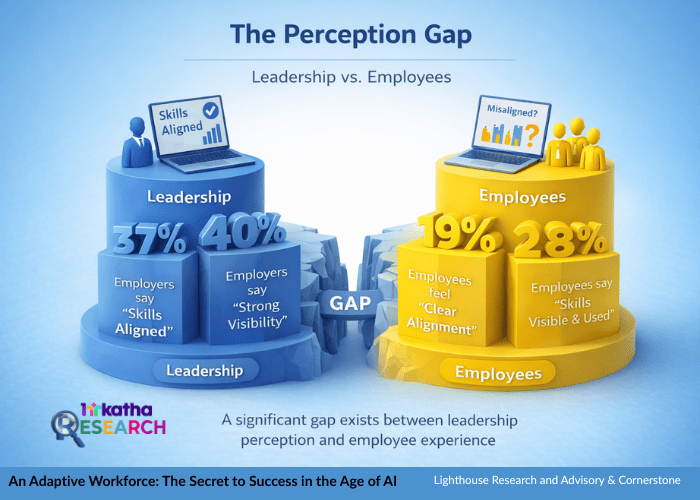
On the surface, the numbers suggest confidence. Thirty-seven per cent of employers report enterprise-wide alignment between skills and business priorities, and 40 per cent say they have robust visibility into employee capabilities. Yet this confidence does not travel down the organisation. Only 19 per cent of employees believe their skills are clearly aligned with the company’s future direction, and just 28 per cent say their capabilities are consistently visible or used to guide work decisions.
This divergence is not merely perceptual. It reveals a system in which knowledge exists, but is not operationalised.
The intelligence that does not move
The report reaches for an apt analogy: workforce intelligence is like money sitting in a bank account. It has value, but only in potential. Until it is put to work, it changes nothing.
Many organisations have invested in building that account. They have deployed skills platforms, conducted assessments and created dashboards. But when business priorities shift, the response mechanism remains slow. Decisions are still routed through managerial familiarity rather than system-level insight. Skills data is reviewed periodically, not used dynamically.
The result is a form of organisational inertia. Companies know more about their workforce than ever before, but continue to act as if they do not.
The internal hiring paradox
This inertia becomes most visible when organisations need to respond to change.
For many, the instinct remains external. A new priority triggers a hiring process: roles are defined, candidates sourced, new employees brought in to fill capability gaps. The process is familiar, but slow and often redundant.
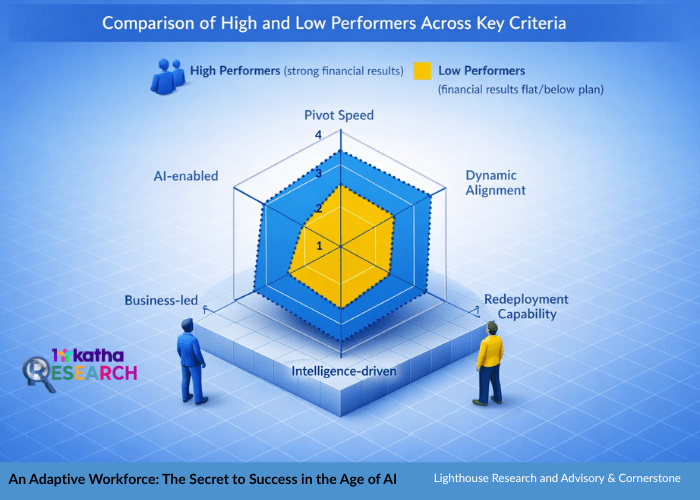
The study shows that organisations which have built activation capability behave differently. They are far more likely to look inward first. Those with strong activation practices are nine times more likely to staff new initiatives using internal talent rather than defaulting to external hiring. They are also significantly more responsive when priorities shift, with the most adaptable organisations 57 per cent likely to redeploy existing capability, compared to 22 per cent among lower-performing peers.
The contrast becomes sharper in cross-functional work. Where skills are visible and connected to decision-making, 71 per cent of organisations can assemble teams quickly. Where such visibility is absent, that number drops to 22 per cent. The workforce, in both cases, is identical. What differs is the organisation’s ability to see and use it.
The manager bottleneck
If the system fails to move, it is often because of one critical point of resistance: the manager.
The study identifies middle management as the decisive variable in whether activation happens at all. Managers function, in the researchers’ framing, like valves in the talent pipeline. When they support movement, talent flows across the organisation. When they resist, even the most sophisticated systems stall.
The consequences are measurable. Organisations where managers actively support internal mobility report productivity outcomes four times stronger than those where they do not, alongside significantly higher retention. Yet 36 per cent of employees say managerial resistance remains a barrier to moving within the organisation.
The gap between enabling and inhibiting behaviour is stark. In organisations where managers lack the tools, incentives or training to support mobility, fewer than 3 per cent consistently staff new initiatives with internal talent. Where those supports are in place, 75 per cent are able to redeploy or develop talent quickly in response to shifting priorities.
What appears, at first glance, to be a systems issue turns out to be a leadership one.
The AI accelerant
Into this already uneven landscape, the report introduces agentic AI — not as a disruptor of the model, but as a multiplier of existing advantage. And that, for companies still in the data-collection phase, is the uncomfortable part.
Even today, organisations with workforce intelligence tools rely heavily on human interpretation to translate data into action. Skills are reviewed periodically, decisions are made episodically, and the connection between insight and execution remains fragile.
Agentic systems promise to compress that gap. By continuously analysing work activity, they can infer emerging skills, identify capability shortfalls earlier and surface redeployment recommendations in real time. The argument is not that AI replaces human judgment; it is that it removes the lag between knowing and acting.
This matters because the environment itself is accelerating. The study finds that 80 per cent of employers believe the skills required for current roles have already changed since employees were hired into them. High-performing organisations respond by treating capability as something that must be continuously recalibrated, not stored and periodically consulted. As agentic systems mature, the gap between these two approaches will widen. Organisations that have already embedded intelligence into decision-making will find their responsiveness compound. Those still relying on periodic reviews and informal managerial judgment will find themselves further behind, faster.
Execution as advantage
Across the study, the cumulative effect of these differences is clear. High-performing organisations outperform their peers by approximately 40 per cent across key measures of adaptability, coordination and execution. The advantage does not come from access to better technology. It comes from the ability to use what already exists.
Three capabilities define this gap: visibility into skills, the ability to act on that visibility, and leadership alignment around talent mobility. Remove any one, and the system weakens. Bring them together, and the organisation becomes measurably more responsive.
The implications for leaders are straightforward, if not easy. Make capability visible and tie it to strategy. Treat internal talent as the first option, not the fallback. Hold managers accountable not only for performance, but for how effectively they develop and redeploy people.
None of this is technologically complex. But it is organisationally demanding.
The real divide
The study ultimately reframes the AI conversation.
The divide is not between companies that have AI and those that do not. It is between companies that act on what they know and those that do not. Intelligence without activation remains inert. Activation without leadership alignment stalls. But when the two are combined, the effect is multiplicative — eleven times more likely to adapt, seven to eight times more likely to outperform financially, six times more productive.
In a world where strategic priorities shift faster than hiring cycles, the ability to move people quickly has become a competitive advantage in its own right.
The companies that understand this are not waiting for AI to tell them what to do next.
They have already built the discipline to act on what they know.