

Close Menu
    Facebook X (Twitter) Instagram
    • Our Story
    • Partner with us
    • Reach Us
    • Career
    Subscribe Newsletter
    HR KathaHR Katha
    • Exclusive
      • Exclusive Features
      • Perspectives
      • Friday Features
      • herSTORY
      • Rising Stars
      • Case-In-Point
      • Point Of View
      • Research
      • HR Pops
      • Dialogue
      • Movement
      • Profile
      • Beyond Work
      • By Invitation
    • News
      • Global HR News
      • Compensation & Benefits
      • Diversity
      • Events
      • Gen Y
      • Hiring & Firing
      • HR & Labour Laws
      • Learning & Development
      • Merger & Acquisition
      • Performance Management & Productivity
      • Talent Management
      • Tools & Technology
      • Work-Life Balance
    • Special
      • HR Forecast 2026
      • Cover Story
      • Editorial
      • HR Forecast 2024
      • HR Forecast 2023
      • HR Forecast 2022
      • HR Forecast 2021
      • HR Forecast 2020
      • HR Forecast 2019
      • New Age Learning
      • Coaching and Training
      • Learn-Engage-Transform
    • Magazine
    • Reports
      • Whitepaper
        • HR Forecast 2024 e-mag
        • Future-proofing Manufacturing Through Digital Transformation
        • Employee Healthcare & Wellness Benefits: A Guide for Indian MSMEs
        • Build a Future Ready Organisation For The Road Ahead
        • Employee Experience Strategy
        • HRKatha 2019 Forecast
        • Decoding and Driving Employee Engagement
        • One Platform, Infinite Possibilities
      • Survey Reports
        • Happiness at Work
        • Upskilling for Jobs of the Future
        • The Labour Code 2020
    • Conferences
      • Leadership Summit 2025
      • Rising Star Leadership Awards
      • HRKatha Futurecast
      • Automation.NXT
      • The Great HR Debate
    WhatsApp LinkedIn X (Twitter) Facebook Instagram
    HR KathaHR Katha
    Home»News»Events»Finding the missing dots: Can coaching survive the system?
    Events

    Finding the missing dots: Can coaching survive the system?

    At a conference organised by the International Coaching Federation, two leaders examined why corporate India’s coaching boom may be solving the wrong problem
    mmBy Liji Narayan | HRKathaApril 6, 2026Updated:April 7, 20265 Mins Read7155 Views
    Share LinkedIn Twitter Facebook WhatsApp
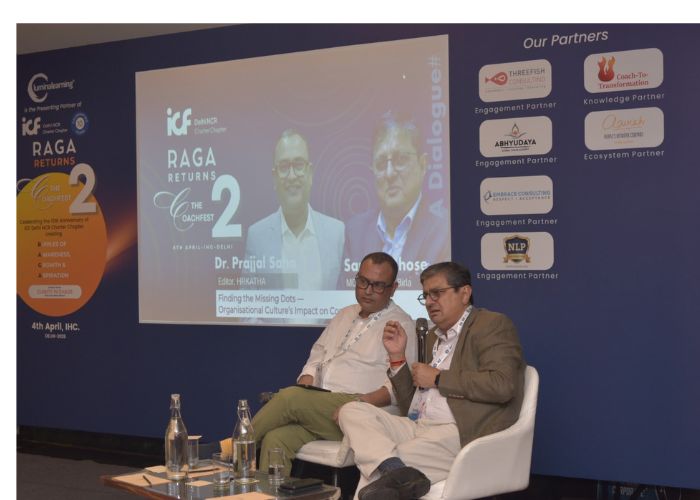
    Prajjal and Sandip Ghose at ICF's RAGA: Connecting the Dots
    Share
    LinkedIn Twitter Facebook WhatsApp

    Organisations are investing heavily in coaching. Coaches are multiplying rapidly. Employees across levels are being “coached” in some form or the other. The intent is clear.

    But what happens after the coaching ends?

    That question, posed by Prajjal Saha, founder and editor of HRKatha, set the tone for a sharp exchange with Sandip Ghose, CEO and MD, MP Birla Group, at the RAGA Returns, organised by the ICF Delhi NCR Chapter.

    Saha framed the dilemma: when an individual returns after being coached, does the system accept the change? If not, what exactly is coaching solving?

    Ghose responded from an operator’s lens. In many organisations, systems are not designed to absorb change at the same pace as individuals—creating a gap between transformation and acceptance.

    The expectations gap

    Ghose, who trained as a coach during the pandemic, described himself as “more of a customer” when bringing coaching into organisations.

    For him, outcomes depend on clarity of expectations—not just for the individual being coached, but also for the organisation.

    The individual expects change. The organisation expects visible impact. Unless both sides are aligned on what success looks like, there is no way to determine whether coaching has worked.

    He also pointed to contextual differences. Coaching models, particularly those influenced by global frameworks, assume standardisation. In India, organisational realities vary widely, leading to disconnects in application.

    From his experience, Ghose emphasised the need to clarify not just expected outcomes, but also what coaching cannot guarantee—because credibility depends on it.

    Skills versus degrees

    Saha drew attention to a persistent contradiction. Organisations emphasise skills and competencies, yet hiring decisions continue to prioritise degrees.

    “How do you assess skills meaningfully in a one-hour interaction?” Prajjal Saha asked, questioning whether systems are equipped to evaluate what they claim to value.

    The same concern, he suggested, applies to coaching. Are organisations clear about what kind of coaching they actually require? Do they have a firm grasp of the problem they are trying to solve?

    The larger issue, he indicated, is clarity of organisational need. Without that, coaching risks becoming disconnected from real business requirements.

    Ghose agreed, adding that coaching cannot be formula-driven. The effectiveness of coaching depends on selecting the right coach for the right context.

    Behavioural coaching, for instance, requires psychological depth. In other cases, domain experience may be an unstated expectation from the coachee.

    Real transformation, he indicated, depends on alignment between need, coach capability, and organisational intent.

    Coaches or advisors?

    Saha raised a structural question: when organisations engage coaches, are they actually looking for advisors?

    The expectation, he suggested, often goes beyond facilitation to include guidance and expertise.

    Ghose acknowledged this reality. Organisations, he said, expect a combination of experience, insight and knowledge—a “bouquet of expertise”.

    While a single individual may not provide all of this, a collective approach can.

    He also emphasised that effective coaching requires drawing from internal context and lived experience, not just frameworks.

    In promoter-led organisations, the expectation is even more direct: what is the return on investment?

    The market mismatch

    Ghose pointed to a structural imbalance in the ecosystem.

    “We are producing more coaches,” he observed. “But are we building enough organisational demand that knows how to use coaching effectively?”

    In more mature markets, the demand for coaching is clearly identified and defined. In India, however, that demand is still evolving.

    As a result, while the number of coaches is increasing, the corresponding organisational readiness is not keeping pace.

    His suggestion was clear: the focus should shift towards developing the market for coaching, not just expanding its supply.

    The celebrity problem

    Saha brought in a parallel from his advertising days, recalling how clients often preferred working with names such as Piyush Pandey or Prasoon Joshi.

    A similar pattern, he suggested, appears in coaching, where well-known names attract disproportionate attention.

    Audience responses were mixed. Some believed celebrity coaches are relevant primarily at senior levels. Others pointed out that highly successful individuals often seek established names due to credibility considerations.

    At the same time, a broader view emerged: organisations ultimately focus on outcomes. Reputation may matter, but only insofar as it signals proven results.

    A former CHRO in the audience added that mature organisations evaluate coaches based on body of work, testimonials and track record—not just certifications. Networks and referrals also play a role.

    The ROI illusion

    Return on investment remains a widely used but loosely defined concept in coaching.

    Saha questioned what organisations are actually measuring—behavioural change, business outcomes, or perception shifts.

    Ghose responded that while organisations expect impact, coaching outcomes are not always linear or immediately measurable.

    He also pointed out that credibility plays a significant role in coaching engagement, particularly at senior levels. Individuals often seek coaches based on experience and track record rather than certification.

    At the same time, he acknowledged that coaching investments are more common at senior levels, where alignment with business outcomes is clearer.

    The missing question

    What emerged from the discussion was a deeper structural concern.

    Saha’s central question remained: organisations are investing in changing individuals, but are they prepared to change themselves?

    Ghose’s observations reinforced the same concern. Systems are often not equipped to absorb the change they initiate.

    Until organisations define expectations clearly, align them with the right coaching interventions, and prepare themselves to accept transformed individuals, the coaching boom may remain uneven in its impact.

    The real challenge is not producing better coaches.

    It is building systems that are ready for them.

    Organised by the ICF Delhi NCR Charter Chapter, RAGA Returns gave a strong message on coaching as a driver of nation-building. The chapter was announced a 2025 ICF Chapter Recognition Award winner, among 140 global ICF chapters. Over the past year, it has grown 1.8x in membership, powered by 50+ volunteers, impact projects, peer coaching circles, strong partnerships, and inclusive leadership with 50 per cent women on the board with the first woman president — marking 10 years as a thriving hub for the coaching community.

    Are organisations prepared to change? transformation through coaching Can coaching survive the system celebrity coaches CHRO Movement Coaching corporate India deamnd for coaching demand for coaches demand for coaching Employee employer Executive Coaching Ghose HR HR strategy Human Resources ICF Leadership leadership development Learning and Development Organisational Culture Prajjal Prajjal Saha producing coaches but not their demand producing more coaches RAGA Returns RoI in coaching Saha Sandip Sandip Ghose Systems are not equipped to absorb the change they initiate. Talent Development Workforce
    Share. LinkedIn Twitter Facebook WhatsApp
    mm
    Liji Narayan | HRKatha

    HRKatha prides itself in being a good journalistic product and Liji deserves all the credit for it. Thanks to her, our readers get clean copies to read every morning while our writers are kept on their toes.

    Leave A Reply Cancel Reply

    Related Posts

    Manish Dwivede joins Allana Group as group CHRO

    July 31, 2026

    BP proposes 700 job cuts in non-frontline roles amid restructuring push

    July 31, 2026

    SELLABILITY appoints Sneha Sahasrabudhe as CHRO

    July 31, 2026

    Government to bring gig workers under social security net through new labour codes

    July 31, 2026
    zoha
    Editorial

    What Jantar Mantar told us about the generation now entering India’s workplaces

    A senior television journalist, who now runs his own YouTube channel, was speaking to a…

    India’s IT services industry built the talent. Its biggest clients are now hiring it directly through GCCs

    Something significant is happening to India’s technology workforce in 2026. Most people are describing the…

    EDITOR'S PICKS

    The five-minute rituals that make the workday better

    July 31, 2026

    HR leadership lessons from the military

    July 30, 2026

    herSTORY: Beena Dixit, Country Head, People & Organisation, Siemens Energy India

    July 30, 2026

    Case-in-Point: The internal informant

    July 30, 2026
    Latest Post

    Manish Dwivede joins Allana Group as group CHRO

    Movement July 31, 2026

    Manish Dwivede has been appointed as group chief human resources officer at Allana Group, a…

    BP proposes 700 job cuts in non-frontline roles amid restructuring push

    Global HR News July 31, 2026

    British Petroleum (BP), a multinational oil and gas company headquartered in London is planning to…

    SELLABILITY appoints Sneha Sahasrabudhe as CHRO

    Movement July 31, 2026

    SELLABILITY, an Indian real estate sales and marketing mandate consultancy has named Sneha Sahasrabudhe as…

    Government to bring gig workers under social security net through new labour codes

    News July 31, 2026

    Millions of delivery agents, cab drivers and other platform workers could soon have access to…

    Asia's No.1 HR Platform

    Facebook X (Twitter) Instagram LinkedIn WhatsApp Bluesky
    • Our Story
    • Partner with us
    • Career
    • Reach Us
    • Exclusive Features
    • Cover Story
    • Editorial
    • Dive into the Future of Work: Download HRForecast 2024 Now!
    © 2026 HRKatha.com
    • Disclaimer
    • Refunds & Cancellation Policy
    • Terms of Service

    Type above and press Enter to search. Press Esc to cancel.