




It’s a well-established fact that happy employees are more productive, and it’s not because they spend more time at work, but they achieve a lot more during their working hours.
Happy employees also provide better customer service. Employees who are highly satisfied with their jobs will stay on with their employers longer. Their happiness is manifested in better mental and physical health too. These are some of the valuable insights from the Happiness at Work report by happyness.me.

Most employers are well aware of all these points. However, unless action is taken to take care of these important aspects, there will be unhappy employees everywhere. During the pandemic the boundaries between the personal and the professional life have blurred and this is why it’s become even more important to emphasize workplace happiness and employee well- being.
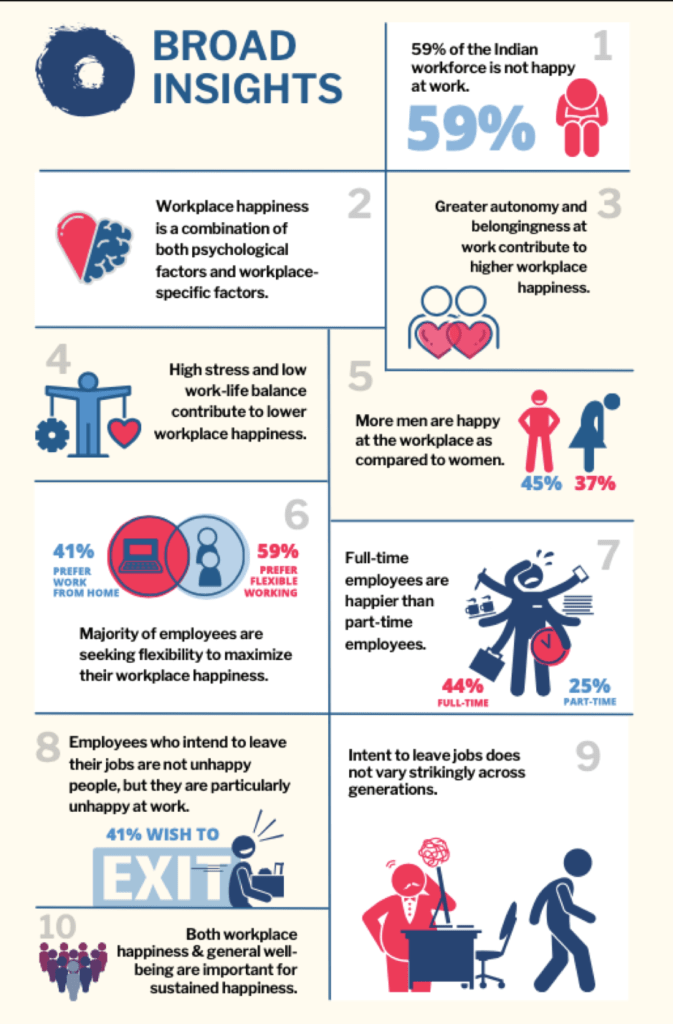
This study covered 1,360 employees and analysed their happiness quotient in terms of general wellbeing, mental health, stress, work-life balance, turnover intent, autonomy, belongingness, and innovation at work. The discoveries and learnings from the study are as follows:
59% of the Indian workforce is unhappy at work
Only 41 per cent of the workforces seem happy at work. The pandemic made people realise that only a sense of belongingness, autonomy, meaning and purpose can make them happy. Their mental peace can be ensured if they are able to feel less stressed, for which, it is essential to strike a balance between work and personal life. If they are happy at work, they will automatically be happy at home too. Happiness at the workplace can be achieved through various ways — strong bonds with co-workers, a strong sense of belongingness and a lot more autonomy at work, which can ensure workplace happiness.
The more the stress from work and interference of official work in personal/ private life, the higher is the intent to leave or quit the workplace. Therefore, despite remote work, it is essential for organisations to ensure that their employees enjoy more autonomy. Their personal time and private space need to be respected.
45% of men and 37% women are happy employees
Although majority of reasons for happiness at workplace – general well-being, work-life balance, innovation, autonomy, belongingness, and lower interference between work and personal lives – among men and women continue to be the same, the study highlighted the fact that women are more stressed and mentally worn out at work than men, making them more unhappy than men. This is not surprising, since among the senior management and those earning over Rs 5 lacs, women formed only 37 per cent. Add to this the societal demands that put more pressure on women, and they are forced to leave their jobs early in their career.
Full-time employees are happier (44%) than part timers (25%)
Part-time employees are more insecure about their jobs and earnings. They also lose out on a sense of belongingness and inclusion, which the full-timers enjoy. Also, some of the part-timers are actually overqualified for the jobs they are doing. This also makes them unhappy and dissatisfied. Only 49 per cent of the part-timers feel a sense of belongingness towards their co-workers, whereas 78 per cent of the full timers feel a strong sense of belongingness towards their co-workers.
Only 41% workers want to work from office; 59% want remote / hybrid working
There is a clear inclination towards the non-traditional modes of work, that is, remote and hybrid (59 per cent). That means, a lesser number of employees (41 per cent) want to return to the normal work-from-office mode. This also means that while a sense of belonging is essential, this does not necessarily require employees to be physically present in the office. Employees can remain connected virtually too. A hybrid model can help employees enjoy flexibility and also strike a balance between work and home.
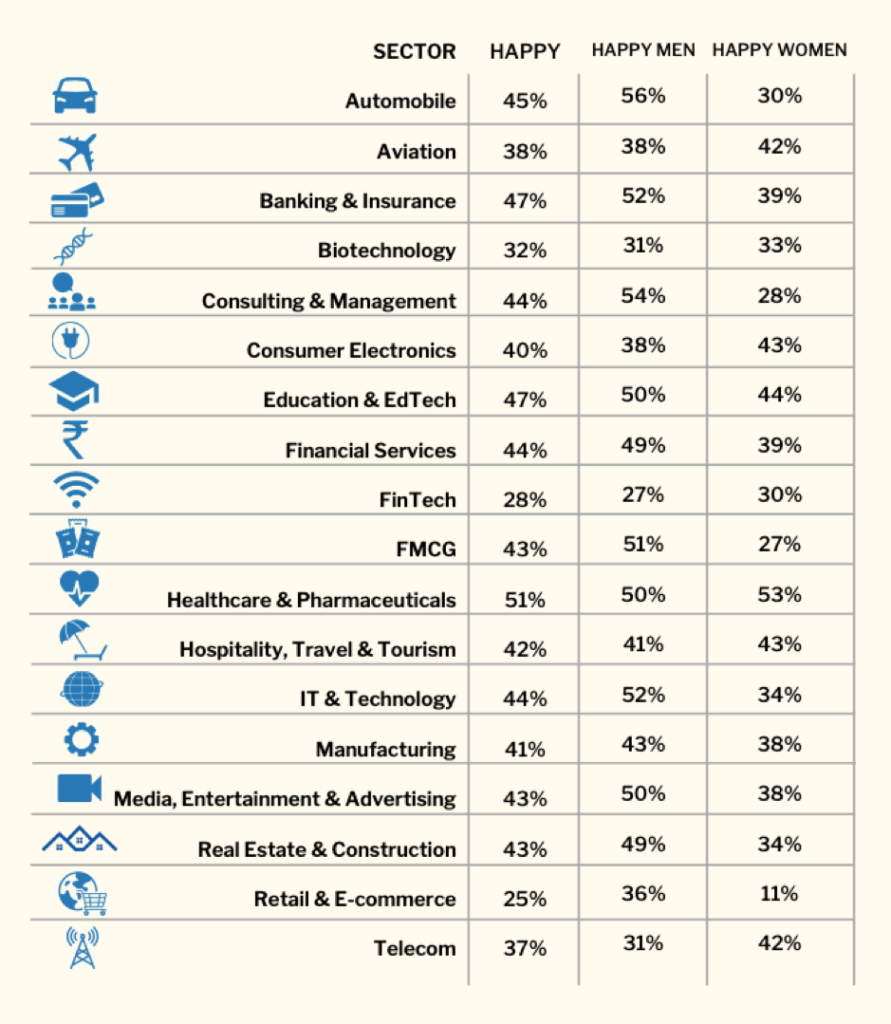
51% of employees in healthcare are happy compared to 25% in the retail space
There is more pressure on employees in the retail sector. There is a constant demand for timely and perfect deliveries, especially since there is stiff competition with so many service providers. This takes a toll on the mental and physical health of employees. Not surprisingly, 36 per cent of the workers feel they do not share a sense of purpose and meaning with their colleagues. A significant 50 per cent feel they will be happier if they are given more flexibility.
In retail, the happiness quotient among women is even lesser – only 11 per cent of women are happier compared to 36 per cent of men.
On the other hand, there is less interference of work in the personal lives and time of healthcare workers. Therefore, they enjoy a better sense of purpose and meaning from their work. Their better connectedness with their co-workers also adds to their higher level of happiness.
In fintech companies which are mostly in the startup mode, only 28 per cent are happy; compare this to the traditional sectors, 47 per cent of employees in the BFSI sector and 44 per cent in financial services are a happier lot.
FMCG and automobile are other traditional sectors which have a higher percent of happy employees viz-a-viz other sectors – 43 per cent and 45 per cent, respectively.
Interestingly, the gap between happiness quotient among men and women in these sectors is quite wide – only 30 per cent of women are happy in automobiles, compared to 56 per cent men. In FMCG, 51 per cent of men are happier compared to only 27 per cent of women.
Even in consulting and management more men (54 per cent) are happier compared to women (28 per cent).
In media, entertainment and advertising space, 43 per cent of people are happy – 50 per cent men and 38 per cent women. In IT & technology companies – 44 per cent of employees are happy – 52 per cent men and 34 per cent women.
Around 38 per cent of employees in the aviation sector are happy – may be due to high pressure jobs and the insecurity in the sector. However, more women (42 per cent) are happier than men (38 per cent) in this sector. Telecom is another sector where women are more happier than men; 42 per cent vs 31 per cent.
