


Among the highly developed and talent-ready countries, Switzerland, Singapore, United Kingdom and the United States top the list.
The developed, high-income countries top the global talent competitiveness scores highlighting a strong correlation between GDP per capita and global talent competitiveness index scores. INSEAD just released the fourth edition of the Global Talent Competitiveness Index (GTCI) that measures how countries grow, attract and retain talent, providing a resource for decision makers to develop strategies for boosting their talent competitiveness.
This year’s index, produced in partnership with The Adecco Group and the Human Capital Leadership Institute of Singapore (HCLI) revolves around the theme of Talent and Technology: Shaping the Future of Work. The 2017 report explores the effects of technological change on talent competitiveness, arguing that while jobs at all levels continue to be replaced by machines, technology is also creating new opportunities.
Among the highly developed and talent-ready countries, Switzerland, Singapore, United Kingdom and the United States top the list, followed by Sweden, Australia, Luxembourg, Denmark, Finland and Norway. India ranks at a shocking number 92 with a talent competitiveness score as low as 35!
This year, the GTCI sees three non-European countries make up the top 10, led by Singapore, the United States and Australia. Among the top 25, six additional non-European countries that made it to the list are Canada, New Zealand, the United Arab Emirates, Qatar, Japan and Israel. Based on its analysis of technology and talent, the report lists out a few messages that organisations need to consider to ensure talent competitiveness.
The report suggests that in terms of its net effect on employment, technological innovation is likely to require new technical and vocational skills, while many unskilled jobs will continue to be automated, basically through the replacement of humans by robots and algorithms empowered by big data. But to manage the implications of digitalisation in a comprehensive way, decision-makers (private and public) need to think ‘beyond automation’.

Secondly, the rapid advancement of technology is changing how talent works. Propelled by cost reduction and innovation, technology is changing many aspects of work. Organisations and societies are moving from an environment in which work was based on employment (salaries) to one where nearly 30 per cent of the population in Europe and the United States comprise, to a greater or lesser degree, free agents. This new environment will have an enormous impact on legal, regulatory, fiscal, and social frameworks.
In a world where technical skills are of utmost importance to organisations, the report reveals that despite many opportunities for people with digital skills, technical skills must be complemented with social and project skills to meet the needs of the highly-connected new economy, where innovation comes increasingly from collaboration and co-creation.
Most importantly, educational and employment policies need to be in line with the transformational changes of the fourth industrial revolution, the report suggests. Educational systems need to produce talent with technical skills and the ability to collaborate with others from different disciplines.

Employment policies need to combine labour market flexibility with social protection, and above all, active labour market policies that facilitate mobility, retraining, entrepreneurship and adjustment to market needs—since those market needs will continually change in the future. Employment policies also need to be adapted to a world where many people are free agents rather than employees.
As per the report, countries with successful transformations are those that have strong well-connected ecosystems. The report states that addressing the societal impact of digitalisation and automation requires close connectedness and collaboration between stakeholders, such as government/municipalities, business and educational institutions.
Moreover, the GTCI analysis of 118 countries shows that some countries are exposing their populations to risk by looking backwards rather than forwards. Based on an assessment of talent readiness for technology, GTCI finds that nine countries are particularly well positioned. Listed in order of their GTCI ranking, these are Switzerland, Singapore, the United Kingdom, Denmark, the Netherlands, Ireland, Canada, New Zealand, and the United Arab Emirates.
From a regional perspective, Singapore is Asia’s clear leader, while Malaysia demonstrates stronger talent readiness for technology than the Republic of Korea (South Korea), though the technological infrastructure of the latter is superior; China is in a reasonably robust position on talent readiness for technology, closely followed by Viet Nam. Elsewhere, Chile leads in Latin America while Botswana leads in Africa.
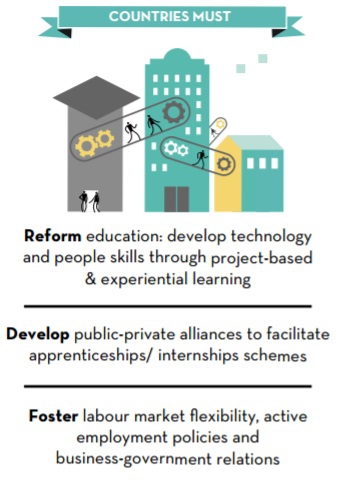
In short, the GCTI index highlights the need for countries and companies to gear up for talent readiness for a more complicated and disrupted future. Countries must focus on educational reforms, development of public-private alliances to facilitate apprenticeships/ internship schemes and foster labour market flexibility. Companies, on the other hand, need to invest in constant upskilling of staff, encourage autonomy and collaboration over authority and hierarchy, and embrace flexibility and mobility.
Last but not the least, employees also play a vital part in their own development through constant skilling up for the digital age. They should embrace a multi-career, committing to lifelong learning and building cross-border networks with a spirit of collaboration.