


Close Menu
    Facebook X (Twitter) Instagram
    • Our Story
    • Partner with us
    • Reach Us
    • Career
    Subscribe Newsletter
    HR KathaHR Katha
    • Exclusive
      • Exclusive Features
      • Perspectives
      • Friday Features
      • herSTORY
      • Case-In-Point
      • Point Of View
      • Research
      • HR Pops
      • Dialogue
      • Movement
      • Profile
      • Beyond Work
      • Rising Star
      • By Invitation
    • News
      • Global HR News
      • Compensation & Benefits
      • Diversity
      • Events
      • Gen Y
      • Hiring & Firing
      • HR & Labour Laws
      • Learning & Development
      • Merger & Acquisition
      • Performance Management & Productivity
      • Talent Management
      • Tools & Technology
      • Work-Life Balance
    • Special
      • HR Forecast 2026
      • Cover Story
      • Editorial
      • HR Forecast 2024
      • HR Forecast 2023
      • HR Forecast 2022
      • HR Forecast 2021
      • HR Forecast 2020
      • HR Forecast 2019
      • New Age Learning
      • Coaching and Training
      • Learn-Engage-Transform
    • Magazine
    • Reports
      • Whitepaper
        • HR Forecast 2024 e-mag
        • Future-proofing Manufacturing Through Digital Transformation
        • Employee Healthcare & Wellness Benefits: A Guide for Indian MSMEs
        • Build a Future Ready Organisation For The Road Ahead
        • Employee Experience Strategy
        • HRKatha 2019 Forecast
        • Decoding and Driving Employee Engagement
        • One Platform, Infinite Possibilities
      • Survey Reports
        • Happiness at Work
        • Upskilling for Jobs of the Future
        • The Labour Code 2020
    • Conferences
      • Leadership Summit 2025
      • Rising Star Leadership Awards
      • HRKatha Futurecast
      • Automation.NXT
      • The Great HR Debate
    • HR Jobs
    WhatsApp LinkedIn X (Twitter) Facebook Instagram
    HR KathaHR Katha
    Home»Exclusive Features»Research»Sexual harassment cases mishandled by organisations: Deloitte Survey
    Research

    Sexual harassment cases mishandled by organisations: Deloitte Survey

    mmBy Dr. Prajjal Saha | HRKathaApril 5, 20164 Mins Read4020 Views
    Share LinkedIn Twitter Facebook WhatsApp
    Share
    LinkedIn Twitter Facebook WhatsApp

    It is common for companies to try and wriggle out of the situation and avoid legal processes, instead of being compassionate with the complainant. In fact, they even tactically encourage the complainant to reconcile or quit.

    As workplaces move towards an informal culture, the line between colleagues and friends also gets blurred. As a result, the relationship between two colleagues extends beyond work hours. In addition, easy access to technology and social media at work inadvertently leads to there being no difference between friends and colleagues.

    This change in relationship can be the primary cause for the rise of sexual harassment at work. For instance, if a male colleague compliments a woman co-worker by admiring her dress, it may seem like a normal and acceptable conversation at work. However, the woman, who is at the receiving end may not interpret it as a simple statement. Based on her interpretation or analysis of the situation, it could turn into a case of sexual harassment. If she finds the comment by her male colleague uncomfortable, she can file a complaint of sexual harassment, even if he actually had no wrong intentions.

    Many such comments that sound unintentional or harmless can amount to sexual harassment, for instance, ‘You look very decked up today, that new lipstick colour is a welcome change’ or ‘Would you like to go out for dinner sometime with me’?

    With the environment as it is, organisations need to have some strict guidelines on sexual harassment.

    According to Deloitte, except for 8 per cent of the respondent companies, that claim they are in the process of developing a structured grievance redressal mechanism, around 50 per cent also claim that they already have such a mechanism in place to deal with allegations related to sexual harassment at the workplace. However, around 69 per cent of the companies follow a mechanism wherein the complainants can directly write to the Internal Complaints Committee (ICC).

    “While these measures taken by organisations are commendable, it is important to understand that sexual harassment tends to stem largely from cultural issues and can manifest itself in myriad forms —some of which an employee may not even be able to readily identify so as to seek help,” says Rohit Mahajan, APAC leader, partner and head—forensic, financial advisory, Deloitte.

    “In such cases, a more participative approach, including discussing case studies and potential sexual harassment scenarios, can help employees readily identify and respond to such incidents,” he adds.

    The Deloitte study reveals some interesting facts on the way organisations in India handle such cases.

    Surprisingly, around 15 per cent of the respondents revealed that their organisations had worked towards a reconciliation between the complainant and the accused. Another 15 per cent disclosed that informal discussions were arranged with the aggrieved woman and the accused by their respective team managers.

    Companies are probably unaware that unless clearly requested by the aggrieved woman, such acts of finding a middle path or attempting reconciliation can be treated as flouting of the Prevention of Sexual Harassment at the Workplace or POSH Act.

    However, around 62 per cent of respondents also stated that all complaints underwent a formal enquiry process led by the ICC members, with the assistance of external professional experts, such as lawyers (54 per cent) and psychologists (46 per cent).

    Further, around 56 per cent of respondents stated that all complaints were dealt with by way of a formal enquiry process led by the ICC members.

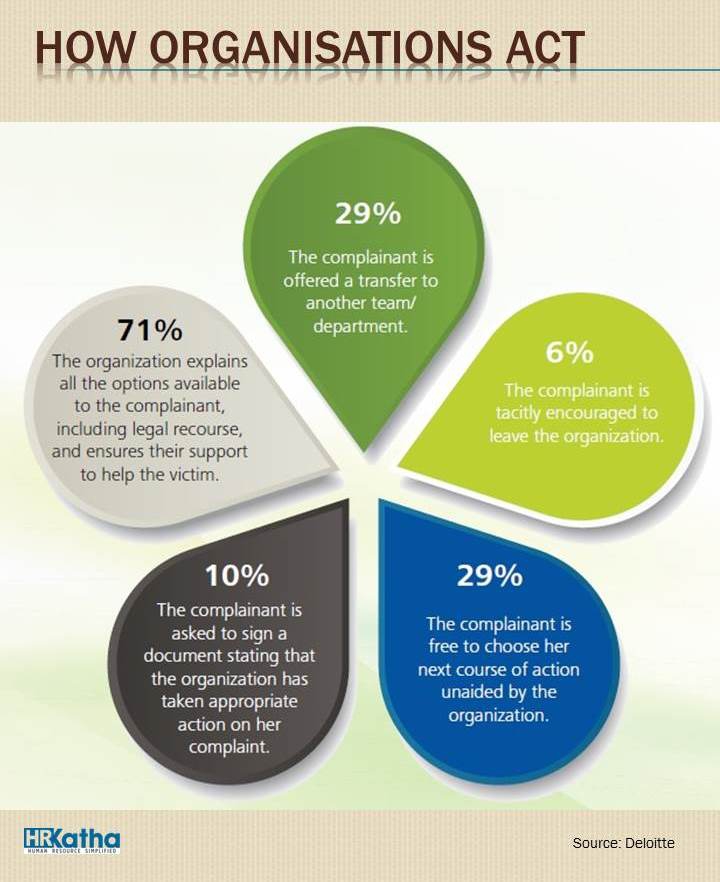
    More surprising is the way organisations tend to get rid of this problematic situation. Around 29 per cent of the survey respondents stated that either the complainant was offered a transfer to another department within the organisation or was free to choose her next course of action. About 6 per cent also tacitly encouraged the complainant to leave the organisation.

    In 10 per cent of the cases, organisations asked the complainant to sign a document stating that the organisation had taken appropriate action on her complaint. This implies that the organisation was more desperate to get itself out of the situation and also pay safe at the same time, instead of being sympathetic or supportive of the complainant.

    Informal culture Sexual Harassment
    Share. LinkedIn Twitter Facebook WhatsApp
    mm
    Dr. Prajjal Saha | HRKatha

    Dr. Prajjal Saha, editor and publisher of HRKatha since 2015, leverages over 25 years of experience in business journalism, writing, and editing. He founded HRKatha to provide insightful analysis on the evolving workplace. With expertise spanning HR, marketing, distribution, and technology, Saha has a deep understanding of business dynamics. His authorship of the acclaimed Marketing White Book highlights his versatility beyond HR. A trusted voice across industries, his clear and thoughtful commentary has earned him a reputation for thought leadership, making him a reliable source of knowledge and insights for professionals navigating the complexities of the business world.

    2 Comments

    1. Avika Kapoor on April 5, 2016 5:42 am

      Mishandling the situation or an attempt to get out of the situation is one of the major causes for the matter being blown out of proportion and escalating to agencies outside the organization that ultimately lead to intervention of authorities and public scrutiny of the matter. Thus, the organization suffers a bad image.

      The best way is to handle the matter in an unbiased manner and ask the experts for the same.

      You may contact Kapgrow Corporate Advisory Services Private Limited to seek expert help in creating a preventive culture in the first place as well as to handle the matter in an independent and professional manner.

      To know more, visit http://www.kapgrow.com

      Reply
    2. rnitinsoni@gmail.com on April 5, 2016 6:26 pm

      Its mandatory to submit the report to labour commissioner then why it is nit imposed upon companies to form such committees and have regular meetings.in fact as per Corp governance and compliance one is bound to form such committees and report to board.

      Reply
    Leave A Reply Cancel Reply

    Related Posts

    MSME workers deliver just 14% of large-firm output; informality is costing India billions

    February 25, 2026

    Thane now pays more than Mumbai; India’s salary map is being redrawn

    February 18, 2026

    98% feel urgency to deliver on AI, 91% aren’t ready

    February 11, 2026

    88% are spending more on AI; Just 5% are using it strategically

    February 4, 2026
    Editorial

    When AI companies turn HR into their testing ground

    When a company builds artificial intelligence, its own workforce becomes the most visible proof. If…

    Sam Altman says listening to old people is a mistake; he’s half right

    When Sam Altman declared that “listening to old people is the biggest mistake young people…

    EDITOR'S PICKS

    Why building women’s leadership pipelines remains difficult

    March 10, 2026

    Capability DNA: The genetic code of organisational capability

    March 10, 2026

    HRForecast 2026: Work systems—not effort—will determine sustainable performance – Subrat Chakravarty, CHRO – Corporate, DS Group

    March 9, 2026

    When AI companies turn HR into their testing ground

    March 9, 2026
    Latest Post

    Trontek to expand, create 500+ jobs by FY27

    Uncategorized March 10, 2026

    Trontek, an Indian manufacturer of lithium-ion batteries with a strong presence in the energy storage…

    Why building women’s leadership pipelines remains difficult

    Exclusive Features March 10, 2026

    Diversity programmes typically measure success through representation percentages—how many women occupy positions across organisational levels.…

    Capability DNA: The genetic code of organisational capability

    HR Pops March 10, 2026

    What does it mean? Capability DNA refers to the distinctive mix of skills, behaviours, mindsets,…

    Ritu Tushir is head of HR, India for NatWest Group India

    Movement March 10, 2026

    NatWest Group India has appointed Ritu Tushir as head of HR, India. She moves from…

    Asia's No.1 HR Platform

    Facebook X (Twitter) Instagram LinkedIn WhatsApp Bluesky
    • Our Story
    • Partner with us
    • Career
    • Reach Us
    • Exclusive Features
    • Cover Story
    • Editorial
    • Dive into the Future of Work: Download HRForecast 2024 Now!
    © 2026 HRKatha.com
    • Disclaimer
    • Refunds & Cancellation Policy
    • Terms of Service

    Type above and press Enter to search. Press Esc to cancel.