


A mid-career technology professional receives another reskilling notification.
Third certification this year. Another upskilling programme. Another attempt to stay relevant.
The skill learned eighteen months ago is already outdated. The new capability required wasn’t in any curriculum when their career began.
Across knowledge industries, employees face a quiet but accelerating reality: the half-life of professional skills is collapsing faster than organisations can retrain people.
Meanwhile, organisations are under intense pressure to deliver faster AI transformation, adopt new systems and manage rising talent costs—all while containing the expense and time required to continuously retrain staff.
The result: a growing tension between capability renewal and workforce stability that few organisations are prepared to manage.
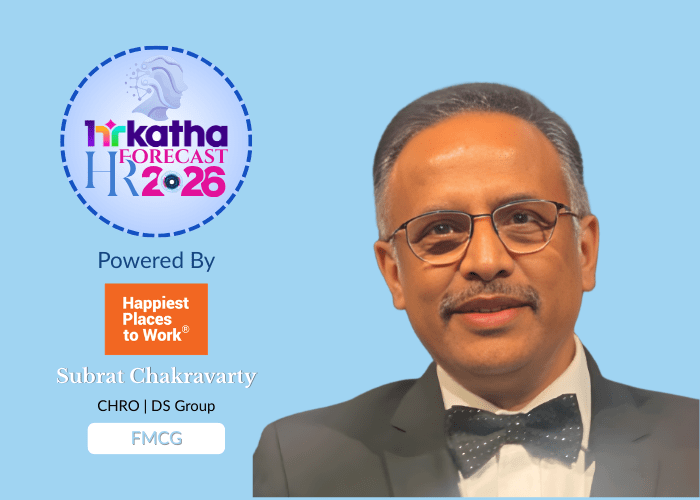
Subrat Chakravarty, CHRO (Corporate) at DS Group, believes this tension will become one of the defining HR challenges by 2026—with implications extending far beyond individual careers.
“The knowledge work segment has grown at a phenomenal pace, creating continuous war for talent,” he says.
“But as the cost of data and digital technology drops and AI-led transformation becomes reality, the accelerating pace of knowledge obsolescence creates a twofold challenge: skills expiring faster, and the rising cost and time to constantly retrain staff.”
By 2026, organisations will need to fundamentally rethink how work is designed, how leaders operate and how employee voice is integrated into workforce transitions.
Three signals point to this shift.
Signal 1: Workforce disruption may trigger new forms of employee voice
The knowledge economy expanded rapidly over two decades, offering unprecedented career mobility and skill specialisation.
But technological change is now creating mid-career vulnerability at scale.
As AI reshapes roles and skills become obsolete faster, organisations face a growing risk: large segments of experienced professionals may struggle to remain employable in their chosen fields.
“The risk of a large pool of semi-skilled workers facing a mid-career crisis is quite real, potentially leading to mass redundancies and layoffs,” Chakravarty says.
Unlike previous waves of automation that primarily affected manufacturing and routine work, this disruption targets knowledge workers—professionals accustomed to quality employment, competitive compensation and career progression.
Finding alternative careers may prove exceptionally difficult for this cohort. Their skills are often specialised. Their salary expectations reflect years of experience. Their professional identity is deeply tied to specific domains.
“Having been used to a quality of work, workplace and lifestyle, they may find it extremely difficult to find alternate careers,” Chakravarty notes.
So far, corporations have managed workforce transitions with relative sensitivity. But as the scale intensifies, mitigation measures may prove inadequate.
“This needs to be watched closely,” he warns. “The problem can become significant if mitigation measures are not adequate and can lead to a deteriorating industrial relations environment overall.”
Historically, knowledge industries have not relied on collective representation. Individual negotiation, career mobility and market competition have been the primary mechanisms for managing employment relationships.
By 2026, this may change.
If workforce disruption accelerates without adequate support systems, organisations may face renewed pressure for employee voice mechanisms—internal forums, structured consultation processes, or new forms of collective representation designed for knowledge workers.
The question is whether organisations will strengthen dialogue platforms proactively, or wait until workforce anxiety forces the issue.
Signal 2: Psychological safety requires systems, not just culture
As workforce anxiety rises, organisations increasingly emphasise psychological safety—creating environments where employees feel safe to speak up, take risks and make mistakes.
Chakravarty is confident organisations recognise the value. The challenge is operationalising it.
“Every organisation endeavours to shape such an environment,” he says. “The real challenge lies in establishing processes and methods to ensure this happens through an organised, predictable framework aligned to deliver desired business outcomes.”
The gap between intent and execution is significant.
Psychological safety cannot coexist with fear of retribution, stigma around failure, or unchecked workplace aggression. Yet many organisations struggle to eliminate these dynamics systematically.
“I truly believe an organisation’s full potential is the sum total of its collective contributions,” Chakravarty argues.
“In a market where differentiation is the sole source of value creation, those who know how best to execute are the only ones positioned to deliver that value.”
This means creating structures—not just stating values—that enable people to contribute fully without career risk.
By 2026, organisations will differentiate based on whether psychological safety is cultural aspiration or operational reality. Those that embed it into processes, decision frameworks and accountability systems will unlock contributions others cannot access.
Signal 3: Leadership transformation is no longer optional
Organisations have discussed generational workplace shifts for years. Now those shifts are operational reality.
Younger employees bring fundamentally different expectations around communication, autonomy and leadership behaviour.
For managers trained in traditional hierarchical models, this creates existential pressure.
“What has been discussed over the last decade in terms of generational mix has finally arrived in the real world,”
Chakravarty says. “That generation is already part of our organisational systems.”
The implications for leadership are stark.
“It is a double whammy for managers. If they do not transform and align their style, their ability to lead and be effective is surely at risk.”
This is not theoretical. Managers are experiencing this shift in real time—and not just at work.
“We have all been experiencing this in our homes,” Chakravarty observes. “Why should we expect the workplace to be any different?”
Command-and-control leadership models that worked for decades now generate resistance, disengagement and attrition. Coaching, empowerment and collaborative approaches are not leadership trends—they are operational requirements.
By 2026, the divide will be visible. Some organisations will operate with transformed leadership cultures. Others will maintain hierarchical models beneath updated terminology while struggling with engagement, retention and performance.
Leadership transformation is no longer about style preference. It is about operational effectiveness.
The burnout paradox: Systems, not effort
Post-pandemic burnout has reached epidemic levels. Organisations respond with wellbeing programmes, flexibility initiatives and mental health resources.
Yet Chakravarty believes the problem is often misdiagnosed.
“There is an inherent conflict in the question itself,” he says. “The real question is what we are seeking as an organisation: a one-time blitz or sustained value creation and market differentiation?”
If the goal is sustainable performance, the solution is not managing effort—it is redesigning systems.
“If it is the latter, then it is not just about effort. It is about process, tooling and organisational design. The moment one takes a systems approach to outcomes, sustainability becomes inherent.”
Burnout emerges not from hard work but from dysfunctional work. When processes are inefficient, tools are inadequate, roles are poorly designed and expectations are unclear, even moderate effort produces exhaustion.
“I have always believed that the quality of work and an enabling environment are the true antidotes to burnout,” Chakravarty says. “That should be the focus for organisations.”
By 2026, organisations pursuing sustainable performance will invest less in wellness programmes and more in work system redesign. Those maintaining relentless productivity demands without fixing underlying processes will experience mounting burnout despite wellbeing initiatives.
The CEO pipeline question
These forces—workforce disruption, psychological safety, leadership transformation, sustainable performance—converge on a deeper organisational question: who is equipped to lead in this environment?
Chakravarty believes HR should be in the CEO succession pipeline—not as exception but as norm.
“I would want HR to be in the first succession line for CEO role,” he says. “It is overdue. Everyone else has got their chance.”
In an environment where talent sustainability, workforce transitions, leadership transformation and organisational culture determine competitive advantage, HR expertise becomes central to enterprise strategy.
“Only with a true balance of people and business strategy can one create a sustainable organisation.”
But this requires evolution within HR as well.
“It is certainly going to be a two-way journey,” Chakravarty acknowledges. “HR professionals need to learn to speak the language of business and align their plans and practices not to functional outcomes alone, but to broader business outcomes.”
By 2026, the organisations that elevate HR leaders who combine people expertise with business acumen will operate with strategic advantages. Those maintaining functional silos will struggle as talent and culture challenges become business-critical.
Three Strategic Imperatives
Workforce Sustainability: Anticipate skill obsolescence and build continuous capability renewal systems—treating reskilling as core business function, not HR programme.
Leadership Evolution: Transform management capability from command-and-control to coaching and empowerment—not through training alone but through accountability and selection criteria.
Systems-Based Performance: Redesign work processes, tools and organisational structures so sustainable productivity becomes default outcome—reducing reliance on individual resilience.
The systems advantage
The workplace is entering a period of profound change.
AI transformation, accelerating skill obsolescence and generational shifts are reshaping how organisations operate and how people work.
In this environment, the traditional formula—effort equals performance—is breaking down.
Organisations demanding more effort without redesigning work systems will experience mounting burnout, workforce disruption and leadership disconnection.
Those investing in better processes, adaptive leadership and employee voice mechanisms will build performance models that are both productive and sustainable.
By 2026, the companies that succeed will not be those extracting maximum effort.
They will be those designing optimal systems.
Because sustainable performance is not about working harder.
It is about working within systems designed for human capability—not against it.