


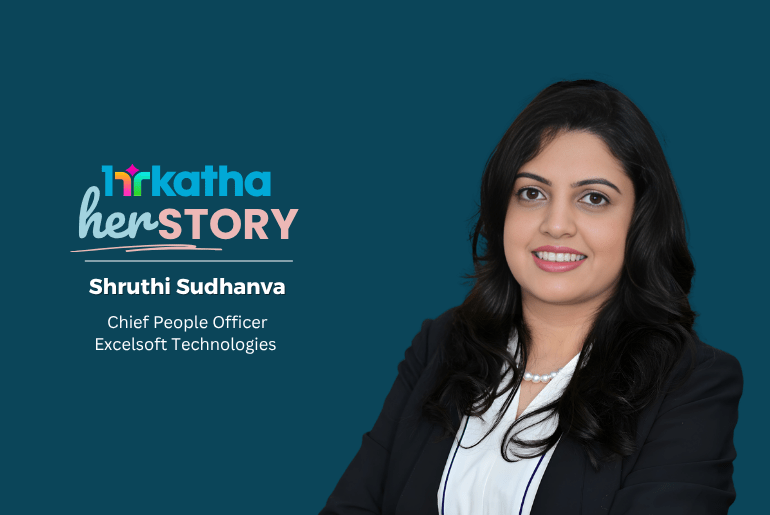
When she realised that waiting to be invited into the conversation was not a strategy she could rely on, one leader decided that preparation and presence would speak for her instead
How to show up
Shruthi Sudhanva has never experienced overt bias in the traditional sense. But there have been moments that stayed with her.
In senior leadership discussions and decision-making forums, she has often been one of the very few women in the room. Sometimes her presence was noticed before her contribution.
Sometimes conversations moved ahead before she had the opportunity to speak.
None of that prevented Sudhanva from reaching her current role as chief people officer at Excelsoft Technologies.
Early in her career, she realised that waiting to be invited into the conversation was not a strategy she could rely on. Instead, she focused on preparation and presence, making sure she was the best-informed person in the room, speaking with clarity and consistently adding value.
Over time, that changed the equation. When you show up consistently with strong thinking and quiet confidence, attention shifts from who is speaking to what is being said.
“Credibility is one of the most powerful tools available to any professional, built one conversation, one decision, one moment at a time,” she says.
She readily acknowledges that bias, whether spoken or unspoken, does exist. Her response has always been to focus on what she can control.
“Preparation, clarity of thought and integrity in how I show up. That has been my anchor.”
Pull quote: “Credibility is built one conversation, one decision, one moment at a time.”
A journey that converged in HR
Sudhanva’s journey into HR was less a planned career move and more the convergence of multiple experiences.
Across her career at , she worked across business consulting, client solutioning, corporate affairs, enterprise strategy and strategic risk management. Each role offered a different perspective on how organisations function and, more importantly, what enables them to succeed.
Over time, one pattern became impossible to ignore. Every major business decision eventually came back to people.
“Whether we were advising on business challenges, shaping client solutions, crafting market strategy, managing risk, or influencing the direction of the company, outcomes were ultimately determined by the quality, commitment and culture of the people involved,” she observes.
She also saw data and emerging technologies such as AI beginning to reshape these decisions, making an integrated, people-centric approach even more important.
When the chief people officer role became available, it felt less like a career shift and more like the natural culmination of everything she had been building towards. Years of working closely with HR had already shown her how profoundly people decisions influence business outcomes.
Looking back, she sees accepting the role as one of the most deliberate decisions of her career.
Leading change with transparency
According to Sudhanva, the toughest HR decisions are rarely the visible ones. They are the quieter, more complex decisions that accompany organisational change.
New structures and new ways of working often create uncertainty because they disrupt familiarity.
For her, the real challenge is not deciding what needs to change, but helping people navigate that change with confidence.
That is why transparency has become central to her leadership approach. She believes people deserve clarity about why change is necessary, what it means for them and what the organisation is trying to achieve.
One principle consistently guides her decisions.
“If a decision strengthens the organisation while remaining fair and respectful to its people, it is worth pursuing.”
Balancing business priorities with human sensitivity is rarely straightforward. Yet decisions communicated with honesty and empathy build trust, and trust is what enables organisations to navigate change successfully.
HR at the centre of business
Sudhanva believes the perception of HR as merely a support function needs to evolve quickly.
Today, HR sits at the centre of business strategy. Talent acquisition, leadership development, capability building, workforce planning and culture are no longer peripheral activities. They determine whether business strategy succeeds.
Technology and artificial intelligence have only strengthened HR’s strategic role. Organisations that position HR as a business partner rather than an administrative function will be better equipped for the future.
At the same time, she believes organisations must guard against becoming overly data-driven at the expense of human connection.
“Behind every data point is a person with aspirations, concerns, relationships and a life outside of work.”
Dashboards and productivity metrics are valuable. But they can never replace empathy, active listening and meaningful human connection.
The real challenge, she believes, is holding both together, delivering business outcomes while ensuring every individual feels genuinely valued and heard.
Pull quote: “Behind every data point is a person with aspirations, concerns, relationships and a life outside work.”
AI as an enabler
“At Excelsoft Technologies, we think about the future of work not as a destination we are moving towards, but as a continuous journey of adaptation. And at the heart of that journey is our people,” says Sudhanva.
The organisation believes tomorrow’s workforce will not simply be defined by technical expertise. It will be defined by the ability to learn, unlearn and relearn continuously.
That is why the focus has shifted from building skills alone to building capabilities such as adaptability, curiosity, collaboration, critical thinking and empathy.
“We see AI as an important enabler in this journey, not as a replacement for human capability, but as an amplifier of it.”
By automating repetitive work and enabling better decisions, AI creates more space for creativity, innovation and higher-order thinking.
For HR, the responsibility extends beyond introducing new technology. It involves building AI readiness, redesigning learning, rethinking roles and ensuring employees feel supported throughout the transition.
Psychological safety, she believes, is essential for genuine agility.
________________________________________
Quick fire round
Best career advice you’ve ever received?
Make decisions objectively. Anchor them in the goal, not the people involved.
Morning ritual that sets you up for success?
A daily walk followed by intentional planning for the day.
If not HR, what career path would you have pursued?
As a software engineer by training, I would likely have been deeply immersed in building technology.
Best investment you’ve made in yourself?
Practising mindfulness. It is still a work in progress, but invaluable.
One skill you’re currently working on developing?
Using AI more effectively for both personal and professional decision-making.
Staying close to business and technology
For young professionals entering HR, Sudhanva offers two pieces of advice.
First, think of yourself as a business leader who happens to specialise in people. Understanding commercial realities is just as important as understanding HR.
Second, stay close to technology. HR leaders do not need to become technologists, but they do need to understand how AI, data and digital tools are reshaping organisations.
Alongside these capabilities, she believes empathy, communication, influence and the ability to navigate difficult conversations will remain enduring leadership strengths.
She also encourages young women to trust their own voices. One thing she has observed in many talented young women is a tendency to wait until they are entirely certain before speaking up, or to downplay the value of what they bring to a conversation.
“Do not do that. What you think matters. Your perspective adds something that no one else in the room can offer because it is uniquely yours,” she says.
“The future HR leader will not simply manage people. She will help organisations think, adapt and grow better.”
A mother’s enduring influence
The person who has shaped Sudhanva most is her mother.
From her, she learnt that success rarely comes from being the loudest person in the room. It comes from resilience, consistency and quietly showing up every day, especially during difficult times.
Watching her mother navigate adversity with strength, grace and grounded optimism shaped the way Sudhanva approaches leadership.
She believes resilient leaders create resilient teams. Leaders who remain optimistic without ignoring reality create energy within organisations. And leaders who consistently act with integrity build the trust that carries organisations through their most challenging moments.